
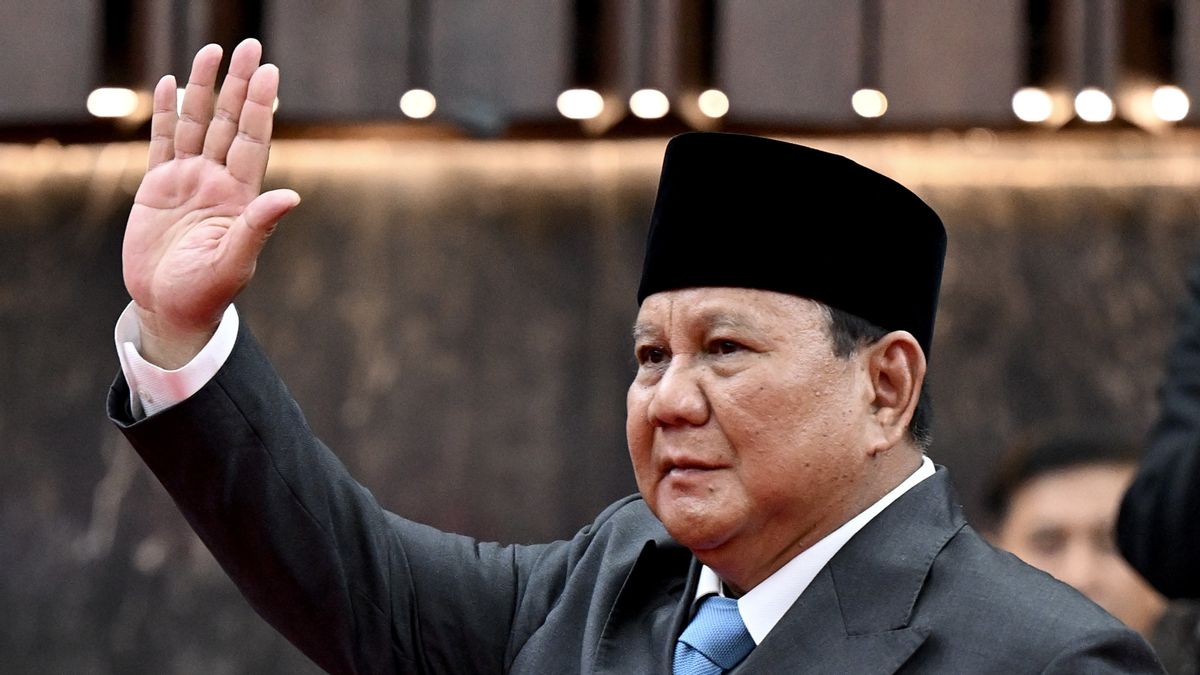


JAKARTA - One of the points that caught the attention in President Prabowo Subianto's speech regarding the Macro Economic Framework and Fiscal Policy Elements (KEM-PPKF) for the 2027 Fiscal Year is the projection of the rupiah exchange rate. In response to this, the Director of Fiscal Justice of CELIOS, Dr. Media Wahyudi Askar, reminded that this issue must receive very serious attention from the government.
In the plenary session of the Indonesian House of Representatives on Wednesday, May 20, 2026, President Prabowo conveyed that Indonesia's economic challenges in 2027 will be increasingly difficult due to external factors, especially the escalation of global geopolitics.
Therefore, the government has set the assumption of the rupiah exchange rate in the range of Rp. 16,800 to Rp. 17,500 per US dollar in the 2027 draft state budget. This figure is an indication that the government is preparing an anticipation room to face global pressures that have not subsided, ranging from conflicts in the Middle East to world geopolitical tensions.
"Interest rates and fiscal-monetary strategies must be able to keep our exchange rate stable," said Prabowo. In addition to the rupiah exchange rate, the government also set a target for the interest rate of the 10-year State Securities (SBN) in the range of 6.5 to 7.3 percent.
Rupiah Weakening Becomes a Sensitive and Problematic Issue
According to Wahyudi, the target and assumptions that were announced were not an easy task for the president and his economic team.
"The president mentioned the rupiah target. In my opinion, this is the most sensitive. The government indirectly acknowledges that the rupiah will still remain weak and will likely continue to depreciate. Politically, this is certainly problematic," he explained.
Apart from the exchange rate problem, Wahyudi also highlighted the existence of a blind spot or important things that escaped the president's attention in the speech. One of them is the issue of capital flight abroad.
"I see that there are still many blind spots that have not been discussed. The President did not mention the issue of capital outflow, even though we know that foreign investors leaving the Indonesian market are quite significant at this time," said Wahyudi.
Soroti Personalisasi Kebijakan Ekonomi yang Presidential-Centric
Furthermore, Wahyudi assessed that what was conveyed by President Prabowo still tends to be political rhetoric and is too centered on the figure of the leader (presidential-centric).
"The president has repeatedly emphasized sentences such as 'I stand up immediately, I am responsible, I am sworn in'. This is actually a form of personalization of economic policy, with the framing that the stability of the national economy depends on the figure of a president," he explained.
Wahyudi added that this kind of political communication approach actually risks triggering negative responses or doubts from global market players.
"The narrative of this policy is being led as if it were due to the success of the leader alone. In the market perspective, this is a bit strange because what is highlighted is not the strengthening or success of the institution," he concluded.
The English, Chinese, Japanese, Arabic, and French versions are automatically generated by the AI. So there may still be inaccuracies in translating, please always see Indonesian as our main language. (system supported by DigitalSiber.id)


