

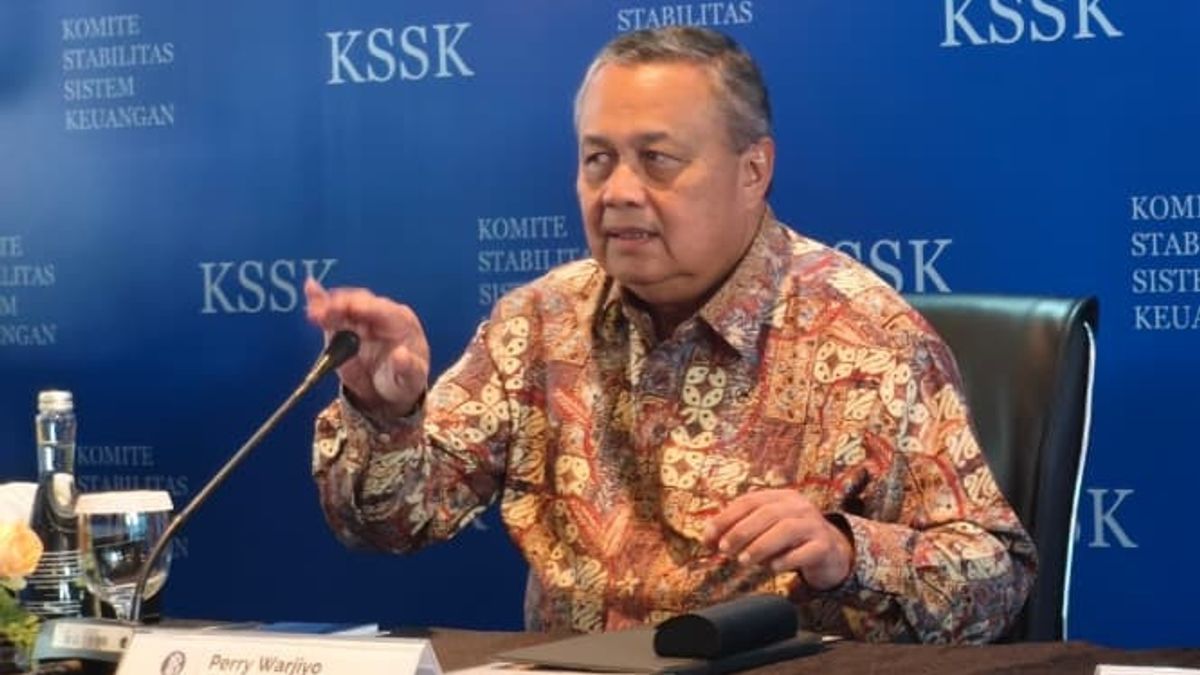


JAKARTA - Bank Indonesia (BI) continues to rely on the rupiah securities instrument of Bank Indonesia (SRBI) to attract foreign capital flows amid pressure on the rupiah exchange rate due to global uncertainty.
This step was taken after the rupiah had weakened to touch Rp17,700 per US dollar on May 19, 2026.
Governor of BI Perry Warjiyo said that the central bank had raised the yield rate (yield) of SRBI so that domestic financial instruments remained competitive in the eyes of foreign investors.
For information as of May 13, 2026, the interest rate for the 6-month SRBI tenor increased to 6.21 percent, the 9-month tenor to 6.31 percent, and the 12-month tenor to 6.45 percent.
According to Perry, the strengthening of the monetary instrument is part of the strategy to maintain the stability of the rupiah in the midst of the rapid outflow of capital from emerging countries due to conflicts in the Middle East and the strengthening of the US dollar.
"Various policy responses that have been taken can encourage the return of foreign portfolio investment," he said in a press conference, Wednesday, May 20.
BI noted that foreign capital flows in the second quarter of 2026 began to show a positive trend, namely until May 18, 2026, net inflows were recorded at US$ 5.5 billion, mainly flowing into SRBI instruments and State Securities (SBN).
In addition to increasing the yield of SRBI, BI also strengthened interventions in the foreign exchange market, both through the offshore Non-Deliverable Forward (NDF) market and spot transactions and Domestic Non-Deliverable Forward (DNDF) in the domestic market.
Perry emphasized that the strengthening of the interest rate structure of monetary instruments was carried out to increase the attractiveness of foreign portfolio investment while maintaining the stability of the rupiah exchange rate.
Not only that, he added that BI also strengthened the foreign exchange market transaction policy through adjustments to the limit on the purchase of foreign exchange cash without underlying, an increase in the threshold for DNDF/Forward transactions, and an adjustment to the swap transaction threshold which will take effect from April 2026.
The central bank also expanded foreign exchange monetary operations instruments through spot and swap transactions in Chinese Renminbi (CNH) offshore currency against the rupiah, as well as expanding the implementation of Local Currency Transaction (LCT) in trading and investment activities.
In addition, the rupiah stabilization policy is strengthened through the purchase of SBN in the secondary market, supported by the optimization of foreign exchange market policies and the expansion of foreign exchange-based monetary instruments.
Meanwhile, these steps are taken to maintain the stability of the rupiah amid high demand for US dollars and global financial market turmoil.
"This policy is supported by strengthening the strategy of the interest rate structure of monetary operation instruments with an increase in the SRBI interest rate as above as part of the stabilization of the rupiah exchange rate," he explained.
As of May 18, 2026, the position of SRBI was recorded at Rp921.88 trillion and of the total, the ownership of non-resident investors increased to Rp221.59 trillion or approximately 24.04 percent of the total outstanding SRBI.
He said that amid global pressure, BI remained optimistic that SRBI would continue to be sought after by investors because it offered attractive returns and was supported by the outlook for Indonesia's economy, which was considered solid.
Perry said BI also continues to optimize various pro-market monetary instruments to increase foreign capital inflows so that they can support the strengthening of the rupiah.
"In the future, Bank Indonesia believes that the rupiah exchange rate will be stable and tends to strengthen, supported by Bank Indonesia's commitment, attractive yields, and Indonesia's economic growth prospects remain good," he said.
The English, Chinese, Japanese, Arabic, and French versions are automatically generated by the AI. So there may still be inaccuracies in translating, please always see Indonesian as our main language. (system supported by DigitalSiber.id)
Popular


