

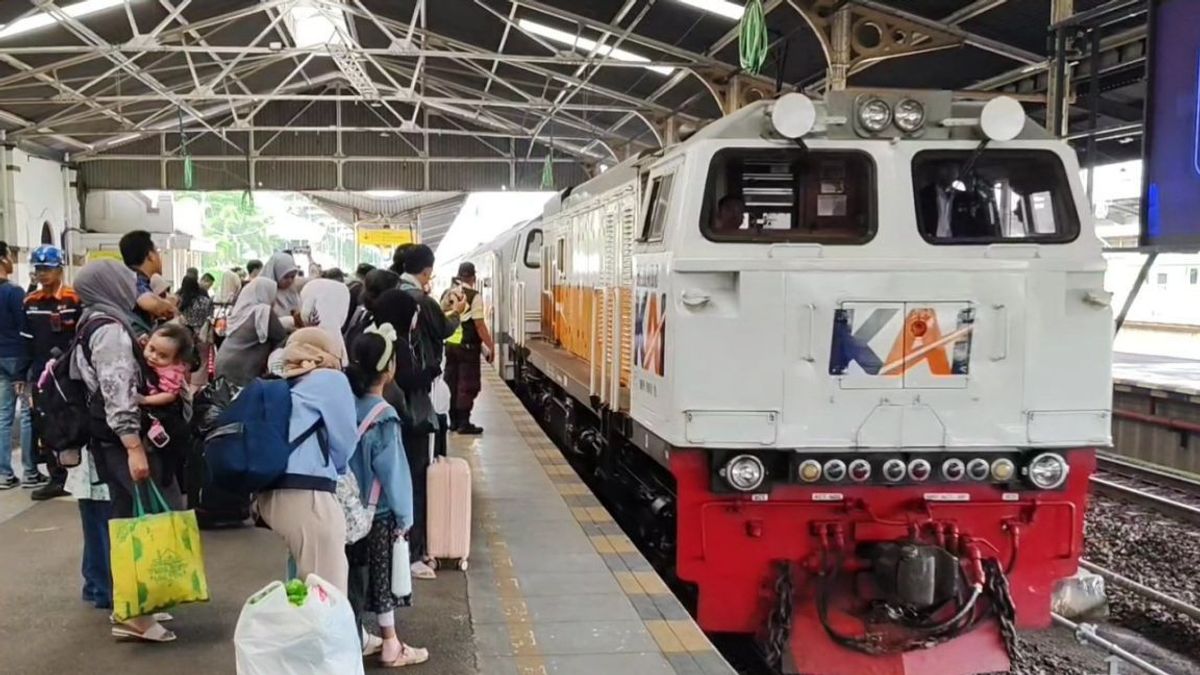


JAKARTA - PT Kereta Api Indonesia (Persero) or KAI has finalized a series of technical tests on diesel-based railway facilities ahead of the mandatory implementation of B50 biodiesel nationwide starting July 1, 2026.
As a public transport operator based on railways, KAI continues to strengthen its readiness to implement B50 through thorough testing on locomotives and generating trains. This technical test is a continuation of the use of B35 and B40 biodiesel that has previously been applied in the company's operational environment.
KAI Vice President of Corporate Communication, Anne Purba, said KAI fully supports the government's steps in expanding the use of plant-based energy in the national transportation sector.
"At every stage of implementation, safety aspects, reliability of facilities, and service quality remain the main concern," Anne said in an official statement, Monday, May 18.
Throughout 2025, the use of B40 biodiesel in long-distance train services produced a total carbon emission of 127,315,192 kilograms of CO₂e or about 127,300 tons out of a total of 47.4 million customers.
Meanwhile, in the period from January to April 2026, the long-distance and local train services managed by KAI have served 19,218,440 customers with consistency in the use of biodiesel-based fuel on diesel-based train journeys.
In terms of the environment, the rail transport mode is considered more efficient in producing emissions than private vehicles. Based on various transportation studies, train emissions are in the range of 15-40 grams of CO₂ per passenger-kilometer, while private vehicles can reach 120-250 grams of CO₂ per passenger-kilometer.
In supporting the implementation of B50, KAI is working with the Ministry of Energy and Mineral Resources and LEMIGAS. A series of tests were carried out gradually since mid-April 2026, starting from the fuel blending process, inspection of facilities, to operational testing.
"For locomotives, testing is carried out at the Sidotopo Depot with a focus on engine performance and fuel consumption during B50 use," he said.
Meanwhile, Anne continued, the testing of the power train was carried out at the Yogyakarta Train Depot with monitoring of fuel consumption and periodic evaluation every 300 hours of operation.
KAI is also preparing further testing in the longer term to ensure that the durability of the facilities is maintained while operating intensively. Until now, all test results are still in the process of evaluation with the government and related technical teams.
"Accelerating the implementation of B50 requires measurable readiness to remain in line with safety standards and quality of public transportation services. KAI continues to strengthen coordination and technical testing so that its implementation can run optimally and sustainably," concluded Anne.
The English, Chinese, Japanese, Arabic, and French versions are automatically generated by the AI. So there may still be inaccuracies in translating, please always see Indonesian as our main language. (system supported by DigitalSiber.id)
Popular


