

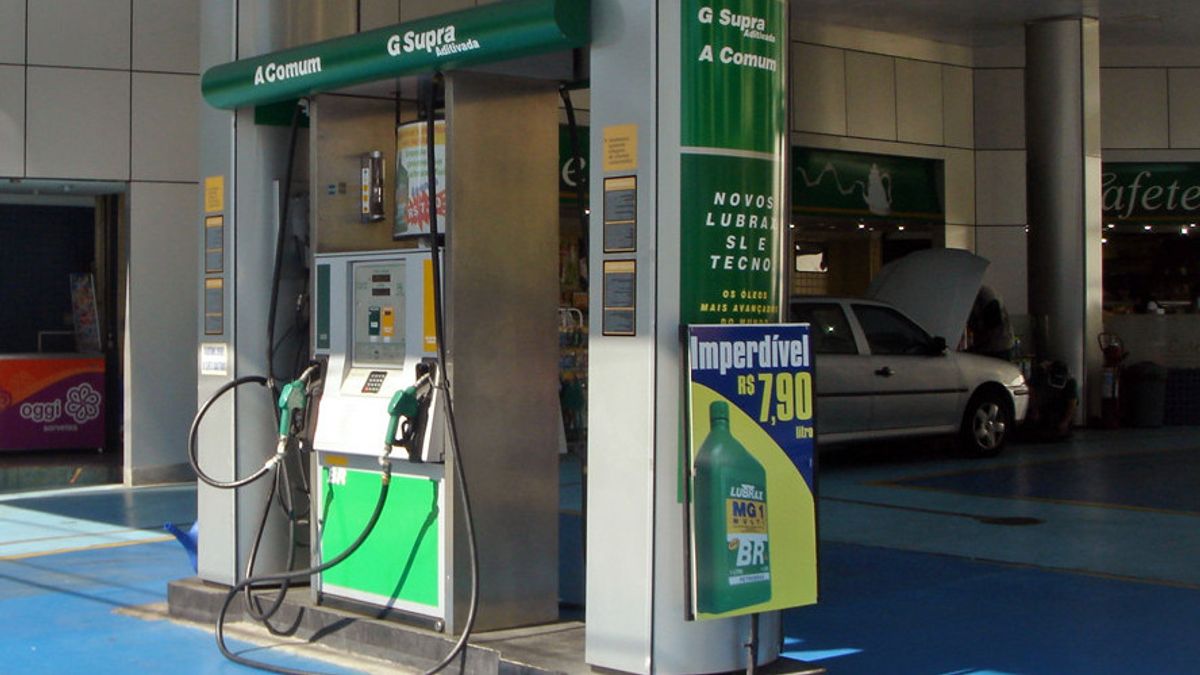


JAKARTA - The Iran war is starting to feel like it's in the kitchens and gas tanks of Asian residents. Fuel prices are rising, supplies are stalled, and a number of governments are once again looking at biofuels as a way out.
Biofuel is a fuel from plant materials or organic waste. The form can be ethanol for gasoline blends, or biodiesel for solar blends.
In India, taxi driver Ravi Ranjan now has to buy LPG three times more expensive. He used to get one LPG cylinder for 1,000 rupees or about 11 US dollars. Now, because of the delayed delivery, he pays 3,000 rupees or about 31 US dollars on the black market.
"I used to get one cylinder of LPG for 1,000 rupees. Now I pay 3,000 rupees on the black market," Ranjan said, quoted by Kyodo News, Monday, May 18.
In Chennai, Sushmita Sankar also felt a similar pressure. The cost of gasoline and cooking fuel has risen. He also complained about gasoline mixed with ethanol, which is now commonly sold at gas stations in India because it makes his car's mileage decrease.
"With only gasoline mixed with ethanol available, I feel my car's mileage is reduced," he said.
The energy crisis was triggered by delivery disruptions due to the Iran war and the closure of the Strait of Hormuz, an important route for world energy trade. Asia is a region that is quickly hit because many countries still rely on oil imports.
India, which imports almost 90 percent of its crude oil needs, has started to accelerate the use of ethanol. The local government proposes that vehicles can use 85 percent ethanol, even 100 percent. Currently, most gas stations in India are already selling gasoline with a 20 percent ethanol blend.
The Indian government claims that ethanol blends can reduce pollution and reduce oil imports. According to a Kyodo News report citing the Institute for Energy Economics and Financial Analysis, the use of 20 percent ethanol reduces India's crude oil imports by 2.5 percent by 2025.
However, the policy is not free of problems. Drivers complain that mileage is down. Automotive manufacturers are also facing uncertainty because vehicle engines must be tested again for higher ethanol blends.
Shyamasis Das from the Centre for Social and Economic Progress said ethanol has a lower energy density than gasoline. This means that vehicles may require more fuel to cover the same distance.
Another problem concerns food and water. In India, about 70 percent of ethanol comes from sugar cane, corn, and rice. Producing one liter of ethanol can require 3,000 to 10,000 liters of water. In countries facing groundwater pressure, that figure becomes a serious problem.
Southeast Asia is also moving. Indonesia wants to increase the biodiesel mix to 50 percent from the previous 40 percent. President Prabowo Subianto said Indonesia would make a big move to biofuels.
For Indonesia, biofuel has a double appeal. It can reduce fuel imports while absorbing palm oil in the domestic market. But the risks are also clear. If the need for raw materials increases without strict supervision, pressure on land and forests can also increase.
Malaysia took a similar direction. The country approved a mixture of biodiesel to 15 percent and is considering a 20 percent mixture.
The rise in energy prices is making biofuels attractive again. But experts warn, biofuels are not a panacea. Their climate benefits depend heavily on the source of raw materials and the way they are produced.
Charith Konda from IEEFA assessed that electric vehicles and renewable energy for industry could be a more efficient long-term solution. Meanwhile, Das emphasized that biofuels should be made from agricultural residues, municipal waste, or waste oil, not from food crops that require large land and water.
"If biofuels are not sourced from residues or waste, usually the fuel is not treated as renewable energy," Das said, quoted by Kyodo News.
The increase in the use of biofuels is now a quick option in the midst of an energy crisis. However, the risks to food, water, and the environment are beginning to be debated.
The English, Chinese, Japanese, Arabic, and French versions are automatically generated by the AI. So there may still be inaccuracies in translating, please always see Indonesian as our main language. (system supported by DigitalSiber.id)
Most Popular Tags
#Prabowo Subianto #donald trump #2026 World Cup #Febrie Adriansyah #8791Popular


