



JAKARTA - Japan and the United States have agreed to strengthen coordination in the currency market after Tokyo intervened to curb the weakening of the yen. This step was taken when the Middle East conflict made the US dollar increasingly sought as a safe asset.
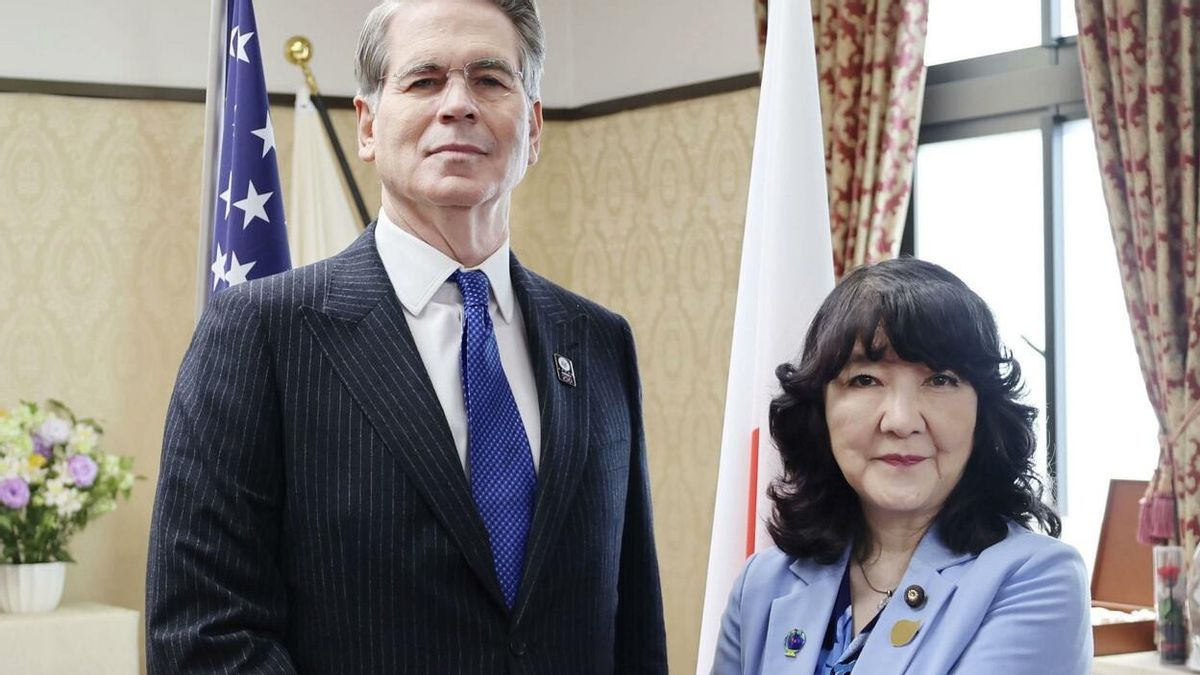
Quoted from Kyodo News, Tuesday, May 12, Japanese Finance Minister Satsuki Katayama said this after meeting with US Treasury Secretary Scott Bessent in Tokyo on Tuesday.
"We have good coordination regarding the movement of the currency recently," said Katayama. He said Japan's position had full support.
Bessent also said Washington and Tokyo both judged excessive turbulence in the currency market undesirable.
"We continue to be in close contact with the Japanese Ministry of Finance and will continue to coordinate," Bessent said, quoted by Kyodo News.
According to Bessent, Japan's economic fundamentals remain strong and resilient. He assessed that condition will eventually be reflected in the exchange rate of the yen.
Pressure on the yen increased after uncertainty in the Middle East prompted investors to enter the US dollar. According to Japanese government sources, Japanese authorities intervened on April 30 when the yen weakened to the upper range of 160 per US dollar. Tokyo is also suspected of buying yen again in early May during the Golden Week holidays.
Katayama said Japan and the US still referred to the joint statement last September. In the agreement, market intervention is seen only to deal with excessive volatility as well as irregular weakening or strengthening of the currency.
A weak yen does help Japanese exporters because foreign earnings become larger when converted into yen. However, a too deep weakening could hit households and companies because the cost of importing fuel and raw materials also goes up.
In addition to currencies, Katayama and Bessent discussed critical mineral supply chains ahead of next week's G7 finance ministers meeting in Paris. The agenda is important because developed countries want to reduce dependence on China for strategic resources.
Katayama also touched on China's restrictions on the export of critical minerals. He called Beijing's move against Japan "bad and unfair". According to Katayama, the US will continue to emphasize this issue to China.
Bessent previously also met with Japanese Prime Minister Sanae Takaichi. They discussed plans for a meeting between US President Donald Trump and Chinese President Xi Jinping, Japanese investment in the US, and critical mineral supply chains.
Another issue discussed was the threat of advanced AI, including Anthropic's Claude Mythos, which is said to be able to find gaps in technology infrastructure and financial systems.
"To be honest, China could catch up with the development of such a model in six months or a year. Western countries need to coordinate so that the technology is not used as a weapon by parties other than our allies," said Katayama.
The English, Chinese, Japanese, Arabic, and French versions are automatically generated by the AI. So there may still be inaccuracies in translating, please always see Indonesian as our main language. (system supported by DigitalSiber.id)


