
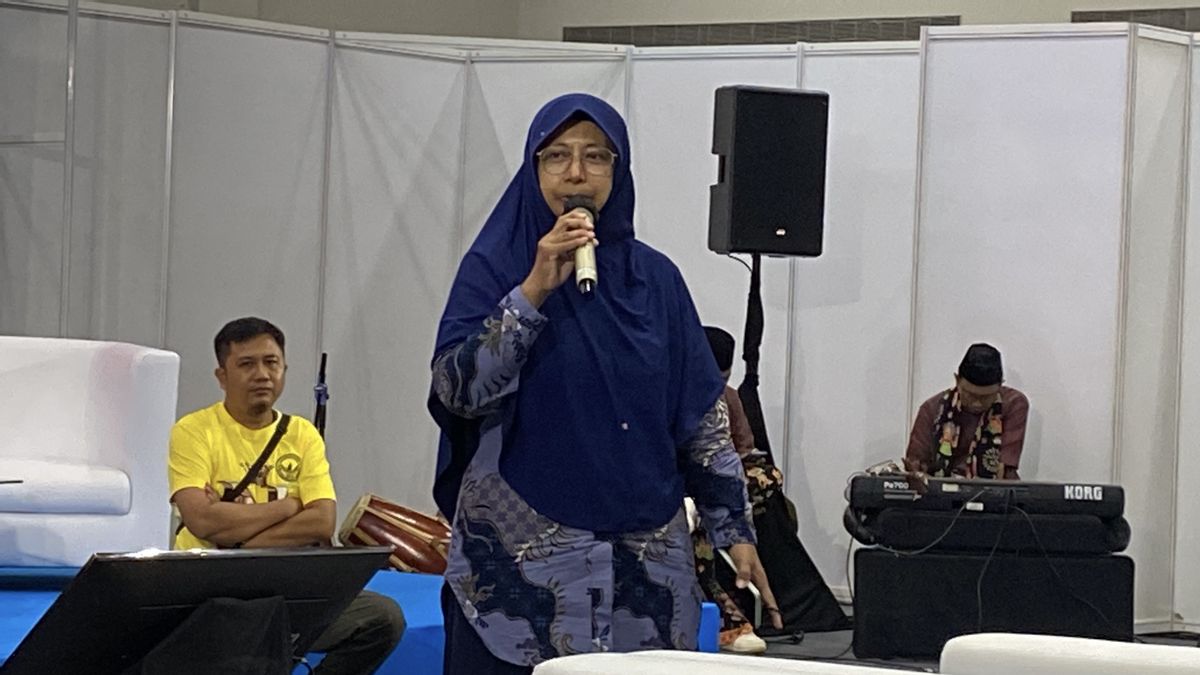


JAKARTA - People's egg farmers urge the government to open the data on the population of laying hens and the distribution of chicken seeds transparently following the continued decline in egg prices at the farmer level.
Chairman of the Blitar Egg Blessing Cooperative, Yesi Yuni Astuti, said that data openness was needed so that the causes of the decline in egg prices could be clearly known, including to ensure whether there was an excess of laying hens.
"If the price is falling now because of overpopulation, then the solution is different. But now there is no open data," said Yesi in a seminar held by AGRIMAT, at Nice PIK 2, Jakarta, Friday, May 8.
Yesi explained that farmers have also asked the government to open GPS (Grand Parent Stock) and DOC (Day Old Chick) data.
For information, GPS is a top-level chicken breed in the poultry breeding system, while DOC is a one-day-old chick that is raised by farmers for egg and meat production.
"We have said it and we are not tired of saying it. We ask that there be open data on GPS and DOC distribution. Why? This is very ingrained in the problem," he said.
According to Yesi, the number of GPS and DOCs greatly affects the national chicken population and egg production in the market. Therefore, data transparency is considered important to maintain the balance of production and prices.
He also highlighted the condition of the national egg industry which was considered not synchronous. On the one hand, the government stated that Indonesia had achieved self-sufficiency in eggs, but on the other hand, there were still efforts to increase stocks through cooperation with foreign investors.
"When the Minister of Agriculture says we are self-sufficient in eggs, on the other hand, there are those who are partnering with foreign investors to increase egg stocks. My logic as a farmer from the village is not connected," he said.
"If everything from the state or from the related services says open data, now it is overpopulated, then no one says we add egg stock. There is none. Now it's funny. That's what happened," he continued.
Yesi emphasized that the people's farmers did not reject the modernization of the livestock industry. However, they rejected the entry of foreign investors into the people's livestock sector because it was considered to increase business inequality.
"We do not reject modernization, but we reject foreign investors entering the livestock industry," he said.
Previously, it was reported that in a seminar forum held by AGRIMAT, Yesi conveyed the condition of farmers in the field who often face egg prices below the reference purchase price (HAP), while on the other hand, the public still considers egg prices expensive.
Yesi said that the price of eggs at the level of farmers continued to decline. He said that at the end of March 2026, the price was at the level of Rp. 23,800 per kilogram (kg). Then, it fell to Rp. 22,000, then Rp. 21,500 to the lowest at Rp. 21,200.
"Starting from March 30 to today, the price has not been raised. It plays at Rp21,000, Rp22,000," said Yesi when delivering his complaint at the AGRIMAT seminar, at NICE PIK 2, Jakarta, Friday, May 8.
Yesi admitted that he was surprised when eggs were said to be a contributor to inflation, while farmers actually suffered losses due to low prices for eggs at the cage level.
"In Blitar we cried. The price of eggs is Rp. 21,000-Rp. 22,000 we have cried. But from the ministry it says eggs contribute to inflation. Where is the inflation? We are crying," he said.
The English, Chinese, Japanese, Arabic, and French versions are automatically generated by the AI. So there may still be inaccuracies in translating, please always see Indonesian as our main language. (system supported by DigitalSiber.id)
Popular


