

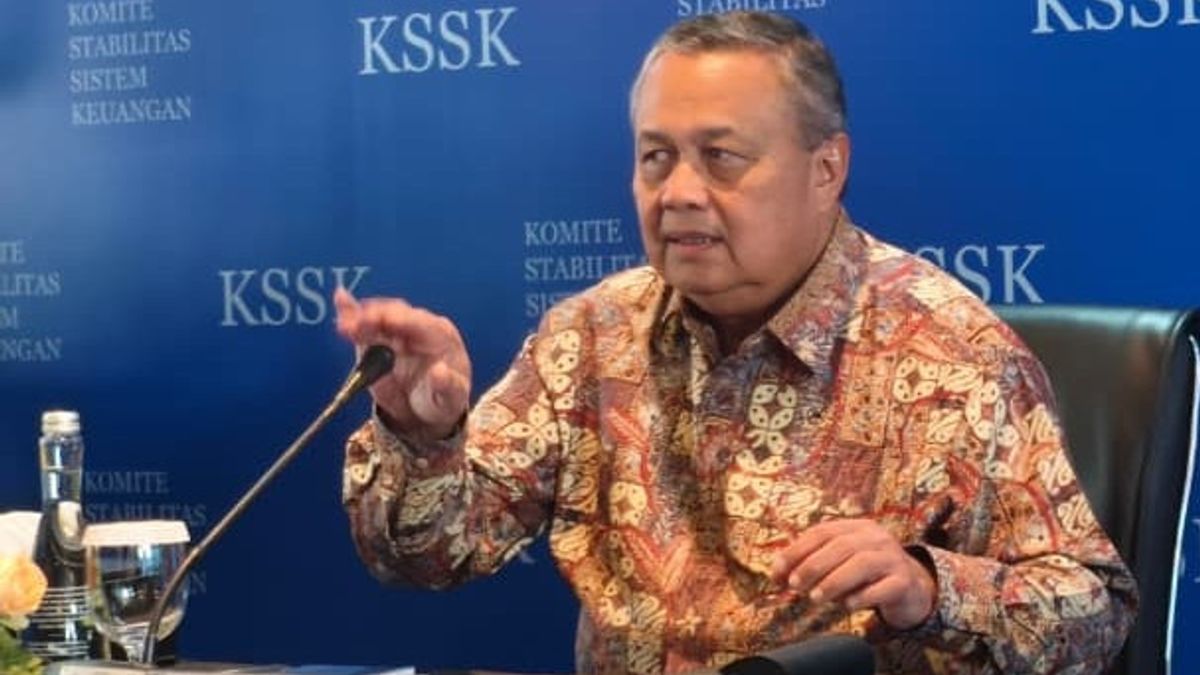


JAKARTA - Bank Indonesia (BI) Governor Perry Warjiyo emphasized the central bank's strong commitment to maintaining the stability of the rupiah exchange rate amid high geopolitical and global geoeconomic uncertainties.
Perry said that the seven strategic steps taken by BI at the direction of President Prabowo Subianto were carried out to the maximum and were not ordinary steps.
According to him, all these policies are extraordinary efforts to maintain national economic stability.
"This is not business as usual. The seven steps are all-out steps!" Perry said at a press conference for the Financial System Stability Committee (KSSK) II in 2026, Thursday, May 7.
He explained that one of the main steps taken was a massive intervention in the foreign exchange market, both through Non-Deliverable Forward (NDF) transactions in the overseas market and spot transactions and Domestic Non-Deliverable Forward (DNDF) in the domestic market.
According to him, this aggressive intervention also affected Indonesia's foreign exchange reserves position which in March 2026 was recorded as falling to US$148.2 billion.
However, Perry ensured that the amount was still sufficient to support the need for financial market stabilization.
"Foreign exchange reserves fell last month (March 2026) to 148.2 billion US dollars, but 148.2 billion is more than enough. We measure the needs for intervention. Remember! We collect foreign exchange reserves during the harvest of large inflows, so we use them during the recession, when the outflow is large," he said.
Perry added that BI's intervention was carried out comprehensively and took place almost non-stop in various financial centers of the world such as Hong Kong, Singapore, London, to New York.
This step shows the seriousness of BI in maintaining the stability of the rupiah.
"That's not business as usual. It's all out," he said.
In addition to market interventions, Perry said BI also utilizes the Indonesian Bank Rupiah Securities (SRBI) instrument to attract foreign capital inflows as a counterbalance to the outflow of foreign funds from the stock market and Government Securities (SBN).
Year to date (ytd), the flow of funds into SRBI was recorded at Rp78.1 trillion.
On the other hand, the stock market still experienced an outflow of IDR 38.6 trillion, while SBN recorded an outflow of IDR 11.7 trillion even though it had recently started to experience inflow again.
"Foreign investors yesterday outflow for stocks, continued SBN outflow, but recently inflow, so if stocks are the same as SBN outflow, should SRBI also outflow? It must be compensated (for inflow)," he said.
Perry assessed that this strategy is important so that the flow of foreign capital that comes out of certain instruments can be offset by the inflow of funds into other instruments.
He also emphasized that the current rupiah exchange rate is in an undervalued condition or below its economic fundamentals, so it still has room to stabilize and strengthen again.
The assessment is supported by a number of domestic economic indicators which are considered solid, such as economic growth in the first quarter of 2026 of 5.61 percent on an annual basis, controlled inflation at the level of 2.42 percent, trade balance surplus for 71 consecutive months since May 2020, and the position of foreign exchange reserves which remain high.
Regarding the weakening of the rupiah, which had touched the level of Rp17,400 per US dollar, Perry explained that the condition was influenced by global factors and seasonal factors.
Globally, the pressure comes from rising world oil prices, increasing geopolitical tensions in the Middle East, high US interest rates reaching 4.41 percent, and strengthening the US dollar index which pushes foreign funds out of developing countries, including Indonesia.
Meanwhile, from the seasonal side, the high demand for foreign exchange in April to May also put pressure on the rupiah.
The demand comes from the needs of pilgrims and umrah, repatriation of corporate dividends, to the payment of foreign debt and its interest.
However, Perry ensured that Bank Indonesia would continue to work optimally to maintain the stability of the rupiah through close coordination with the government and the full support of President Prabowo Subianto.
"That's the condition. Bank Indonesia is all out to protect the rupiah, closely coordinating with the government, and continues to receive the full support of the President," he said.
The English, Chinese, Japanese, Arabic, and French versions are automatically generated by the AI. So there may still be inaccuracies in translating, please always see Indonesian as our main language. (system supported by DigitalSiber.id)
Popular


