

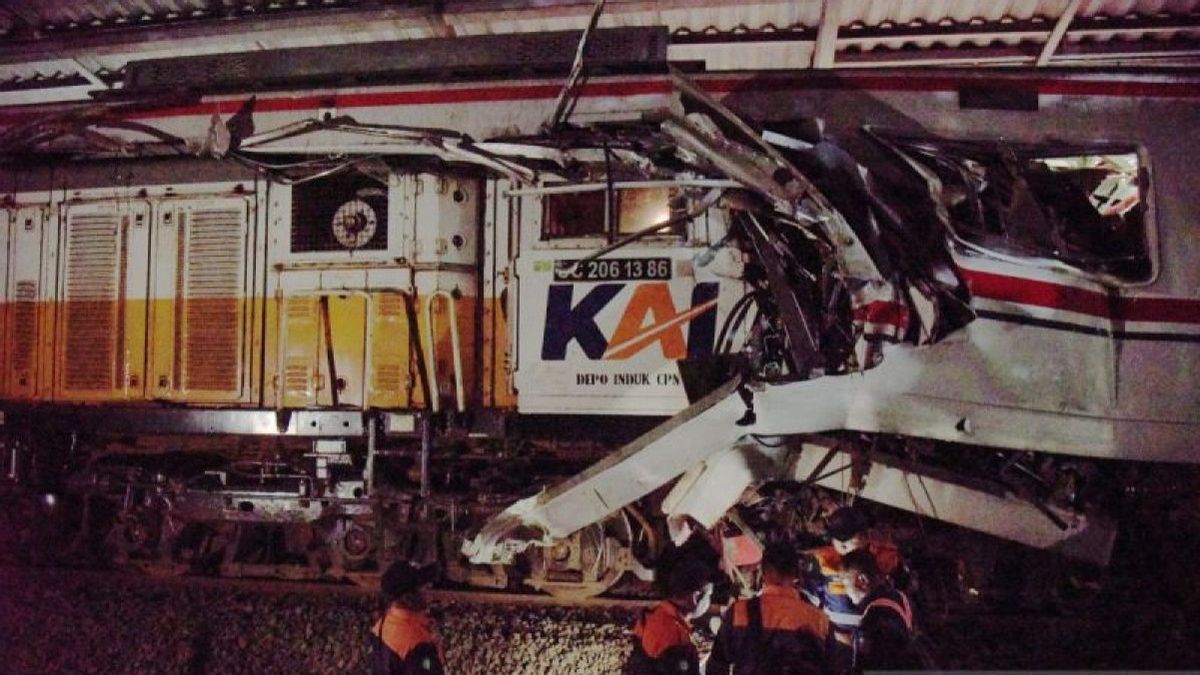


JAKARTA - The Indonesian Transportation Society (MTI) urges a thorough audit of the national railway safety system following the train accident at Bekasi Timur Station on Monday, April 27 evening.
Chairman of the MTI Railway Forum Deddy Herlambang assessed that the incident showed that there was still a serious gap in the safety system that was not entirely based on fail-safe.
Although there is a policy that regulates safety as the main principle of railway operations, namely within the framework of Law Number 23 of 2007 concerning Railways, safety is the main principle of implementation.
"The train accident on April 27, 2026 at Bekasi Timur Station shows systemic vulnerabilities in the implementation of national railways, especially on mixed traffic-based dense crossings (KRL with long-distance/intercity trains), train travel control systems and mitigation of KKA risks (rear-end collision)," Deddy said in a written statement received by VOI, Wednesday, April 29.
Deddy explained that the accident was a series of consecutive incidents that began about 35 minutes earlier at the crossing of a piece of JPL 85 Ampera.
At that time, an electric taxi broke down in the middle of the track and the KRL route from Jakarta to Cikarang was tempered, so the KRL series behind it was stopped.
Within a short time, this condition triggered a domino effect involving three train lines until several people died and dozens of people were injured.
MTI assessed that the implementation of the Minister of Transportation Regulation Number 52 of 2014 regarding the Automatic Train Safety System (SKKO) is still not optimal, which is one of the factors that need to be immediately corrected.
In fact, the rule requires the installation of an automatic safety system within five years of its implementation.
He saw that there were two main issues that were in the spotlight, namely the existence of a piece of crossing without a gate as the initial trigger of the accident and the potential for human error due to negligence in reading the signal.
"The KKA accident, which has the potential to recur with the same cause mode, will cause boundless concern," he said.
The MTI suggested that the government immediately continue the double-double track (DDT) from Bekasi to Cikarang for the separation of travel (Track Segregation Policy) of KRL and intercity trains, especially for crowded train travel and exceeding capacity.
The goal is for the safety of train travel. Then, an immediate audit needs to be conducted in the Central Railway Travel Controller (PPKT) whether it is appropriate to monitor the position and regulate train traffic on the Bekasi-Cikarang crossing through a screen and control panel.
Then, another homework is that KAI must immediately mitigate the train signal with the reform of the Technology-Based Safety System with the main policy being the use of Automatic Train Protection (ATP) for intercity trains (long distance) and the use of ETCS Level 1/2 or CBTC signals. Urban trains / Commuter trains.
In terms of human resources, MTI encourages the implementation of fatigue management for train drivers, emergency simulator training, and the implementation of a safety culture over punctuality. In addition, the implementation of the Railway Safety Management System (RSMS) is considered important to change the safety approach from reactive to preventive.
The case of the East Bekasi KKA accident also shows that the railway safety system is still reactive (post-incident) and not based on risk-based safety management, minimal integration between railway facilities and infrastructure operations and RSMS changing the approach to a predictive and preventive safety system.
"The need to upgrade the national railway facilities and infrastructure to be safer and integrated between the DJKA Ministry of Transportation (Kemenhub) and PT KAI. The positive integration of the two institutions is absolute and fundamental for the inspection and maintenance of state-owned railway infrastructure," he said.
Then from this case, it is seen that mitigation in the form of SOP must be carried out by road users if motor vehicles break down on the KA rail by the Directorate of Land Transportation (Hubdat) of the Ministry of Transportation.
Finally, the homework for the National Transportation Safety Committee (KNKT) is to investigate the KKA later, it is hoped that it will also be mandatory to invest in the reliability of electric taxis that have the potential to go on strike on the KA rail in JPL 85.
"If there is indeed a weakness in the reliability of the electric taxi, the licensing of the electric taxi can be re-evaluated," he explained.
The English, Chinese, Japanese, Arabic, and French versions are automatically generated by the AI. So there may still be inaccuracies in translating, please always see Indonesian as our main language. (system supported by DigitalSiber.id)


