

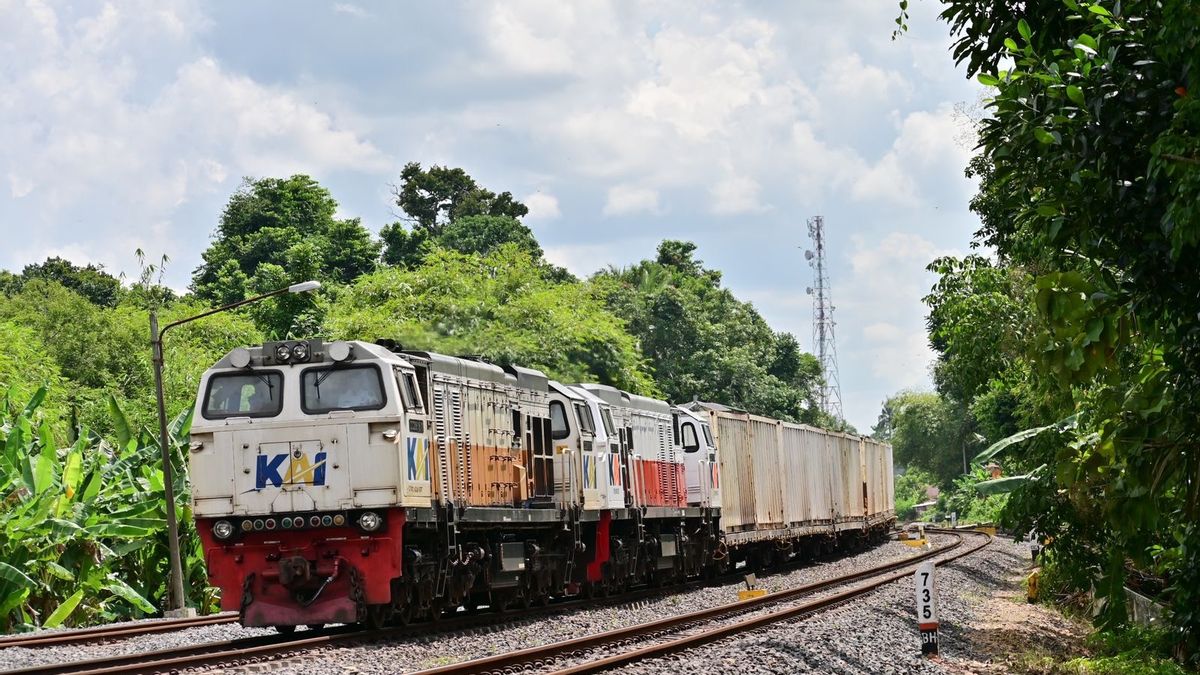


JAKARTA - The performance of rail-based logistics run by PT Kereta Api Indonesia (Persero) or KAI continues to show a strategic role in maintaining the smooth distribution of national commodities. One of them is reflected in fertilizer transportation.
From January to March 2026, KAI recorded the realization of fertilizer transportation reaching 1,950 tons. Meanwhile, in 2025 the total fertilizer transportation reached 21,060 tons. In general, the volume of KAI freight transportation in the first quarter of 2026 reached 14,948,442 tons, showing a scale of distribution that continues to move.
KAI's Vice President of Corporate Communication, Anne Purba, said that transporting fertilizer was an illustration of how the railway logistics system works on a large scale.
"Our focus is to keep distribution running according to schedule with adequate capacity. Fertilizer is one example of how the railway manages regular large-scale shipments," Anne said in an official statement, Monday, April 27.
Anne explained that the train has advantages in carrying capacity and consistency of travel. In one series, the carrying capacity can reach up to 4,200 tons with a maximum support of 60 wagons. Currently, the average capacity per wagon reaches 50 tons and continues to be increased to 70 tons.
Furthermore, Anne said that the performance was also supported by operational timeliness. In the first quarter of 2026, the on-time departure rate for freight transport was recorded at 95.97 percent, while arrivals reached 91.77 percent. This achievement provides certainty for business actors in planning distribution.
"The train keeps the rhythm of distribution stable. When the schedule is maintained, the delivery process can be planned more accurately," he said.
According to Anne, strengthening logistics based on the railway also contributes to national efficiency. Currently, Indonesia's logistics costs are still in the range of 15 percent to above 20 percent of the Gross Domestic Product (GDP), higher than the global standard which is in the range of 7 to 8 percent.
Moreover, continued Anne, about 60 percent of national logistics activities are still concentrated on Java Island with a value of Rp. 2,400 to Rp. 2,500 trillion per year. Improving distribution in this region is considered to have a wide impact on the movement of the national economy.
Regarding its utilization, Anne said that fertilizer is one of the commodities that has a direct impact on the agricultural sector and food security. Therefore, when distribution runs according to schedule, the planting process can take place on time, the harvest is maintained, and the food supply remains stable.
"Distribution that runs according to schedule gives certainty to many sectors, including agriculture as one example. This is what we continue to maintain through improving operational quality," concluded Anne.
The English, Chinese, Japanese, Arabic, and French versions are automatically generated by the AI. So there may still be inaccuracies in translating, please always see Indonesian as our main language. (system supported by DigitalSiber.id)
Popular


