

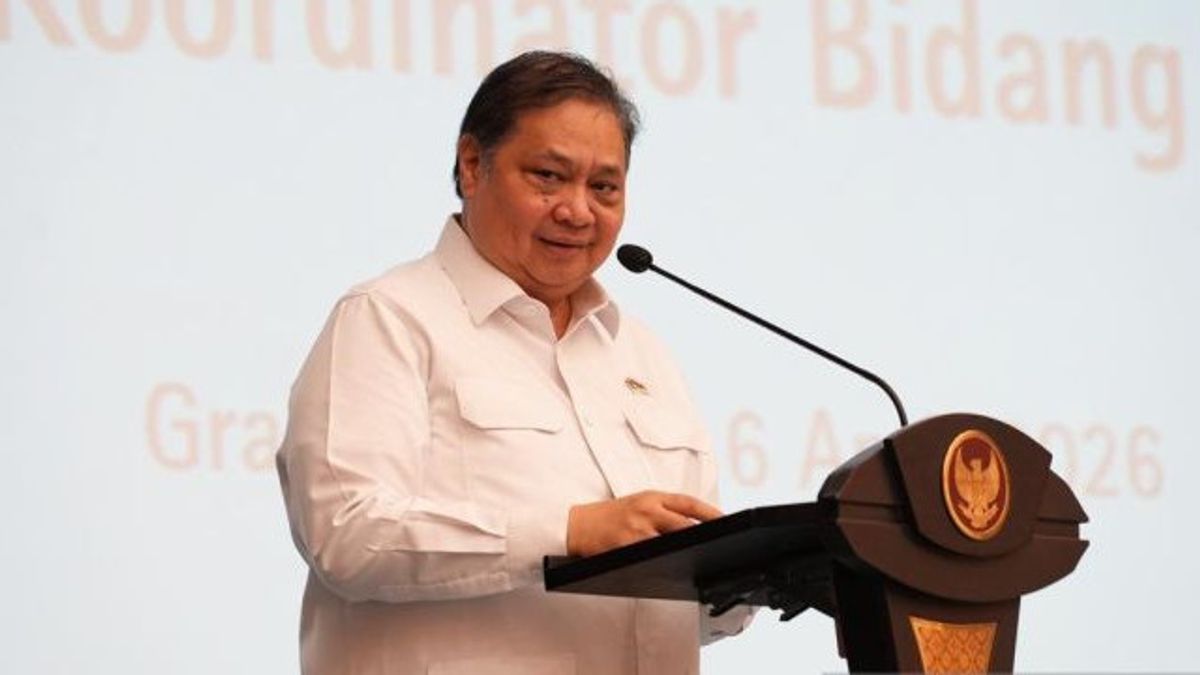


JAKARTA - The government targets the contribution of the investment sector to Gross Domestic Product (GDP) to reach 30 percent by 2026.
This target is an important part of the strategy to encourage national economic growth to 5.4 percent amid global uncertainty.
Coordinating Minister for the Economy Airlangga Hartarto said that investment would be the main driver of economic growth in the second to fourth quarters of 2026.
"Our investment target is 30 percent or more of GDP and in the second, third and fourth quarters, the driver of Indonesia's economic growth is the investment sector," he said at a press conference on the realization of investment in the first quarter of 2026, quoted Friday, April 24.
He added that in addition to relying on domestic and foreign investment, the government also emphasized the role of strengthening investment through BPI Danantara.
According to him, this step is expected to be able to support the achievement of the national investment target of IDR 2,041.3 trillion.
"Mr. Rosan (Minister of Investment/Head of BKPM) also as the chairman of Danantara CEO also has his own additional investment target. So that the target of Rp. 2,041.3 trillion, the government is optimistic that this can be achieved," he said.
Furthermore, he said that a number of international institutions such as the World Bank and the International Monetary Fund estimated that Indonesia's economic growth would be at least in the range of 5.2 percent, in line with the government's target of 5.4 percent in 2026.
Airlangga said that in the midst of global dynamics, the energy sector was the focus of policy to maintain the momentum of growth, and the government prioritized the transition to renewable energy, including the development of solar energy.
The target for the development of solar power plants is pegged at 100 GW, with an initial phase of 13.3 GW in the 3T region (front, outermost, lagging), and currently, the domestic production capacity has reached around 5.9 GW.
According to Airlangga, this program not only supports the energy transition, but also serves as an additional stimulus for investment outside of ongoing projects.
"So it is a leverage rather than investment on top of what is currently invested by investors from within the country and abroad," he explained.
In terms of regions, he assessed that Southeast Asia is still one of the regions with the highest economic growth in the world, namely ASEAN is projected to grow an average of 4.7 percent, surpassing the global growth of around 3.2 percent, and Indonesia is expected to record growth above the average of the region, along with the Philippines, and remain one of the main engines of regional growth.
The English, Chinese, Japanese, Arabic, and French versions are automatically generated by the AI. So there may still be inaccuracies in translating, please always see Indonesian as our main language. (system supported by DigitalSiber.id)
Popular


