

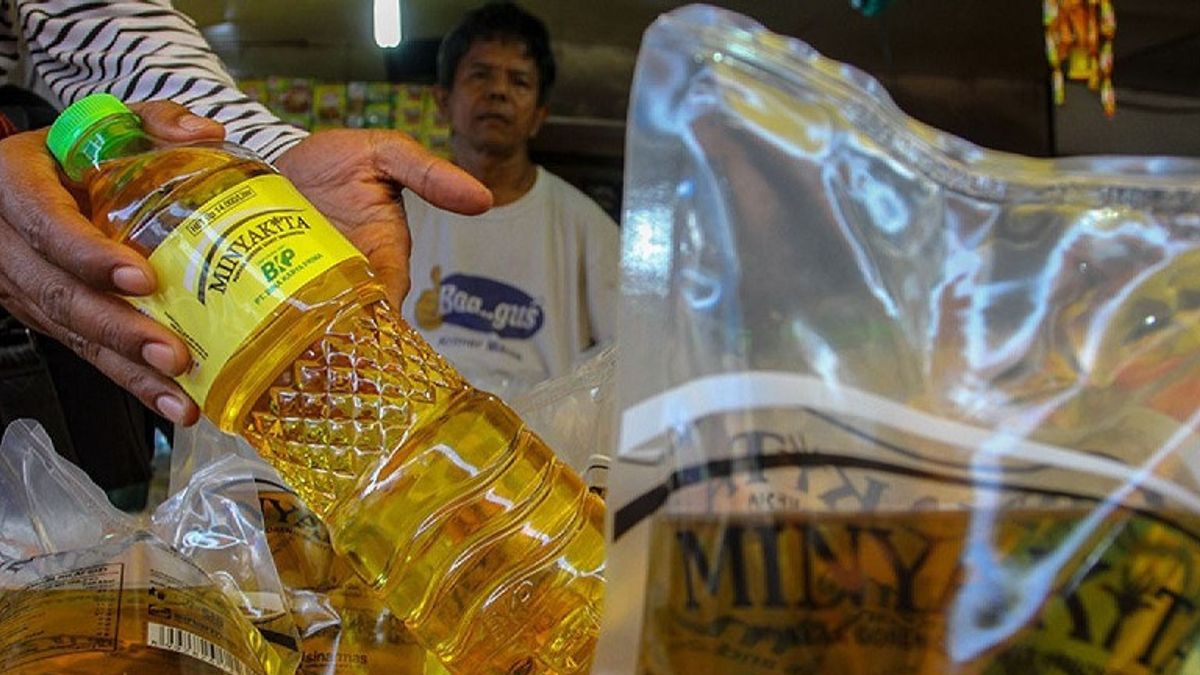


Minister of Trade Budi Santoso assessed that the policy of the obligation of domestic market obligation (DMO) for people's cooking oil of at least 35 percent through Perum Bulog and the Food SOEs is effective in maintaining price stability while ensuring that supplies are still available in the market.
Cooking oil from the distribution, one of which is Minyakita, shows a declining price trend since the policy was implemented. As of April 10, 2026, the average national price of Minyakita was recorded at Rp. 15,961 per liter, down 5.45 percent compared to December 24, 2025 which was at the level of Rp. 16,881 per liter.
Budi said this achievement confirms the role of the DMO policy as an important instrument in maintaining the balance of supply and prices, especially to reach the people's market.
"The DMO policy of at least 35 percent through the Food SOEs has proven effective in maintaining the availability of supplies and maintaining the stability of the Minyakita price in the market. In fact, its realization which has exceeded 49 percent shows that the distribution mechanism is running well," said Budi in Jakarta, Friday, April 17.
Budi revealed that as of April 10, 2026, the realization of DMO distribution had reached 49.45 percent, exceeding the minimum provision of 35 percent as stipulated in Regulation of the Minister of Trade Number 43 of 2025.
Furthermore, according to Budi, this figure shows that business actors not only fulfill minimum obligations, but also contribute more to maintaining domestic supply.
"The DMO provision of 35 percent through SOEs is the minimum limit that business actors must meet. Increasing the realization of distribution above this provision is in principle possible as long as it is supported by supply readiness," he said.
Furthermore, Budi emphasized that the government continues to strengthen the DMO and Domestic Price Obligation (DPO) policies as a response to the dynamics of the price and supply of cooking oil in recent years.
Since 2022, the distribution of DMO has been carried out through the Minyakita brand which is a government-owned brand and can be used by business actors. He emphasized that Minyakita is not subsidized cooking oil, but rather part of the obligation of business actors who carry out exports.
"Currently there is no shortage of cooking oil in the market. The availability of supplies is safe because there are still premium cooking oil and second brand cooking oil as options. In addition, the availability of Minyakita supplies depends on DMO. If exports are not much, then the supply of DMO is also not much," he said.
Budi also stated that the Ministry of Trade together with the Food Task Force (Satgas) of the National Police and the regional government continued to intensify supervision of the distribution of Minyakita. This step is to ensure that the availability of supplies and price stability is maintained.
Apart from the supervision factor, Budi also reminded of the potential for external pressure, such as an increase in the price of packaging raw materials and global logistics disruptions. Therefore, coordination with business actors continues to be strengthened to prevent supply disruptions and price spikes at the consumer level.
Based on the results of supervision, the Ministry of Trade has imposed sanctions on eight non-producer manufacturers and/or exporters who do not meet the provisions of the DMO in the form of suspension of export approval.
"The sanctions given to the eight producers and/or exporters are in the form of suspension of the issuance of export approvals," said Budi.
In addition, said Budi, two business actors were also sanctioned administratively for selling Minyakita above the provisions of the DPO and have not met the administrative requirements.
"The sanctions given are administrative sanctions in the form of a written reprimand and asking the business actors to immediately adjust to the applicable provisions," he said.
Distribution Through SOEs is a Key Factor
Meanwhile, Director General of Domestic Trade Iqbal S. Shofwan added that strengthening the distribution channel through SOEs was a key factor in maintaining the balance of supply.
"Distribution through SOEs we optimize to ensure Minyakita directly reaches the people's market traders. This effort is important to cut the distribution chain that is too long and prevent price speculation," said Iqbal.
Iqbal said that supervision was also tightened together with the trade service throughout Indonesia as well as related ministries and agencies, especially ahead of the National Religious Great Day.
In general, the stock conditions at the retailer and market monitoring levels are in a safe condition with relatively controlled prices. A total of 15 provinces have even recorded prices at the highest retail price (HET) of Rp. 15,700 per liter.
However, the government is still monitoring the price disparity in a number of regions, especially in East Indonesia which is recorded more than 10 percent above the HET.
In terms of supervision, the Ministry of Trade of the Republic of Indonesia together with the Food Task Force of the National Police and the regional government continue to intensify supervision of the distribution of Minyakita to maintain price stability and availability of supplies.
"Distribution is continuously optimized through the distribution channel of SOEs, especially Perum Bulog and Food SOEs. To maintain the balance of supply in the market, the Ministry of Trade encourages business actors to maximize the production and distribution of second-brand cooking oil as an additional alternative for the community," added Iqbal.
The English, Chinese, Japanese, Arabic, and French versions are automatically generated by the AI. So there may still be inaccuracies in translating, please always see Indonesian as our main language. (system supported by DigitalSiber.id)
Popular


