

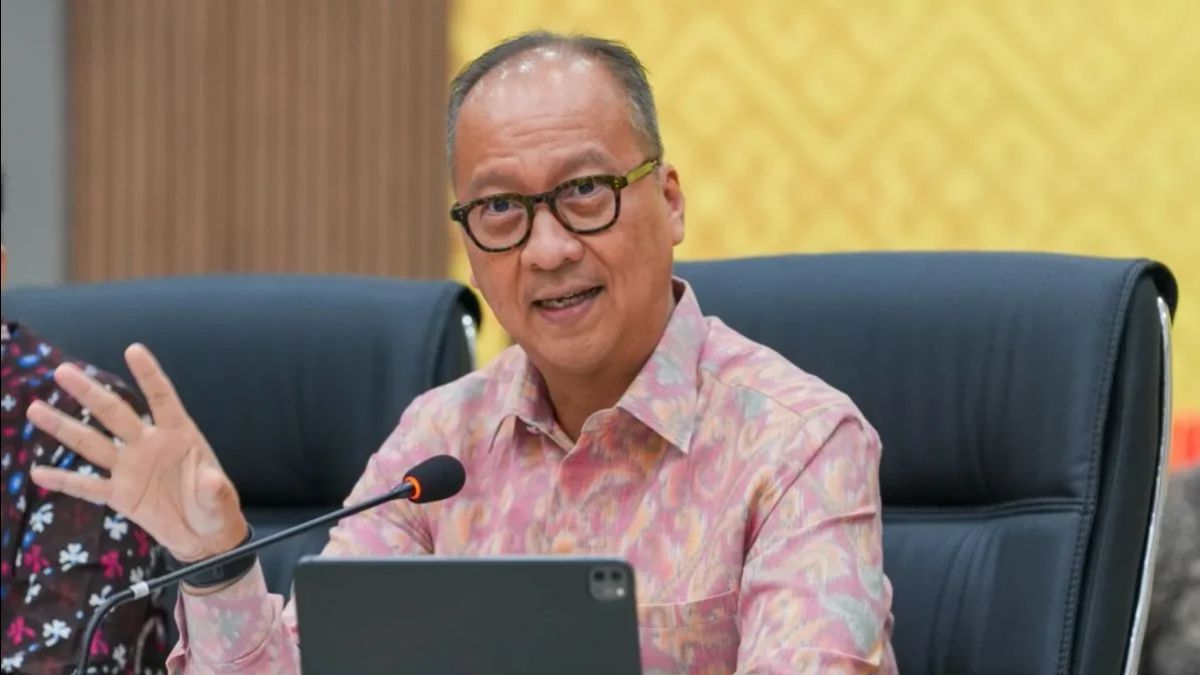


JAKARTA - Minister of Industry (Menperin) Agus Gumiwang Kartasasmita said, based on the balance of supply and demand data for national steel, the average utilization rate of the steel industry is currently in the range of 52.7 percent.
This condition shows that there is still a large enough space for optimization and improvement of capacity utilization and deepening of the national steel industry in the future.
"We highlight that there are still structural challenges, such as the low utilization of the steel industry which is in the range of 52.7 percent and a deficit in intermediate and downstream products due to high imports of raw materials," said Agus as quoted from a written statement, Saturday, April 11.
In general, Agus said, the production capacity of the national steel industry has included various types of products from upstream to downstream and can be produced domestically.
Major products such as slabs, billets, hot rolled coils (HRC), cold rolled coils (CRC) to structural steel have recorded national production capacity with an utilization rate still below 80 percent.
Indonesia currently ranks 13th in the world's steel producers with production reaching 19 million tons in 2025. In the last six years, national steel production has grown consistently with an average growth of 14 percent per year.
"This trend of increasing national production shows that the industry's foundation is getting stronger, while opening up a large space for increasing capacity and deepening the national steel industry in the future," he said.
In 2025, said Agus, the growth of the processing industry reached 5.30 percent, surpassing the national economic growth of 5.11 percent. In addition, the sector's contribution to the Gross Domestic Product (GDP) also increased by 19.07 percent.
Then, the basic metal industry subsector became one of the driving forces of the economy in Indonesia with a national GDP growth rate of 15.71 percent in 2025, far exceeding the national economic growth of 5.11 percent.
"This achievement is supported by increasing demand from the infrastructure sector, manufacturing and downstream industries with added value," said Agus.
Therefore, Agus hopes that the management of IISIA for the period 2026-2030 as a strategic partner can consistently answer challenges while optimizing strategic opportunities for the steel industry in the future.
Meanwhile, the Chairman of IISIA, Muhamad Akbar, emphasized the commitment of the new management to strengthen the role of IISIA as a platform for collaboration in the national steel industry. According to him, the steel industry is not only an economic sector, but also the foundation of national development.
"We want IISIA to be a solid home for all steel industry players, as well as a strategic partner of the government in encouraging the progress of the national industry. With strong synergy between the government and industry players, the steel industry is not only able to succeed in the country, but also respected in the international market," he concluded.
The English, Chinese, Japanese, Arabic, and French versions are automatically generated by the AI. So there may still be inaccuracies in translating, please always see Indonesian as our main language. (system supported by DigitalSiber.id)
Most Popular Tags
#Prabowo Subianto #donald trump #Febrie Adriansyah #8791 #giias 2026Popular


