

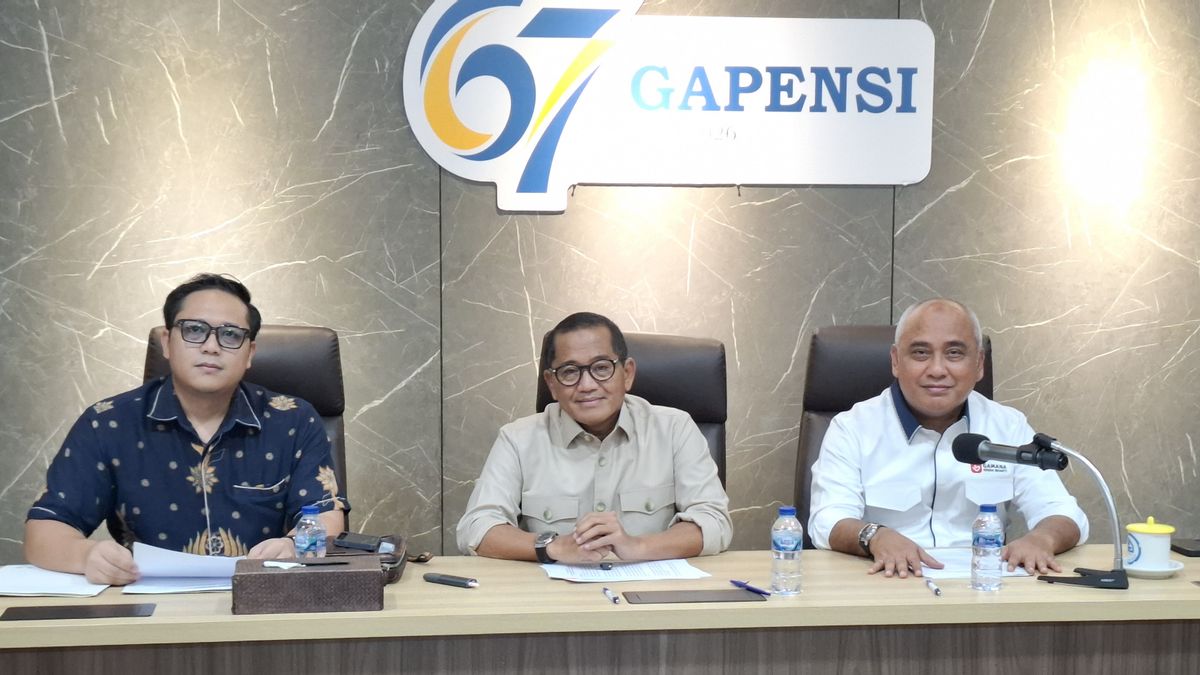


JAKARTA - The Indonesian National Construction Executive Association (Gapensi) asked the government to adjust the price of construction service tenders in line with the increasing cost of energy which began to pressure the national construction services sector.
Gapensi Chairman Andi Rukman Nurdin Karumpa said that business actors in recent months have recorded a significant increase in costs and have the potential to disrupt the sustainability of the project.
Furthermore, Andi Rukman explained, the pressure was triggered by global dynamics which directly impacted the price of industrial fuel.
"In the period from February to April 2026, we see that construction costs can increase by 3 percent to 8 percent, and potentially increase higher if this condition continues," said Andi Rukman in an official statement, Friday, April 10.
Andi Rukman emphasized that the surge in industrial solar prices was one of the main factors that drove the increase in project costs.
The current price of solar is in the range of Rp. 21,000 to Rp. 23,000 per liter, up from the previous Rp. 18,000 to Rp. 20,000 per liter.
He said that the increase also had an impact on the price of construction materials such as asphalt, cement, to steel which are the main components in project work.
"(Construction costs) have the potential to increase higher if this condition continues," said Andi Rukman.
Regarding this condition, the Secretary General of Gapensi La Ode Safiul Akbar asked the government to immediately adjust the price of services for projects that have not entered the contract stage.
According to La Ode, without price adjustments, contractors risk significant losses because the value of the project still refers to the previous year's cost conditions.
"We ask that projects that have not been contracted be given room for price adjustments so that business actors do not bear the burden of costs that do not match the current real conditions," he said.
In addition, Gapensi also highlighted the importance of justice in the distribution of government projects. They encourage construction projects to be tendered openly and not dominated by large-scale public-private partnerships.
According to La Ode, the practice of swakelola can actually only hinder the participation of contractors and payment becomes uncertain.
"It is hoped that large-value work packages will involve national private companies, not only SOEs," he said.
La Ode also reminded that the dominance of certain schemes could have an impact on the decline in the number of construction business actors, which is reflected by the decline in the number of members nationwide in recent years.
Furthermore, La Ode said, pressure on the construction sector not only impacts profit margins, but also has the potential to threaten business sustainability.
"If this condition continues without policy adjustments, then sooner or later construction business actors, especially small and medium-sized ones, will experience difficulties and even potentially stop operating," he said.
As a strategic partner of the government, Gapensi continues to express its support for national development programs.
However, Gapensi emphasized the importance of equitable distribution of projects between state-owned enterprises and national private enterprises. Including also the involvement of business actors in the region.
As well as strengthening an inclusive and sustainable construction ecosystem.
The English, Chinese, Japanese, Arabic, and French versions are automatically generated by the AI. So there may still be inaccuracies in translating, please always see Indonesian as our main language. (system supported by DigitalSiber.id)
Most Popular Tags
#Prabowo Subianto #donald trump #2026 World Cup #Febrie Adriansyah #8791Popular


