

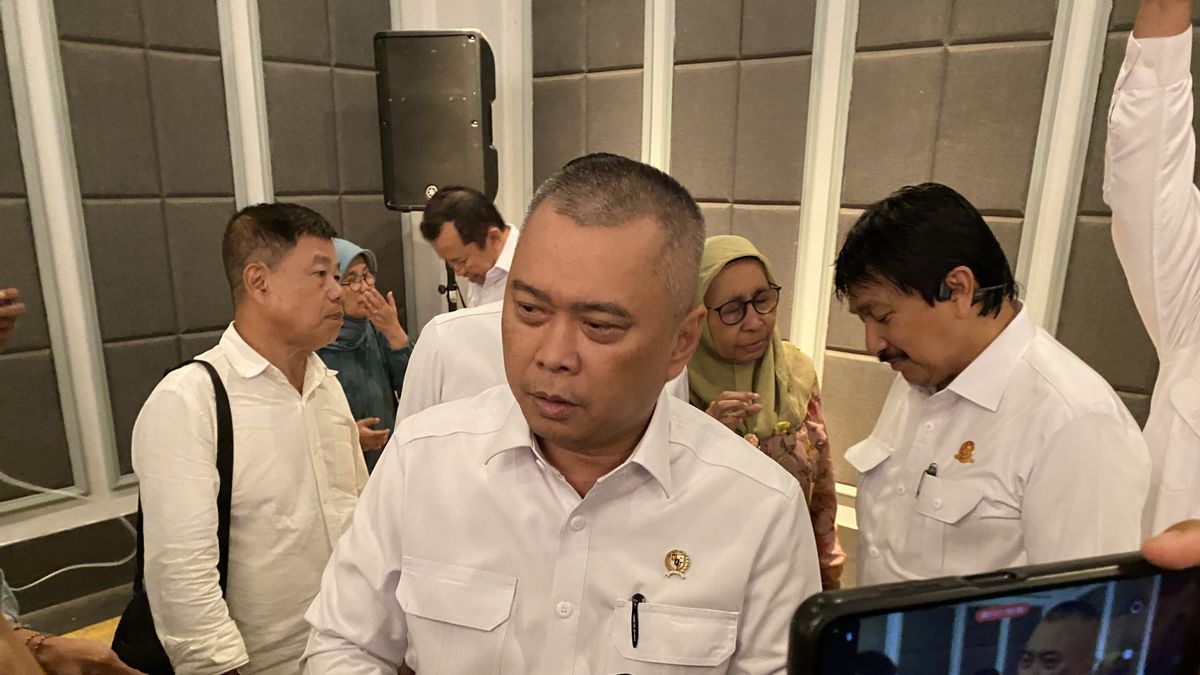


JAKARTA - The government has decided to postpone discussing the revision of the Upper Limit Tariff (TBA) for domestic air tickets. This decision was taken in the midst of various policies that have been implemented to mitigate the impact of rising jet fuel prices on the aviation industry.
Minister of Transportation Dudy Purwagandhi revealed that the delay was made because the government had previously issued a number of steps to maintain the stability of ticket prices.
"We haven't talked about TBA because it's from TBA that the highest operating costs are avtur. Then maintenance is the same as the rental, so the two components that are very influential are avtur, then maintenance, it has been facilitated by the government with an increase in fuel surcharge, and the implementation of a 0 percent entry fee for spare parts," he said in a media briefing in Jakarta, written Friday, April 10.
For information, the government is currently trying to keep the increase in domestic air ticket prices within the range of 9 to 13 percent. This effort is carried out through a number of policies, one of which is by setting a fuel surcharge of 38 percent, both for jet and non-jet aircraft.
In addition, the government also provides incentives in the form of Value Added Tax (PPN) borne by the government at 11 percent, as well as the exemption of import duties on aircraft spare parts to 0 percent.
On the other hand, Dudy assessed that the discussion of the revision of the TBA was also not urgent to be carried out because the aviation industry was entering a low season period after the Lebaran homecoming momentum. At this stage, airlines tend not to raise ticket prices because passenger demand is declining.
"How to do it now is to make it possible to keep the public from flying. If the low season people don't fly, it will also be troublesome for friends who work in the aviation industry," he said.
Previously, INACA Secretary General Bayu Sutanto explained that the proposal to increase the fuel surcharge and the upper limit (TBA) of the air ticket price took into account the condition of the aviation industry which was affected by the Middle East war.
The types of aircraft proposed to increase the tariff are jet and propeller types, based on the Minister of Transportation's Decree Number 106 of 2019.
Bayu said the conflict in the Middle East resulted in an increase in world oil prices and a weakening of the rupiah exchange rate against the US dollar. He said that both cost components greatly affected the increase in the operating costs of national airlines.
Meanwhile, Bayu continued, when TBA was applied in 2019, the average exchange rate of 1 US dollar was equivalent to Rp. 14,136 but in March 2026 the dollar exchange rate had reached Rp. 17,000 or an increase of more than 20 percent.
"The operating costs of the airline are 70 percent using the US dollar, while the national airline's revenue is from the rupiah, so with the rise in the exchange rate of the US dollar, it will further burden the finances of the national airline," he said.
Bayu also said that the increase also occurred in the world oil price. Before the oil price war, it was around 70 US dollars per barrel, but now it has reached 110 US dollars or an increase of 57 percent. This condition affects the fluctuation of jet fuel prices in Indonesia.
Bayu said that in 2019, the price of jet fuel was recorded at Rp. 10,442, while in March 2026 it had increased to Rp. 14,000 to Rp. 15,500 or an increase of 34 to 48 percent.
The English, Chinese, Japanese, Arabic, and French versions are automatically generated by the AI. So there may still be inaccuracies in translating, please always see Indonesian as our main language. (system supported by DigitalSiber.id)
Popular


