

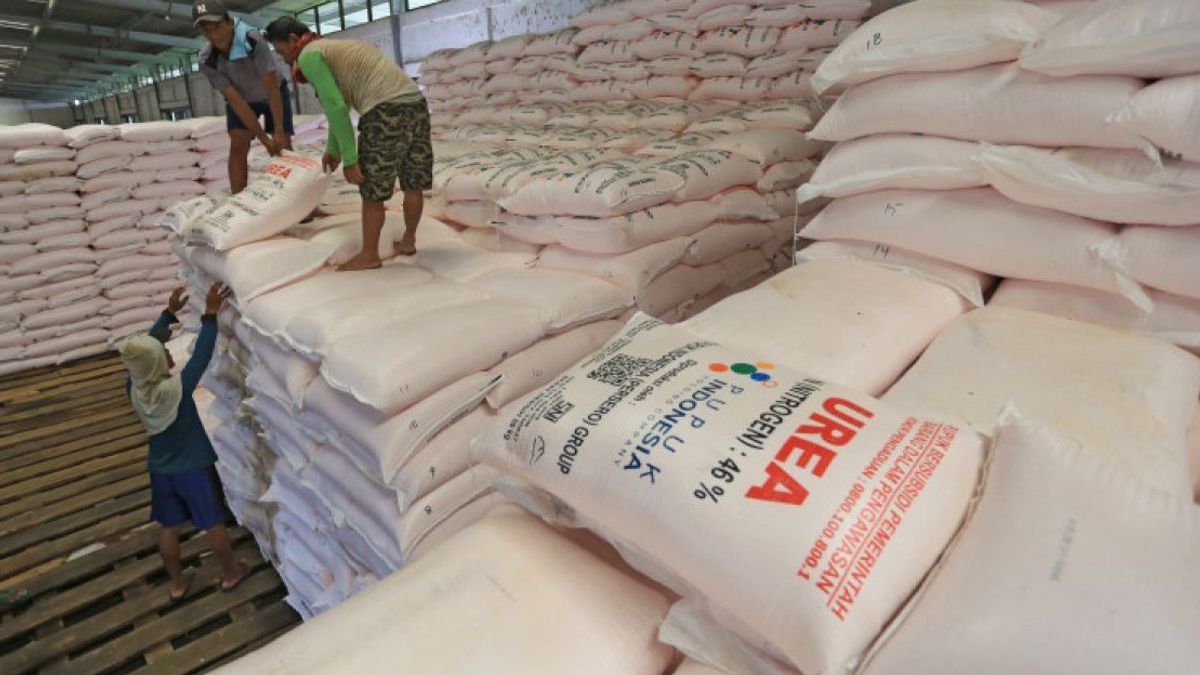


JAKARTA - Fertilizer prices have skyrocketed amid the Iran war, as farmers in the Northern Hemisphere enter the fertilizer season and farmers in the Southern Hemisphere are busy finishing the harvest. CNBC, quoted Thursday, March 26, reported that the disruption in the Strait of Hormuz is now shaking not only oil and gas, but also putting pressure on global fertilizer supplies and triggering a new threat to food security.
Around a third of the world's fertilizer trade transported by sea passes through the Strait of Hormuz. The vital route on Iran's southern border has been heavily disrupted since the war began. Ship traffic has almost stopped, and some ships have reportedly been hit by projectiles around the waters.
The impact is immediately felt on prices. As CNBC wrote, since the United States and Israel attacked Iran on February 28, the price of fertilizers produced in the Middle East has jumped sharply. The FOB price of granular urea in Egypt, one of the references for nitrogen fertilizers, is said to have risen to around US$700 per metric ton, from the previous US$400 to US$490. Oxford Economics noted that urea prices have risen by about 50 percent and ammonia by 20 percent since the war broke out. Other fertilizers such as potash and sulfur have also risen.
Market pressure is growing because it is not just one or two suppliers that are disrupted. According to CRU, about 30 percent of the world's fertilizer export suppliers are now practically unavailable in the market, including from Saudi Arabia, Qatar, Bahrain, and Iran. Iran itself is an important producer of nitrogen fertilizer and one of the world's largest exporters. For sulfur, almost 50 percent of global trade comes from the region. For urea about a third, while ammonia is close to 25 percent.
The most vulnerable problem is nitrogen. This fertilizer cannot be delayed in use. Farmers can still skip one season of potash or phosphate, but not for nitrogen. Urea is widely used for major crops such as corn, wheat, canola, as well as a number of fruits and vegetables. If the supply is disrupted during the fertilizer season, the harvest is at risk of falling.
Fertilizer production is also hit. CNBC wrote, the pressure not only comes from the stalled distribution, but also from the limited storage facilities for products that failed to be delivered and the partial shutdown of energy facilities in the Middle East. QatarEnergy even stopped downstream urea production after shutting down liquid natural gas production. At the same time, China, one of the world's largest fertilizer exporters, restricted exports to protect its domestic market.
Even so, the global food market still has a buffer stock at the beginning of 2026. This cushion can withstand some of the pressure on corn, wheat, soybeans, and rice. However, analysts to CNBC, warned, a 5 percent decline in agricultural yields is enough to trigger food inflation, especially in developing countries.
The greatest risk is expected to hit India and the East African region. The United States is also not completely safe because about a third of the nitrogen, phosphate, and potash fertilizers used in the country still come from imports. The pressure is already felt. As many as 54 agricultural groups in the US sent a letter to President Donald Trump asking for market relief amid a surge in fuel and fertilizer prices.
The English, Chinese, Japanese, Arabic, and French versions are automatically generated by the AI. So there may still be inaccuracies in translating, please always see Indonesian as our main language. (system supported by DigitalSiber.id)


