

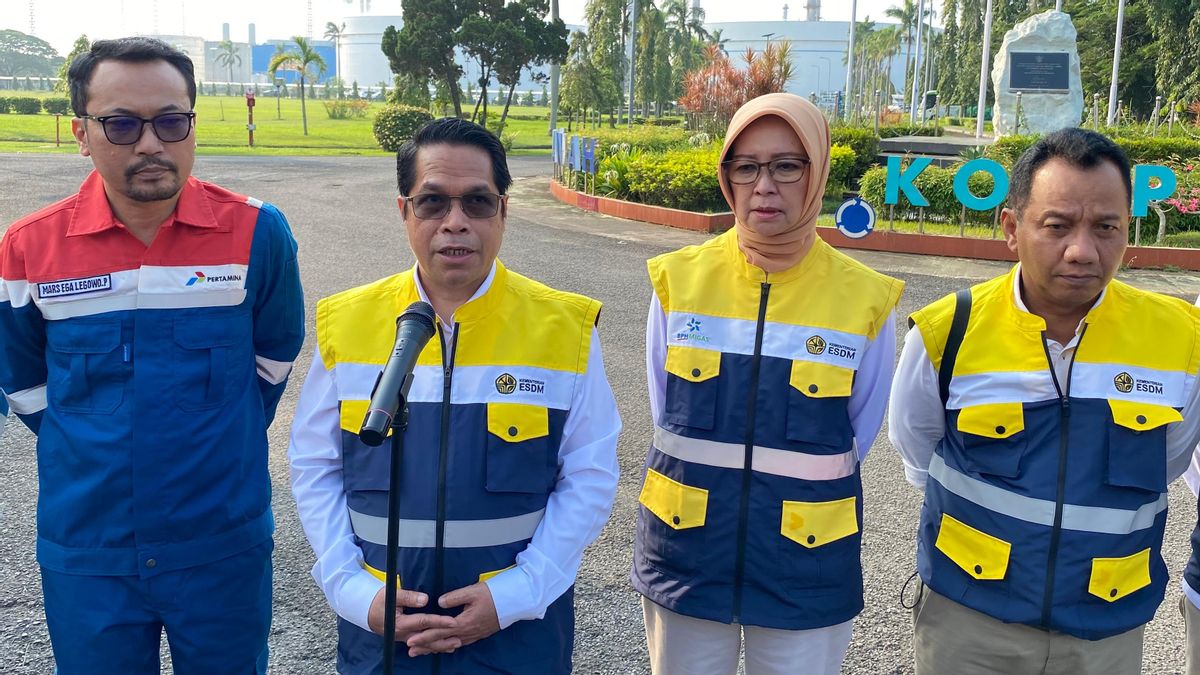


INDRAMAYU - The Ministry of Energy and Mineral Resources (ESDM) through the Director General of Oil and Gas Laode Sulaeman revealed that the impact of geopolitical conflicts in the Middle East region between the United States-Israel and Iran will only be felt by Indonesia in April.
"We are preparing more for the after-RAFI (Ramadan and Eid al-Fitr) because the impact will be felt starting in April," said Laode during the Ramadan Safari at the Pertamina Balongan Refinery, Thursday, March 12.
However, Laode did not elaborate further on what impact would occur in the country.
However, he ensured that the government would still take a number of mitigation steps such as preparing stocks and supplies of fuel, LPG and crude oil.
"So we have done that and Insyaallah later until RAFI then April and onwards we can keep it stable," explained Laode.
When asked about the possibility of an increase in subsidized fuel prices, Laode said that until now there was no government plan to increase prices.
"There is no (possibility of an increase). Not yet," said Laode.
Previously, Minister of Energy and Mineral Resources (ESDM) Bahlil Lahadalia ensured that subsidized fuel prices in Indonesia would not increase until Eid al-Fitr 2026 or 1 Syawal 1447 Hijriah.
Bahlil emphasized that the current national fuel stock is in a safe condition and there is no disruption to the supply of fuel or Liquified Petroleum Gas (LPG) in the country.
According to Bahlil, the government is currently preparing comprehensive steps to anticipate the impact of global energy price fluctuations.
He also asked the public to remain calm because the government guaranteed that fuel supplies would remain available until Eid.
"We will again exercise to take comprehensive steps. But once again, I assure the public that they do not have to feel how it is related to prices because until the holiday (Eid al-Fitr) this fuel supply is guaranteed and God willing there will be no increase in fuel prices for subsidies," he said. last Monday, March 9.
The surge in world oil prices is itself triggered by increasing geopolitical tensions in the Middle East.
The conflict involving the United States, Israel, and Iran raises concerns about disruptions to global energy supplies, especially on strategic oil distribution lines in the region.
Global crude oil prices are reported to have broken through more than 100 US dollars per barrel, with Brent and WTI oil moving in the range of 100-110 US dollars per barrel.
This price increase is triggered by the potential disruption of oil supplies from the Middle East region as well as increased energy demand from major consumer countries.
Despite the increasing global oil price pressure, the Indonesian government has confirmed that it will continue to monitor the development of the situation and maintain the stability of the national energy supply so as not to burden the public, especially subsidized fuel users.
The English, Chinese, Japanese, Arabic, and French versions are automatically generated by the AI. So there may still be inaccuracies in translating, please always see Indonesian as our main language. (system supported by DigitalSiber.id)


