

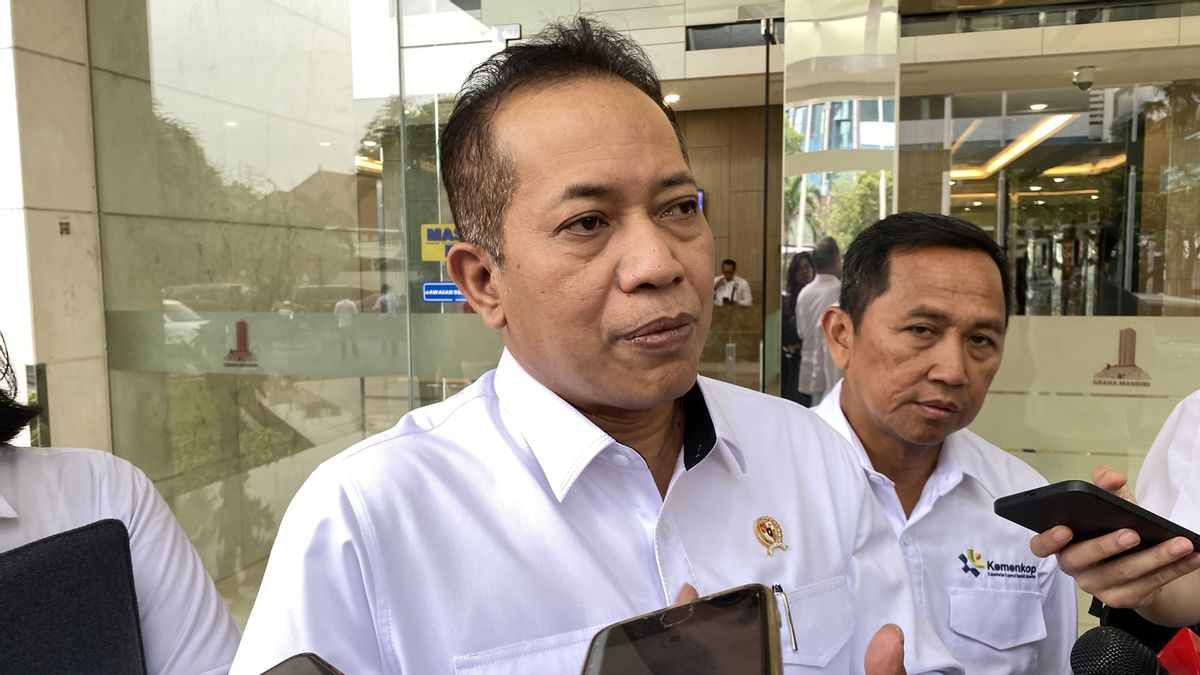


JAKARTA - Minister of Cooperatives (Menkop) Ferry Juliantono received an audience with the General Chairman of the Indonesian Five-Foot Merchant Association (APKLI) Ali Mahsun regarding the impact of modern retail expansion on street vendors and micro-businesses in Jakarta, Thursday, February 26.
During this meeting, APKLI also provided input regarding the implementation of Presidential Regulation (Perpres) Number 112 of 2007 and the 2015 Economic Policy Package, which is considered necessary to be strengthened.
For information, Presidential Decree 112 Year 2007 contains provisions on the arrangement and construction of traditional markets, shopping centers and modern stores. In this case, the association also complained about the existence of modern retail which is not far from the traditional market.
"From there, we appeal that it is checked whether it meets the rules or not. If it turns out that it is less than 500 meters or even overlaps with the traditional market, what is our attitude? Here is where the arena must be made fair," Ferry told the media, Thursday, February 26.
Ferry added that although modern retail has a positive contribution in absorbing employment, there must be an evaluation of violations that occur, especially related to the distance between traditional markets and modern retail which must not be less than 500 meters.
For this reason, Ferry promised to coordinate with relevant parties, such as the Ministry of Trade and local governments, to discuss further about supervision and enforcement of these rules.
As a follow-up to this hearing, Ferry conveyed that Presidential Decree Number 112 of 2007 and the 2015 Economic Policy Package could be reviewed again by involving the Association of Regency/City Governments throughout Indonesia.
"We will convey the APKLI proposal to be studied with colleagues from the Association of Regency/City Governments throughout Indonesia and Regional Heads to be able to settle this issue as wisely as possible," said the Minister of Home Affairs.
The Minister of Cooperatives together with APKLI also encourages the implementation of strengthening cooperatives through the 83,000 Red and White Village/Neighborhood Cooperatives (Kopdes) program. The Minister of Cooperatives is committed to partnering with APKLI in efforts to strengthen the local economy by integrating the existence of street vendors against the Red and White Kopdes ecosystem.
With the presence of the Red and White Kopdes, it is hoped that it will provide goods at a more affordable price for street vendors and micro, small, and medium enterprises (MSMEs).
"Village cooperatives are a solution that can restore economic circulation in villages, so that the benefits of economic activities are felt by the villagers themselves," said Ferry.
The Chairman of APKLI, Ali Mahsun, emphasized the importance of partnerships between modern retail and MSMEs to create fair and healthy competition.
Ali Mahsun highlighted that the points contained in Presidential Decree 112 of 2007 must be upheld in its implementation in the field in accordance with the prevailing regulations. For example, how is the retail area or modern stores such as Minimarket (<400), Supermarket (400-5,000), and Hypermarket (>5,000).
Then how do modern market establishments have to pay attention to the spatial, social and cultural layout, and the economic impact on traditional markets and local small traders. In addition, it is also related to the status of partnership, where modern stores and shopping centers are required to partner with MSMEs in marketing products.
In line with this, Ali also revealed the spirit of the 2015 Economic Policy Package which aims to simplify modern retail licensing should not sacrifice the existence and competitiveness of small businesses.
According to him, modern retail which has developed rapidly since 2015 has had a negative impact on many grocery stores which are increasingly decreasing in number, with more than 2 million grocery stores closing down since the implementation of the policy.
"We are not hostile to modern retail, but we want the people's economy to turn around, the people's economic sovereignty we are regaining. The village economy revolves for the village, the district economy for the district," explained Ali.
Based on research conducted by APKLI, at the time of the issuance of Presidential Decree 112 Year 2007, there were approximately 6.1 million grocery stores throughout Indonesia. Then after the policy was implemented, until 2015 the remaining grocery stores were around 5.1 million or eroded by 1 million throughout the country.
Not stopping there, research from APKLI shows that the issuance of the Economic Policy Package issued in September 2015 further pressured the existence of grocery stores at the village/subdistrict level. By 2025, APKLI recorded the number of remaining grocery stores as many as 3.9 million.
APKLI on that occasion also supported the government's steps to strengthen the existence of the Red and White Kopdes as an economic hub at the local level.
"And finally, we ask the Minister of Cooperatives to create an ecosystem between the Red and White Kopdes and grocery stores, culinary, and so on, throughout the country. This will be a very large source of economic strength," said Ali.
The English, Chinese, Japanese, Arabic, and French versions are automatically generated by the AI. So there may still be inaccuracies in translating, please always see Indonesian as our main language. (system supported by DigitalSiber.id)


