

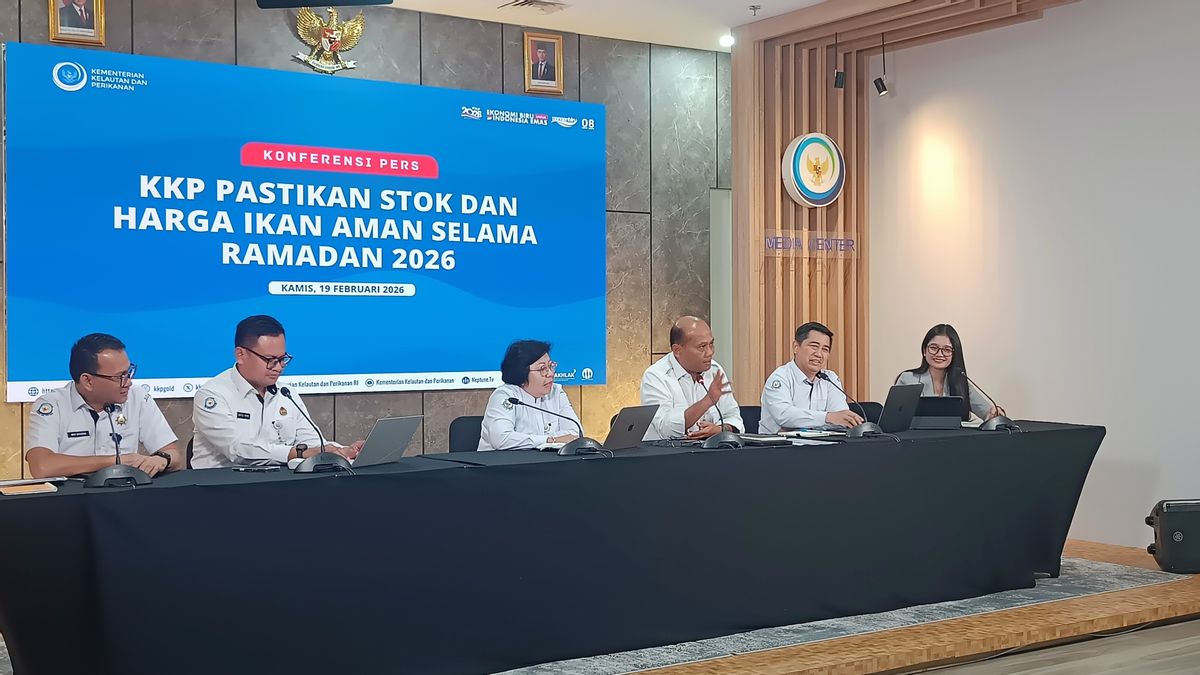


JAKARTA - The Ministry of Maritime Affairs and Fisheries (KKP) ensures that fish prices will not increase significantly during the 2026 Ramadan and Lebaran. The increase that occurs is also likely to be minimal so that prices are stable.
Director General of Aquaculture Fisheries of the Ministry of Marine Affairs and Fisheries, Tb Haeru Rahayu, said that fish prices tend to be stable, including its influence on inflation from fish commodities.
"In terms of price estimates, it seems that we don't need to worry about inflation. Why? In this data, it has been answered, the price increase is only around 0.25 to 1.39 percent," said Tebe in a press conference at the KKP office, Jakarta, Thursday, February 19.
Based on the exposure material, the largest price increase in catfish was an increase of 1.39 percent, ranging from Rp. 24,461 to Rp. 24,859 per kilogram. Meanwhile, the lowest increase was in the bandeng fish with 0.24 percent or a range of Rp. 24,185 to Rp. 24,552 per kilogram.
Tebe also noted the price trend of fish during January. February and March 2026. February-March 2026 was the period of implementation of Ramadan and Lebaran 2026. During these two months, it was observed that the price trend of fish was still tending to be stable.
Lobster is one of the most expensive fishery commodities, estimated at Rp380,571 per kilogram and grouper fish worth Rp110,638 per kilogram.
"God willing, the stock of the results of cultivation will be stable and can meet the needs in the fasting month until the upcoming Eid," he said.
Meanwhile, the Head of the KKP Marine and Fishery Product Quality Control and Supervision Agency, Ishartini, said that his party had carried out quality supervision at a number of locations.
Among others, in cultivation centers, fishing ports, fish landing sites, suppliers to modern markets spread across Indonesia.
The activities carried out include socialization of post-harvest fishing/catching, certification and surveillance of fisheries, quality testing of fish dismantling to sampling of free contamination test.
"From the results that were carried out yesterday in several technical implementation units (UPT), this quality monitoring is carried out at fish processing sites, modern markets, traditional markets, taking samples and testing fresh fish. Then, the results show that the fish are sold there in a safe condition to be consumed," he explained.
The English, Chinese, Japanese, Arabic, and French versions are automatically generated by the AI. So there may still be inaccuracies in translating, please always see Indonesian as our main language. (system supported by DigitalSiber.id)


