

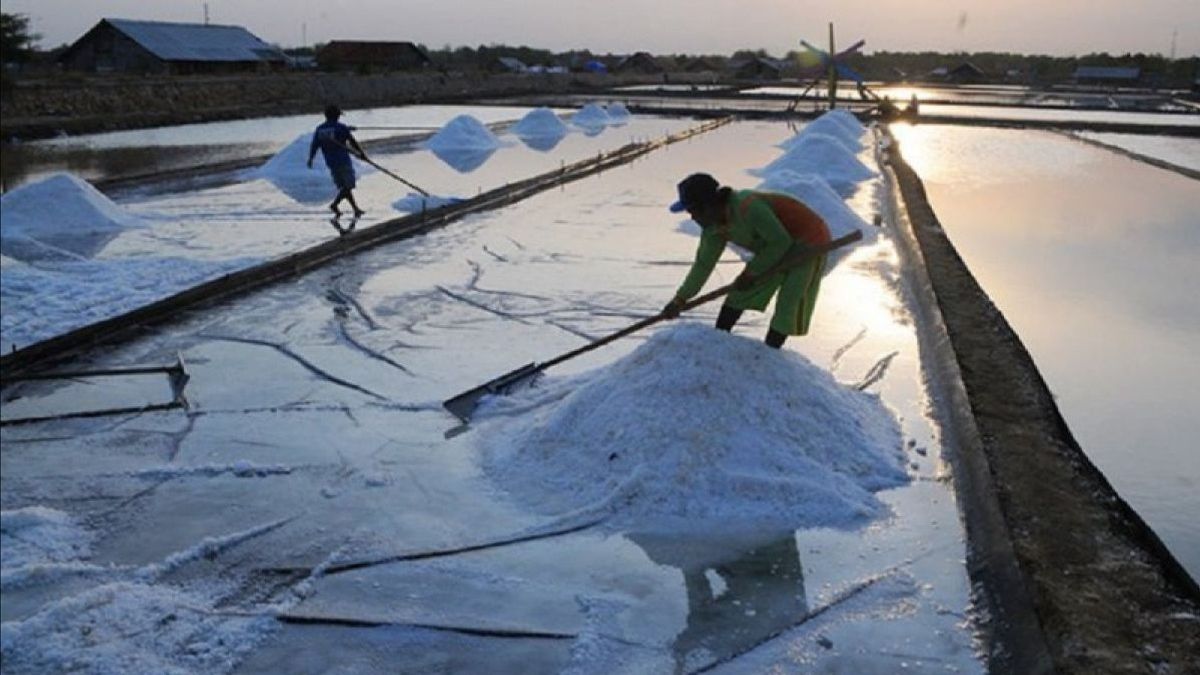


JAKARTA - The Ministry of Maritime Affairs and Fisheries (KKP) revealed that the high national salt prices were influenced by logistical constraints and distribution was not optimal, especially in the salt pond center area.
Director of Marine Resources of the Directorate General of Marine Management of the KKP, Frista Yorhanita, said that inadequate distribution channels were one of the main factors that made the price of salt at the consumer level still relatively high.
This was conveyed by Frista in the Talkshow Bincang Bahari entitled Salt Processing for Independent Indonesia: Challenges and Opportunities for National Industry at the KKP office, Jakarta, Thursday, February 12.
"Including those who make the price of salt high, one of them is that the distribution channel is not good. We have to work with friends in the Ministry of PU, the Ministry of Transportation to build a port," said Frista.
From the policy side, Frista assessed that strengthening the salt sector, from pre-production, production to processing requires collaboration across ministries and agencies. According to him, the Ministry of Marine Affairs and Fisheries cannot work alone, especially in improving supporting infrastructure in the national salt pond area.
Therefore, he said, there was a need for coordination with the Ministry of PU and the Ministry of Transportation for road repairs and port development, considering that logistics infrastructure plays a major role in determining the price of salt.
In addition, the Ministry of Agrarian Affairs and Spatial Planning also collaborates with the Ministry of State Secretariat for regulatory escort and Bappenas and the Coordinating Ministry (Kemenko) for Food to ensure that the salt self-sufficiency program is integrated with other ministerial policies.
"Including later at the Ministry of Trade and the Ministry of Industry because the salt users I just said, besides for consumption, the majority is industry," he said.
Frista assessed that KKP has not only focused on the development of salt processing technology, but also strengthened the upstream, namely the people's salt farmers through the improvement of channels, so that the quality of raw water to the ponds is better and the provision of various processing facilities.
Not only that, the KKP also built salt storage facilities to maintain the quality of farmers' production.
Even so, Frista emphasized that the development of salt technology requires large investments and cannot be fully supported by the state's revenue and expenditure budget (APBN).
"KKP is not possible alone, especially for the development of technology that needs capital or trillions of capex, it is impossible to do it all by the state budget, that's why we are cooperating with PT Garam," he added.
The English, Chinese, Japanese, Arabic, and French versions are automatically generated by the AI. So there may still be inaccuracies in translating, please always see Indonesian as our main language. (system supported by DigitalSiber.id)


