

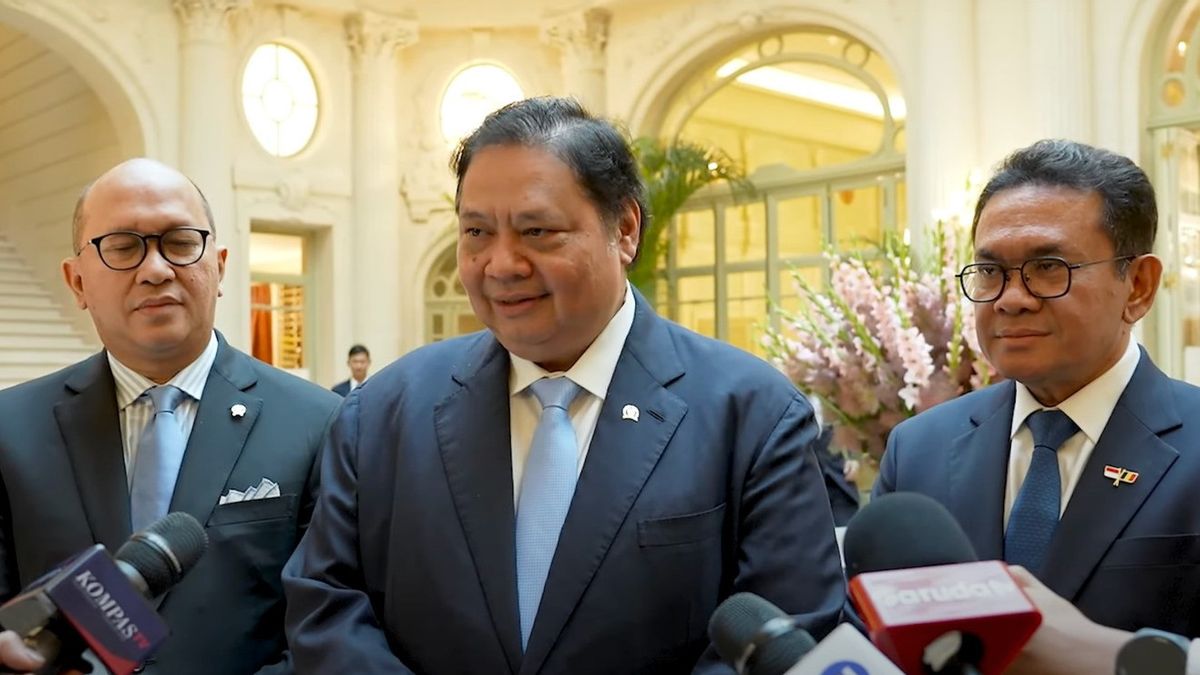


JAKARTA - The government has reaffirmed its commitment to encourage sustainable national economic growth through strengthening the industrial sector, utilizing advanced technology, and improving the quality of human resources (HR).
Coordinating Minister for the Economy of the Republic of Indonesia Airlangga Hartarto conveyed that the development approach was designed to ensure macroeconomic stability, while improving Indonesia's competitiveness in the midst of increasingly complex global dynamics.
"I will talk a little about how to manage the economy in a machine way. During the Covid handling, the policy that was pushed was the gas and the brake. Well, it's very technical, but it's delivered nationally. Now we are talking about three engines of economic growth, and the approach remains the same, how to manage acceleration without sacrificing stability," he said in his statement, quoted Sunday, February 8.
Airlangga conveyed that the President of the Republic of Indonesia, Prabowo Subianto, targeted higher economic growth in the next few years.
He added that the target was sought through strengthening the main driving sectors, especially the manufacturing industry, energy and future technology, as well as construction, which have been the backbone of the national economy and have a close relationship with the development of research and human resource excellence.
The national economic performance until the end of 2025 shows a solid trend, namely the economic growth in the fourth quarter of 2025 was recorded as the highest in the last seven years, with an average growth of around 5 percent.
Macroeconomic stability is also reflected in the maintained inflation at the level of 3.55 percent (yoy), the trade balance which continues to record a surplus in recent years, and foreign exchange reserves which reached around 156 billion US dollars.
He said that within the framework of economic transformation, the Government is carrying out the concept of three engines of economic growth.
Airlangga said the first engine was focused on strengthening the manufacturing industry and labor-intensive industries, such as textiles, footwear, furniture, and the automotive industry, including the development of an electric vehicle ecosystem. The textile industry is considered to remain relevant and sustainable due to the continued increase in global demand, while absorbing millions of domestic workers.
The second machine is directed at building a technology-based and innovative economy through strengthening digitization, artificial intelligence, biotechnology, and semiconductors.
Airlangga conveyed that the government emphasized the importance of investment in research and development (R&D) and strengthening the industrial value chain, so that Indonesia's economic growth would not only depend on natural resources, but increasingly rely on technology and the quality of human resources.
"S-Curve is a lesson in innovation in industrial engineering. So S-Curve is anywhere there must be R&D investment and I encourage the Indonesian economy based on the S-Curve, there is always research and in the future what the goods are that we must be strong," said Airlangga.
Meanwhile, Airlangga said the third engine focuses on increasing the productivity and competitiveness of human resources as the foundation for long-term growth.
He added that the government encourages the strengthening of labor skills, including the preparation of hundreds of thousands of skilled workers, as well as the development of new economic ecosystems such as the gig economy and the creative economy, especially for young people and students.
In addition, Airlangga conveyed that the Government also emphasized the importance of food security as part of national economic stability.
"Efforts to strengthen domestic food production continue through the development of food areas and increasing agricultural productivity, to ensure national food availability in the midst of potential global crises and international supply chain disruptions," he concluded.
The English, Chinese, Japanese, Arabic, and French versions are automatically generated by the AI. So there may still be inaccuracies in translating, please always see Indonesian as our main language. (system supported by DigitalSiber.id)
Popular


