

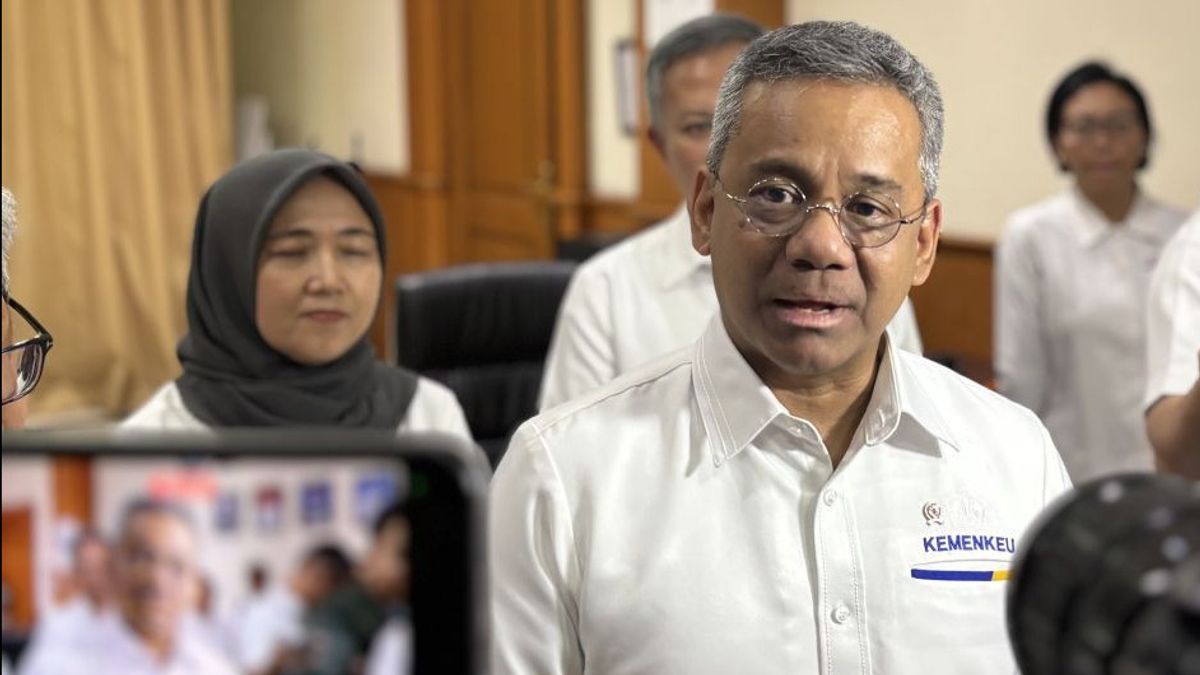


The Ministry of Finance (Kemenkeu) reported that as of December 31, 2025, the realization of central government spending reached Rp. 2,602.3 trillion or around 96.3 percent of the 2025 state budget ceiling which was set at Rp. 2,701.4 trillion.
The achievement comes from the spending of ministries and agencies (K/L) which was realized Rp1,500.4 trillion or 129.3 percent of the state budget target of Rp1,160.1 trillion.
Meanwhile, non-K/L spending was recorded at Rp1,102.0 trillion or 71.5 percent of the ceiling of Rp1,541.4 trillion.
Meanwhile, for the Transfer to the Region (TKD) position, the realization until the end of 2025 reached Rp849.0 trillion or equivalent to 92.3 percent of the state budget target of Rp919.9 trillion.
Thus, the total state expenditure realized until December 2025 reached Rp3,451.4 trillion or around 95.3 percent of the 2025 state budget expenditure target of Rp3,621.3 trillion.
Deputy Minister of Finance Suahasil Nazara explained that the increase in central government spending, especially in the K/L spending position, was influenced by the shift in budget allocation to adjust to government program priorities.
According to Suahasil, some of the shift came from non-K/L spending that was shifted to K/L spending, given that in the non-K/L position there was a reserve budget.
"There are also those who shift the budget, including from non-K/L spending to K/L spending. If non-K/L spending shifts to K/L spending, because in non-KL spending there are usually reserves," he said in a press conference APBN Kita, Thursday, January 8.
He added that the budget reserves were prepared, among others, for disaster handling, namely when a disaster occurs, the reserve funds are then allocated to the relevant ministries or agencies.
"If a disaster occurs, the reserve will be transferred to the ministry and agency budget," he explained.
In terms of quarterly development, Suahasil said that state spending in the first quarter of 2025 grew 14.6 percent year on year (yoy), although nominally it was still relatively low because it was at the beginning of the budget year.
The realization of spending in the first quarter was recorded at around Rp620 trillion and increased significantly to around Rp1,400 trillion in the second quarter, but the growth rate of spending in the second quarter slowed to 0.6 percent year-on-year, one of which was influenced by the budget efficiency policy implemented by the government.
Meanwhile, in the third quarter, state spending reached Rp2,234.8 trillion. Although nominally increased compared to the previous quarter, the realization is still lower than the same period last year.
Furthermore, in the fourth quarter, the government recorded an acceleration in the realization of spending where by the end of the year, state spending cumulatively reached Rp. 3,451.4 trillion with a 3.0 percent (yoy) growth in fourth quarter spending.
"The effect of this spending will later have an effect on economic growth in the fourth quarter which was conveyed by the Minister," he said.
Suahasil reminded that at the beginning of 2025 the government implemented budget efficiency of IDR 306.7 trillion, which includes K/L spending and transfers to regions (TKD), through the budget blocking mechanism.
He added that the policy did not target employee spending, basic operations of ministries and agencies, and social assistance spending.
Suahasil said that as the fiscal year progressed, the government then reopened some of the blockades, namely around Rp. 206.4 trillion was opened to ensure basic operations and social assistance programs continued.
According to him, with the flexibility in shifting the budget, the government is still able to carry out all priority programs, even though the realization of central government spending was recorded at around Rp. 100 trillion lower than the initial ceiling.
In terms of the composition of K/L spending, Suahasil noted that goods spending grew 8.3 percent compared to 2024 and this growth reflected the role of the state budget as a stimulus for the economy, especially through spending on domestic production goods.
The spending of these goods, among others, is used for the distribution of School Operational Assistance (BOS), operational education services, biodiesel subsidies, the Free Nutritious Meal (MBG) program, wage subsidy assistance, and various other programs.
Meanwhile, capital expenditure also showed a significant increase where by the end of 2025, the realization of capital expenditure reached IDR 427.5 trillion or grew 20.3 percent compared to the realization in 2024.
The English, Chinese, Japanese, Arabic, and French versions are automatically generated by the AI. So there may still be inaccuracies in translating, please always see Indonesian as our main language. (system supported by DigitalSiber.id)
Most Popular Tags
#Prabowo Subianto #donald trump #Febrie Adriansyah #8791 #giias 2026Popular


