

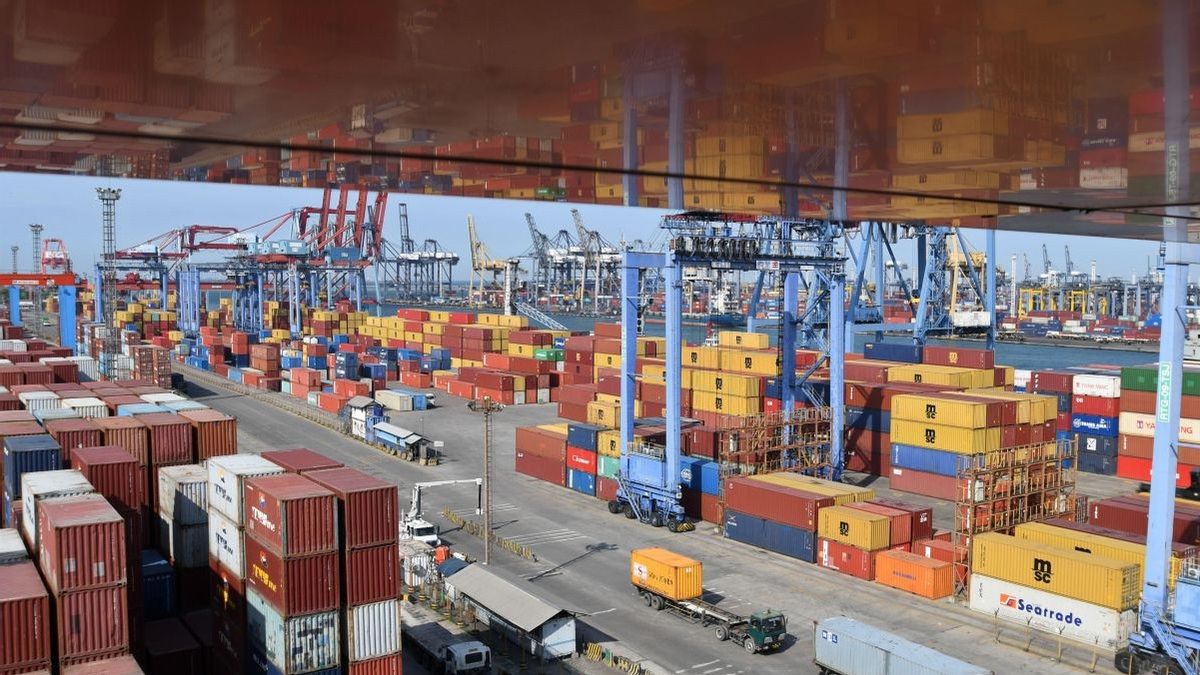


JAKARTA - Indonesia's trade balance in November 2025 again recorded a surplus of US$ 2.66 billion. This achievement extends the trend of Indonesia's trade balance surplus for 67 consecutive months since May 2020.
The November 2025 surplus is much higher compared to the surplus recorded in October 2025 which was recorded at US$ 2.39 billion.
Trade Minister Budi Santoso said the trade balance surplus in November 2025 was mainly supported by the positive performance of the non-oil and gas (non-migas) sector which recorded a surplus of US$4.64 billion.
Meanwhile, Budi continued, the trade balance of oil and gas (migas) still experienced a deficit of 1.98 billion US dollars.
"The trade balance achievement in November 2025 continued the trend of surplus for 67 consecutive months since May 2020. The non-oil and gas trade balance recorded a surplus of US$ 4.64 billion, while the oil and gas balance recorded a deficit of US$ 1.98 billion," Budi said in an official statement, Tuesday, January 6.
Cumulatively, Indonesia's trade balance from January to November 2025 recorded a surplus of 38.54 billion US dollars. This value increased significantly compared to the same period in 2024 which was recorded at 29.24 billion US dollars.
The surplus was mainly driven by the non-oil and gas sector which recorded a surplus of 56.15 billion US dollars, although it was still overshadowed by the oil and gas deficit of 17.61 billion US dollars.
Budi explained that the cumulative non-oil and gas surplus was largely contributed by trade with a number of major trading partners. The United States was the largest contributor with a surplus of 19.21 billion US dollars, followed by India at 12.16 billion US dollars and the Philippines at 7.72 billion US dollars.
In terms of exports, in November 2025, Indonesia's export value was recorded at US$ 22.52 billion or down 7.08 percent compared to October 2025 on a monthly basis. The decline was triggered by a weakening of non-oil and gas exports by 7.30 percent and oil and gas exports by 1.25 percent.
However, cumulatively from January to November 2025, Indonesia's total exports reached 256.56 billion US dollars or grew 5.61 percent compared to the same period last year. This growth is mainly supported by non-oil and gas exports which increased 7.07 percent to 244.75 billion US dollars.
"The three main non-oil and gas commodities with the highest export growth in January-November 2025 are aluminum and its products (HS 76) which increased by 57.69 percent; various chemical products (HS 38) increased by 48.02 percent; and cocoa and its processed products (HS 18) increased by 44.06 percent (CtC)," he said.
Based on the export structure, the processing industry sector still dominates with a contribution of 80.27 percent, followed by the mining and other sectors of 12.65 percent, oil and gas of 4.60 percent, and agriculture of 2.48 percent. Cumulatively, agricultural exports recorded the highest growth of 24.63 percent, followed by the processing industry which grew 14.00 percent.
Meanwhile, Indonesia's import performance in November 2025 was recorded at US$ 19.86 billion or down 9.09 percent compared to October 2025. The import value consists of non-energy imports of US$ 17.00 billion and energy imports of US$ 2.86 billion.
Cumulatively from January to November 2025, Indonesia's imports reached 218.02 billion US dollars or grew 2.03 percent compared to the same period last year. The growth in imports was mainly contributed by non-energy imports which increased by 4.37 percent to 188.61 billion US dollars.
In the import structure, raw materials or auxiliaries still dominate with a share of 70.27 percent, followed by capital goods at 20.55 percent and consumer goods at 9.18 percent. Budi assessed the increase in imports of capital goods reflected investment activities and strengthening of national production capacity.
"The increase in capital goods imports which reached 18.54 percent was also caused by the increase in imports of CPUs, smart phones, non-CKD electric cars, and base stations," said Budi.
Furthermore, imports of raw materials or auxiliary products with the deepest decline in January-November 2025, namely fuel oil, cane sugar, soybeans, feed for livestock, and polypropylene. On the other hand, imports of consumer goods fell mainly for air conditioning control machines, garlic, electric cars (CKD), non-dairy creamer, and medicines.
The English, Chinese, Japanese, Arabic, and French versions are automatically generated by the AI. So there may still be inaccuracies in translating, please always see Indonesian as our main language. (system supported by DigitalSiber.id)
Popular


