



JAKARTA - The government targets Indonesia to be free of imported consumer sugar by 2026 as domestic production is projected to reach 3 million tons.
This target is in line with President Prabowo Subianto's vision of food self-sufficiency, which is now being implemented concretely.
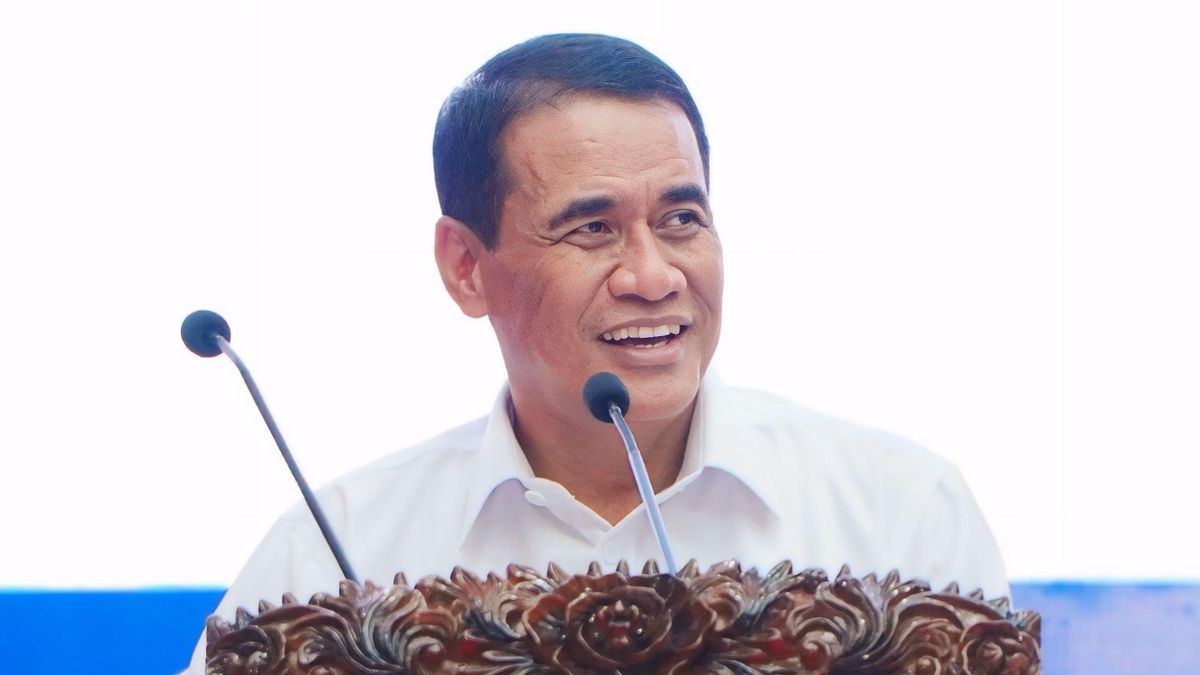
The Head of the National Food Agency (Bapanas) and Minister of Agriculture Andi Amran Sulaiman said that East Java Province is the key to achieving national sugar self-sufficiency.
From the target of expanding the national sugar cane area of 100,000 hectares, as much as 70,000 hectares of which are in East Java.
"We first appreciate the Governor of East Java. The Governor is extraordinary. We appreciate it on behalf of the central government. East Java agriculture during his leadership has always been in the top three positions. This is what we appreciate," he said in an official statement, Tuesday, December 23.
Amran is optimistic that Indonesia will no longer need to import white sugar next year.
The production of national consumption sugar is currently at 2.68 million tons.
"If East Java succeeds, national sugar, God willing, next year will not import white sugar, white sugar. Next year we can stop importing white sugar. Now the production is 2.68 million tons. Next year, God willing, we can consume 3 million tons of sugar," said Amran.
Based on the Food Balance Projection, the end-of-year stock of consumer sugar in 2025 is estimated to reach 1.437 million tons.
This amount is equivalent to almost six months of consumption needs in 2026. Throughout 2025, national consumption sugar production was recorded at 2.668 million tons.
Meanwhile, the consumption sugar demand in 2026 is estimated to reach 2.836 million tons.
With the carry over stock from 2025 of 1.437 million tons, the additional requirement is only around 1.399 million tons.
Meanwhile, if the production target is 3 million tons, the national consumption sugar balance is projected to be in surplus.
"The target for sugar cane land is 70 thousand hectares throughout East Java. The whole of Indonesia is 100 thousand hectares. As much as 70 percent is in East Java. Other areas are Lampung, South Sulawesi, North Sumatra, and Central Java," said Amran.
To accelerate the realization of this target, the government involves various parties, including the TNI, Polri, and the Prosecutor's Office, in securing and assisting the expansion of the sugar cane land program.
"Insyaallah dibantu dengan TNI, Polri, Kejaksaan. Nanti ada hasilnya kita butuh 35.000 hektare, tapi cadangan tadi ada 68.000 hektare. Insya Allah bisa jadi. Ini kita kerjakan sekarang, nanti kita kerjakan lagi, dilanjutkan Januari sampai Maret. Targetnya selesai. Anggaran semuanya totalnya itu seluruh Indonesia Rp1,6 triliun," terang Amran.
Regarding the import policy, Amran explained that the government would still procure raw sugar or raw crystal sugar in early 2025 to anticipate price fluctuations, especially ahead of National Religious Holidays such as Ramadan and Eid al-Fitr.
The procurement is also aimed at strengthening the Government Food Reserve (CPP) stock in SOEs.
However, Amran emphasized that the import of 190,000 tons of raw sugar equivalent to white crystal sugar by ID FOOD did not harm domestic sugarcane farmers because it was carried out outside the harvest period.
"This is because the procurement was not carried out during the harvest," he said.
The English, Chinese, Japanese, Arabic, and French versions are automatically generated by the AI. So there may still be inaccuracies in translating, please always see Indonesian as our main language. (system supported by DigitalSiber.id)
Most Popular Tags
#Prabowo Subianto #donald trump #firearm #8791 #giias 2026Popular


