

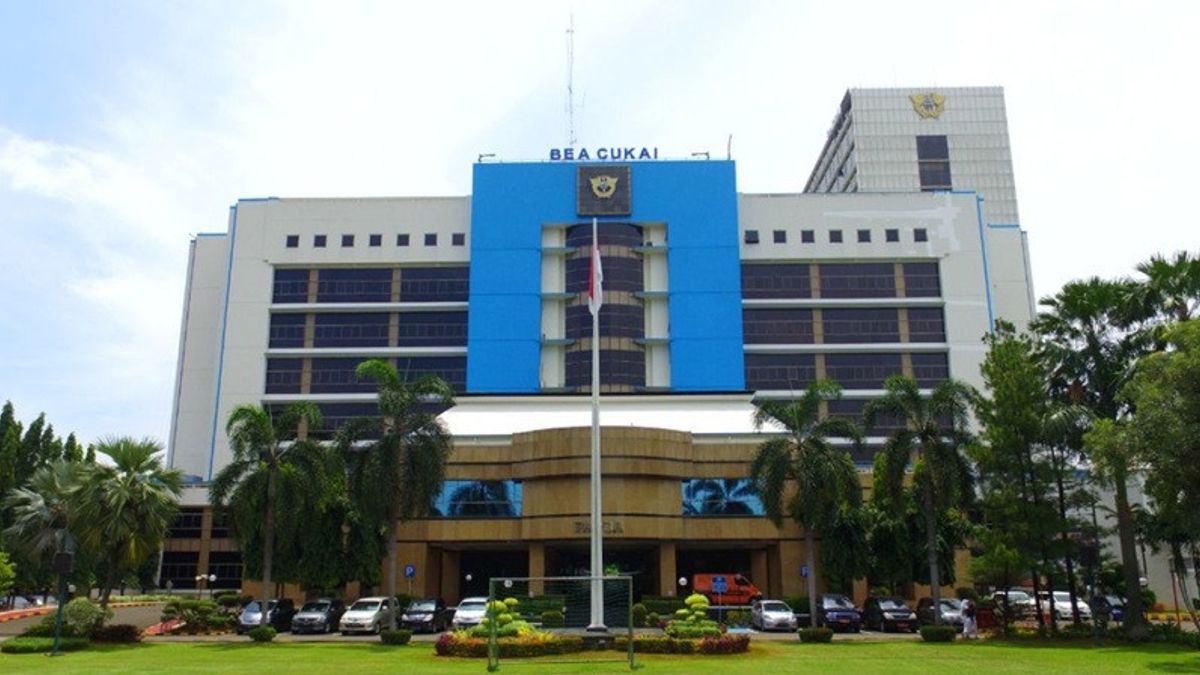


JAKARTA - The Directorate General of Customs and Excise (DJBC) continues to carry out organizational improvements as an effort to strengthen the supervision function and supervision support in the field of customs and excise.
Head of the Customs Public Relations and Guidance Subdirectorate, Budi Prasetiyo, said that one of the strategic steps taken was the restructuring of two technical implementation units, namely the Customs Laboratory Center (BLBC) and the Operational Equipment Base (PSO).
This policy was determined through the Minister of Finance Regulation (PMK) Number 121 of 2024 concerning the Organization and Implementation of BLBC and PMK Number 132 of 2024 concerning the Organization and Implementation of PSO Customs.
Budi explained that the arrangement was made in response to the growing challenges of supervision, which include the increasing complexity of the flow of goods, the various modes of customs and tax violations, and the need to strengthen synergy with other law enforcement agencies.
According to him, the arrangement of technical units is part of the Customs' ongoing efforts to ensure that the surveillance function runs optimally.
"The arrangement of BLBC and PSO is carried out so that supervisory support is more structured, effective, and able to respond to the changing dynamics of risk," he said in a statement, Monday, December 22.
In the laboratory sector, PMK 121 Year 2024 stipulates the upgrading of the Medan BLBC and Surabaya BLBC classes from class II to class I.
In addition, a Customs Laboratory Service Unit was formed which was tasked with carrying out some of the functions of testing and identifying goods in a laboratory in the respective work areas of the BLBC.
Budi said that this arrangement aims to improve the quality of testing and identification of goods to support supervision, law enforcement, services, and the provision of facilities in the fields of customs and taxes.
"This is an important foundation in making decisions on supervision based on scientific data, as well as strengthening the role of BLBC as a backbone of support for customs and tax supervision," he added.
Meanwhile, the PSO Customs as the technical implementation unit of maritime supervision also experienced significant adjustments in line with the implementation of PMK Number 132 of 2024, namely the adjustments include office locations, scope of operations, and PSO organizational structure.
He added that this step was taken based on the results of an evaluation which showed that a number of PSOs that existed previously, such as in Tanjung Balai Karimun, Batam, Tanjung Priok, Pantoloan, and Sorong, were no longer fully in line with the development of internal and external conditions.
Internally, Budi said that problems such as the location of the office which is less strategic, the imbalance of the operational area, and the management of marine surveillance assets affect operational effectiveness.
Meanwhile, from the external side, there is a shift in the smuggling-prone area, one of which is in the Lhokseumawe area which has been identified as a route for the entry of Narcotics, Psychotropic Substances, and Precursors (NPP) from the Middle East and Southeast Asia regions.
In addition, he said that strengthening cooperation in maritime surveillance with other law enforcement agencies requires a more integrated PSO arrangement.
According to him, through the addition and relocation of PSO and sub-PSO, the Customs Service targets an increase in response speed at sea, operational cost efficiency, and clarity of command flow in patrol implementation.
"This arrangement is expected to avoid double command, while ensuring that each sea surveillance asset can be optimally utilized according to the operating area and its level of risk," he said.
Budi added that the adjustment of PSO not only impacts operational performance, but also strengthens protection for the community.
"With the arrangement of PSO, the response of maritime surveillance can be carried out faster and more coordinated. This is part of the Customs' efforts to strengthen its role as a community protector in protecting Indonesian waters from various forms of customs and tax violations," he explained.
According to the provisions of Article 26 of the PMK 121 of 2024 and PMK 132 of 2024, the formation, appointment, and inauguration of officials in the BLBC and PSO environment shall be carried out no later than one year after the PMK was enacted, namely until the end of December 2025.
In line with these provisions, on December 11, 2025, the inauguration of BLBC officials and the inauguration of the Jakarta Class I BLBC Building were carried out, followed by the inauguration and inauguration of officials at the PSO technical unit on December 19, 2025.
Budi said that through the arrangement of this technical unit, the Customs hoped that all employees and stakeholders could fully understand the changes in the organizational structure, roles, business processes, and work patterns of BLBC and PSO.
"This transformation is part of the Customs' commitment to continue to improve, increase the quality of customs and tax supervision, and provide increasingly optimal protection for the community and the country," he concluded.
The English, Chinese, Japanese, Arabic, and French versions are automatically generated by the AI. So there may still be inaccuracies in translating, please always see Indonesian as our main language. (system supported by DigitalSiber.id)
Most Popular Tags
#Prabowo Subianto #donald trump #Febrie Adriansyah #8791 #giias 2026Popular


