

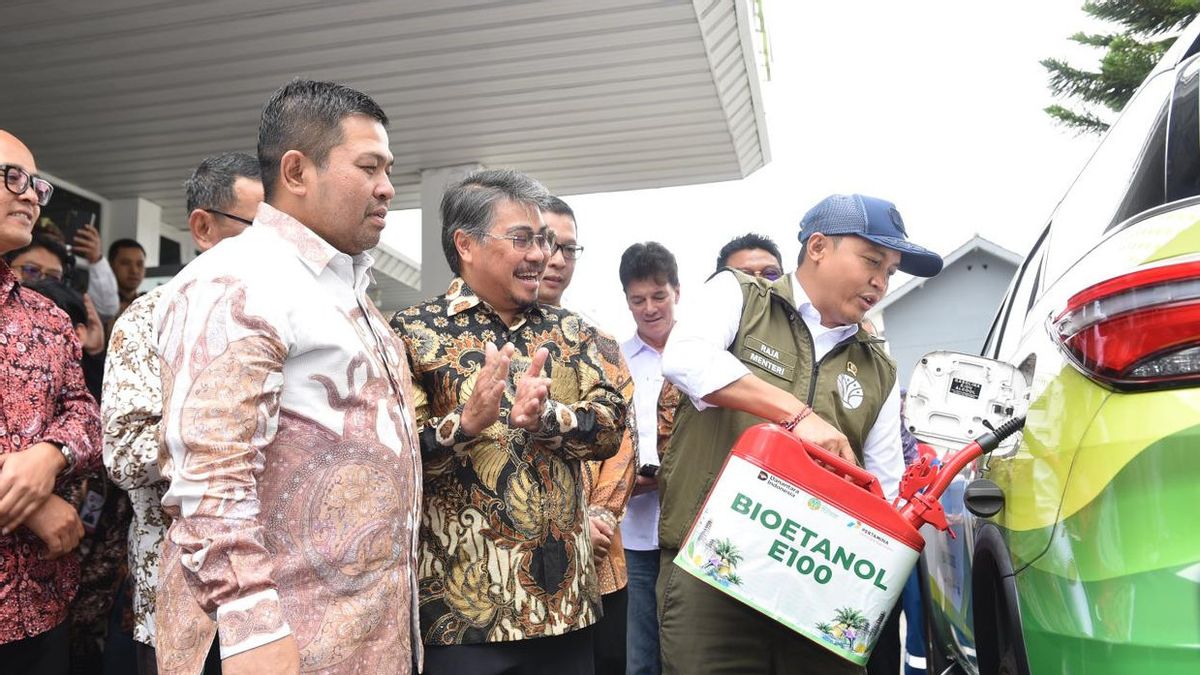


JAKARTA - Pertamina NRE initiated a pilot project (pilot project) for the development of Indonesian-based bioethanol in Kamojang, Garut. The project was officially launched by the Minister of Forestry, Raja Juli Antoni on Wednesday 19 November.
This innovation utilizes nira ISN as raw material, with a production capacity of around 300 liters of bioethenol per day and 300 - 500 kilograms of sugar aren per day. The Nira ISN used comes from the ISN forest managed by the New Bojong Social Forestry Business Group (KUPS), Bojong Village, Garut.
This pilot project is driven by the Ministry of Forestry by forming a working team to accelerate the development of ISN in supporting food and national energy self-sufficiency through the Decree of the Minister of Forestry of the Republic of Indonesia number 440 of 2025.
In an uncertain geopolitical situation, each country will ultimately prioritize its respective domestic interests even though it has to sacrifice other countries, including the need for energy in the country. For this reason, we really need to explore the potential of domestic energy sources, one of which is the raw material for biofuel (BBN). Indonesia has great potential to be developed into BBN," said Raja Juli in a statement to the media, Saturday, November 22.
Raja Juli added that theoretically for 1 hectare of land, we are able to produce 24,000 ethanol per year. Meanwhile, Indonesia has around 125 million hectares that have the potential to be worked on as plantations, so that it has the potential to save the cost of importing fuel oil (BBM).
He hopes that this project can create new economic opportunities for the surrounding community, especially local farmers, and potentially expand in areas that have potential for ISN. Based on information released by the Indonesian Ministry of Forestry, the government plans to plant people on an area of 1.2 million hectares, with a potential for bioethanol 28.8 million kiloliters per year.
SEE ALSO:
-
 | EKONOMI
KPPU: Persaingan Usaha secara Adil jadi Syarat Pertumbuhan Ekonomi Berkualitas
22 November 2025, 09:44 -
 | EKONOMI
Industri Otomotif Catat Kenaikan Produksi dan Ekspor Sepanjang 2025
22 November 2025, 09:34

He added that the development of ISN as a raw material for bioethanol has a number of benefits for the community and the environment, including: supporting the local economy and opening up new jobs; the use of marginal land because ISN can grow on less productive land; reduce dependence on fossil energy and reduce fossil fuel imports; and contribute to reducing emissions through its utilization of BBN.
This pilot project is one of Pertamina's innovations. For the development of bioethanol, Pertamina conducts research on various kinds of plants to become raw materials, one of which is ISN. Aren is one of the plants that has great potential to be cultivated on a large scale in Indonesia," said Pertamina NRE CEO John Ani.
John added that Indonesia has the potential for energy plants that are large enough to be developed into fuel raw materials. With strong support from the government, energy self-reliance or self-sufficiency through the use of local plants can be realized. In this pilot project, Pertamina NRE collaborates with the National Research and Innovation Agency (BRIN).
Furthermore, John also emphasized that the development of palm-based bioethanol is part of PNRE's strategy in developing multifeedstock bioethanol. In parallel, Pertamina NRE is also developing sugarcane bioethanol, sorghum, cassava, corn, and agricultural waste such as palm waste, cane bagase, sorghum stems, and rice straw.
The English, Chinese, Japanese, Arabic, and French versions are automatically generated by the AI. So there may still be inaccuracies in translating, please always see Indonesian as our main language. (system supported by DigitalSiber.id)
Popular


