

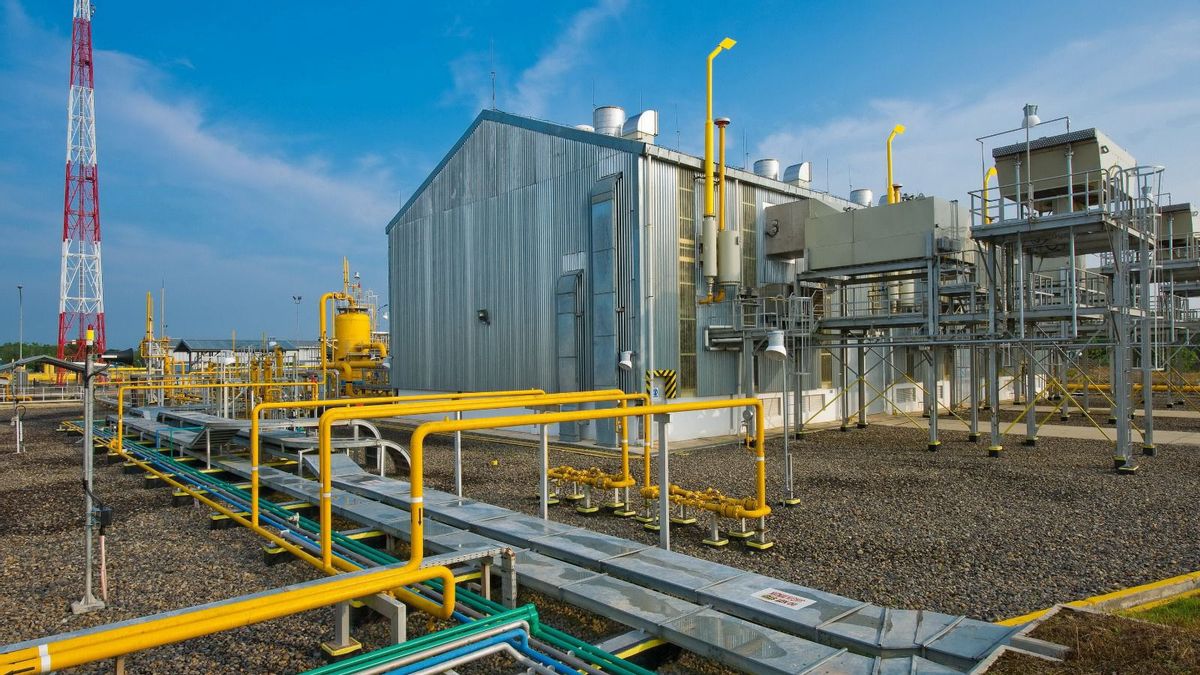


JAKARTA - PT Perusahaan Gas Negara Tbk (PGN) has begun to build an injection point in Pagardewa, South Sumatra, as part of the initiative to develop a biomethane strategic project.
For information, the injection point in Pagardewa is the point where biomethane is 'injected' into the natural gas network, so that biomethane can be used the same as natural gas for households, industry, retail to land transportation, and can be accessed widely according to the range of the gas network that is already operating.
PGN President Director Arief Kurnia Risdianto explained, Injection Point at Pagardewa consists of a Presure Reducing System (PRS) which can also be used as an injection point for other sources of supply, such as coalbed methane (CBM), stranded gas and other sources of supply. Meanwhile, PGN plans to provide Biomethane with a volume ranging from 1.2 BBTUD through the Pagardewa Injection Point.
"The Biomethane project will expand the PGN portfolio in the renewable energy sector by providing products for decarbonization. In addition, it will open up opportunities for PGN to get new income," he said, Thursday, November 6.
In the biomethane project, he continued, PGN utilizes waste from the palm oil mill or Palm Oil Mill Effluent (POME) to produce biogas. Through further processes, biogas will be processed into biomethane and compressed into renewable natural gas so that it can be injected into natural gas infrastructure.
"After being injected, biomethane can be used as renewable energy whose characteristics are similar to natural gas for distribution to various customer sectors," he explained.
According to him, the Biomethane Project was initiated based on Indonesia's potential to produce biomethane from palm oil mill waste. Biomethane is a modern solution in organic waste management to renewable energy.
He added that proper waste management is very important, because if waste is not processed optimally, it can cause environmental pollution and contribute to global warming.
This project has the potential to contribute to reducing GRK emissions by 29,688 tons-CO2e/year (fuel conversion) and 204,867 tons-CO2e/year (methane capture from POME).
SEE ALSO:
-
 | EKONOMI
Ekonomi Indonesia di 2025 Diperkirakan Masih di Level Rata-rata 10 Tahun Terakhir
06 November 2025, 09:45


Apalagi, kata di, di Pulau Sumatera terdapat banyak pabrik pengolahan minyak kelapa sawit dan PGN telah memiliki jaringan infrastruktur gas bumi eksisting di wilayah tersebut, dalam hal ini Pipa Transmisi SSWJ dan Stasiun Kompresor Gas Pagardewa.
"Sehingga PGN mengupayakan untuk pengembangan biomethane. Kehadiran biomethane diharapkan dapat menjadi langkah inovatif dalam rangka meningkatkan ketersediaan energi yang ramah lingkungan dan energi terbarukan untuk masyarakat,” tandas Arief.
SEE ALSO:
-
| EKONOMI
Ekonomi Indonesia di 2025 Diperkirakan Masih di Level Rata-rata 10 Tahun Terakhir
06 November 2025, 09:45
Moreover, said di, di Pulau Sumatra terdapat banyak pabrik pengolahan minyak sawit dan PGN telah memiliki jaringan infrastruktur gas bumi asisting di wilayah tersebut, dalam hal ini Pipa Transmission SSWJ dan Stasiun Kompresor Gas Pagardewa.
"So PGN seeks to develop biomethane. The presence of biomethane is expected to be an innovative step in order to increase the availability of environmentally friendly energy and renewable energy for the community," said Arief.
The English, Chinese, Japanese, Arabic, and French versions are automatically generated by the AI. So there may still be inaccuracies in translating, please always see Indonesian as our main language. (system supported by DigitalSiber.id)


