

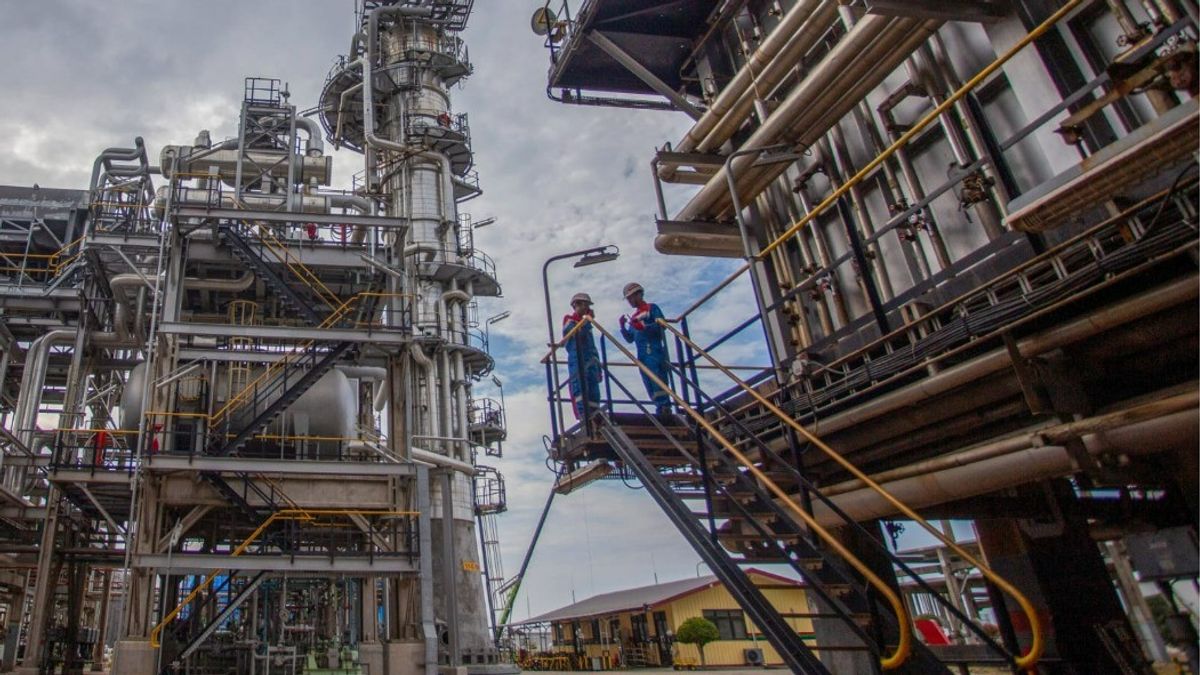


JAKARTA - Pertamina International Refinery (KPI) reported, in the period 2019 to 2024, Pertamina and KPI have completed at least 11 projects within the strategic refinery environment.
Pjs. KPI Corporate Secretary, Milla Suciyani said, this project is spread across five locations, namely Cilacap Refinery, Balongan Refinery, Balikpapan Refinery, Dumai Refinery and PT Trans-Pacific Petrochemical Indotama (TPPI) Refinery in Tuban.
These projects are KPI steps that have been planned and continue to be implemented to answer challenges in the national oil and gas industry. KPI must be able to present fuel products for the community by increasing production capacity, carrying out operational efficiency and transitions to cleaner and environmentally friendly energy," said Milla, Tuesday, October 7.
Milla continued, the 11 projects began at the Cilacap Refinery with the completion of two projects, namely the Blue Sky Cilacap which operated in August 2019. This project succeeded in increasing the production of Gasoline RON 92 from 23,000 barrels per day to 53,000 barrels per day.
This project also succeeded in improving the quality of fuel generated from the equivalent of Euro 2 to the equivalent of Euro 5.
Still at the Cilacap Refinery, Milla continued, in February 2022 the operation of the Green Refinery Cilacap Phase 1, which marks the first step for KPI in processing biofuel based on plant-based raw materials.
Milla revealed that this project produces Hydrotreated Vegetable Oil (HVO) and with a capacity of 3 kbpd by processing RBDPO (Refined Bleached Deodorirized Palm Oil - refined palm oil).
The refinery also produces Sustainable Aviation Fuel (SAF) or aircraft fuel by processing RBDPKO (Refined Bleached Deodorirized Palm Kernel Oil - refined palm oil) and crude oil, with a 9 kbpd co-processing method.
"Green Refinery Cilacap is an important step for KPI in responding to the challenges of the energy transition. From this unit, KPI is able to produce gasoil which is 100 percent of the vegetable known from Pertamina RD. In addition, this unit is also able to produce fuel for PertaminaSAF's future aircraft," explained Milla.
He added that the Balongan Refinery, which is an important support for the energy needs of the Capital City, also did not escape the development carried out by KPI. The Balongan Refinery is also the location with the most intensive activity in 2022.
Two onstream projects in May 2022, namely the Ultra Low Sulfur Diesel (ULSD) project with a production capacity of 15,000 barrels per day, with a maximum sulfur quality of 10 ppm. Then the Residual Catalytic Cracking (RCC) Revitalization project with a production capacity of 63,000 barrels per day increased to 83,000 barrels per day.
RCC itself is a unit capable of converting residuals and producing high-value products such as LPG, propylene, and polygasoline, which supports the national petrochemical sector.
Meanwhile, in June 2022, KPI was able to increase its crude oil processing capacity from 125,000 barrels per day to 150,000 barrels per day.
"Another important step at the Balongan Refinery is to increase operational efficiency through the use of natural gas. In addition to operational efficiency, this natural gas use program is in line with the decarbonization program," said Milla.
In Sumatra, the Dumai Refinery Platform 1 project will start operating in December 2022. This step is part of KPI's efforts to improve the quality and quantity of fuel production at Dumai Refinery.
With this project, the production capacity of the Platform unit at the Dumai refinery increased to 14,000 barrels per day.
The quality of the products produced also increased from RON 92 to RON 95.
On the north coast of East Java, the Tuban TPPI Refinery runs two KPI strategic projects, namely Revamp OSBL and Revamp ISBL which will be on-stream in February 2024.
The project refers to the two main parts of the refinery facility improvement project, particularly in the Aromatic Revamping project which aims to increase petrochemical production capacity such as paraxylene and benzene.
In Kalimantan, three KPI strategic projects that are part of the Great Balikpapan RDMP project have been completed, namely the Balikpapan Seinpah Pipe which was onstream in December 2023, the Balikpapan CDU which was onstream revamp in July 2024 and the Lawe-Lawe Central Crude Oil Terminal (CCOT) which was onstream in December 2024.
The Balikpapan RDMP project itself aims to increase refinery processing capacity, which was originally 260,000 barrels per day to 360,000 barrels per day and also improve product quality from the equivalent of Euro 2 to the equivalent of Euro 5.
Milla explained that the Seinpah Pipe project was created to support the supply of clean energy from Senipah to the Balikpapan Refinery which is 78 kilometers away.
The gas is channeled through a 20-inch diameter pipe, with a flow capacity of 125 Million Standard Cubic Feet per Day (MMSCFD).
Meanwhile, the construction of 2 tank units in Lawe-Lawe will increase crude oil inventory capacity to support the operations of the Balikpapan Refinery.
If accumulated, the 11 strategic refinery projects provide a number of positive impacts, including an increase in processing capacity of 125,000 barrels per day, an increase in fuel production by 3.5 million kiloliters per year, production by Biofuel HVO and SAF reaching 174,000 kiloliters per year and an increase in petrochemical production by 180,000 tons per year.
"The 11 strategic projects from 2019 to 2024 are not just energy infrastructure development, but also strategic investment in the future of the Indonesian economy," Milla explained.
Furthermore, in 2025, said Milla, KPI also hopes to make another major contribution in maintaining national energy security. In the fourth quarter of this year, KPI plans to operate the largest Residual Fluid Catalytic Cracking (RFCC) unit in Indonesia.
"Previously, KPI had operated 2 similar units at the Balongan Refinery and Cilacap Refinery. This would be a leap of KPI's ability to produce fuel products not only in quantity but in much better quality," said Milla.
SEE ALSO:
-
 | EKONOMI
Airlangga Ungkap Bank Permata Ukurannya Sudah Saingi Mandiri dan BRI
07 Oktober 2025, 22:04 -
 | EKONOMI
APPSI Soroti TKD, Purbaya Minta Kepala Daerah Perbaiki Tata Kelola Anggaran
07 Oktober 2025, 21:50 -
 | EKONOMI
Menko Cak Imin: Pemerintah Bentuk Satgas untuk Audit Bangunan Ponpes Rawan di RI
07 Oktober 2025, 21:38
Proyek RDMP Balikpapan tidak hanya sekedar berbicara peningkatan kapasitas, namun juga memberikan dampak sosial dan ekonomi yang besar.
Proyek tersebut menyerap tenaga kerja hingga 24 ribu orang dan mendorong peningkatan Tingkat Komponen Dalam Negeri (TKDN) hingga 35 persen.
Sementara kontribusi terhadap Produk Domestik Bruto (PDB) nasional mencapai angka yang fantastis, yakni Rp514 triliun.
"Program-program peningkatan kapasitas yang sudah maupun sedang dilakukan KPI tentunya berhasil karena adanya dukungan pemangku kepentingan. KPI butuh dukungan seluruh pemangku kepentingan," tutup Milla.
SEE ALSO:
-
| EKONOMI
Airlangga Ungkap Bank Permata Ukurannya Sudah Saingi Mandiri dan BRI
07 Oktober 2025, 22:04 -
| EKONOMI
APPSI Soroti TKD, Purbaya Minta Kepala Daerah Perbaiki Tata Kelola Anggaran
07 Oktober 2025, 21:50 -
| EKONOMI
Menko Cak Imin: Pemerintah Bentuk Satgas untuk Audit Bangunan Ponpes Rawan di RI
07 Oktober 2025, 21:38
The Balikpapan RDMP project does not only talk about increasing capacity, but also has a large social and economic impact.
The project absorbs up to 24 thousand workers and encourages an increase in the Domestic Component Level (TKDN) by up to 35 percent.
Meanwhile, the contribution to the national Gross Domestic Product (GDP) reached a fantastic figure, which was IDR 514 trillion.
"Programs to increase capacity that have been and are being carried out by KPI are certainly successful because of the support of stakeholders. KPI needs the support of all stakeholders," concluded Milla.
The English, Chinese, Japanese, Arabic, and French versions are automatically generated by the AI. So there may still be inaccuracies in translating, please always see Indonesian as our main language. (system supported by DigitalSiber.id)


