

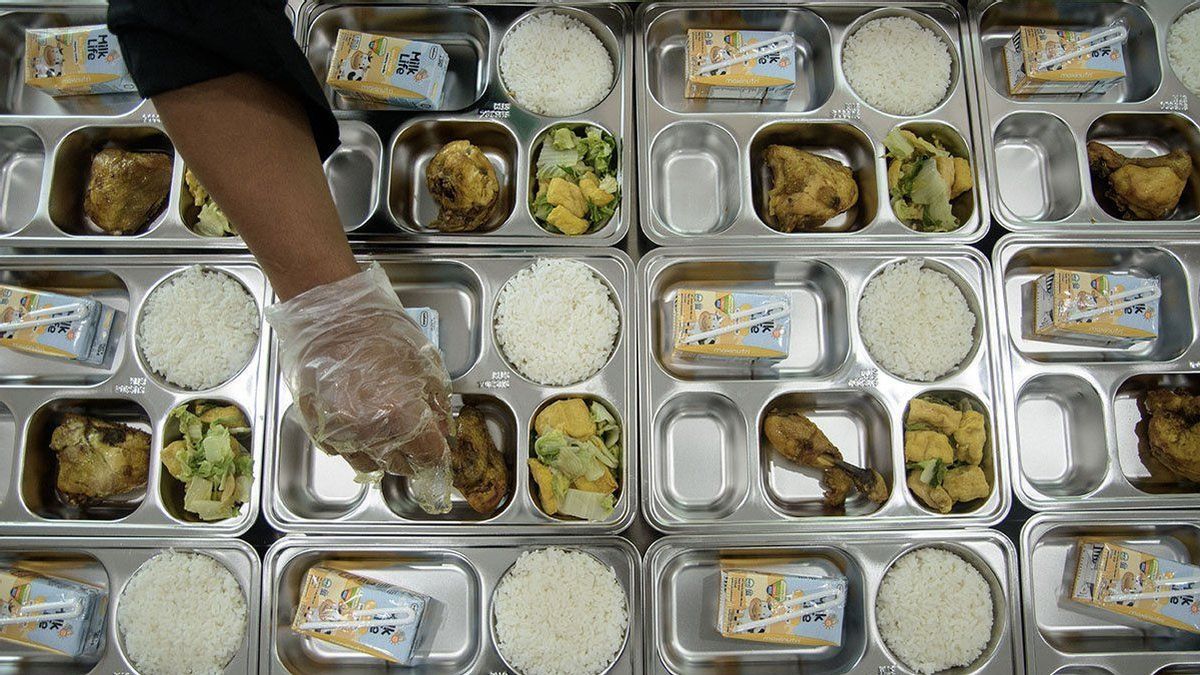


JAKARTA - The Indonesian Economist Alliance (AEI) visited the Coordinating Minister for Economic Affairs Airlangga Hartarto, to convey a request that the Free Nutrition Eating (MBG) program be temporarily suspended.
AEI representative Lili Yan Ing also highlighted the need to stop inappropriate budget allocations, including significantly reducing state spending on populist programs such as the Free Nutrition Food Program (MBG).
According to him, although this program aims to overcome triple burden of malnutrition, namely stunting, obesity, and micro nutritional malnutrition, the government still needs to develop policies based on evidence, taking into account target recipients and implementations that are in accordance with the diversity of local conditions in Indonesia.
He added that the change in the MBG scheme from a universal one to a targeted and targeted program will help improve budget allocation while increasing the effectiveness of the use of public funds.
Lili also revealed that her party was disappointed with the MBG program design which was considered less proportional in terms of budget sharing.
"We express our disappointment that in our opinion the first allocation of MBG is disproportionate," said Lili to the media crew at the Coordinating Ministry for the Economy Office, Monday, September 29.
However, he acknowledged that the MBG program is part of a political promise that has good intentions in improving the quality of children's health and human resources in Indonesia.
However, according to him, there are a number of important things that need to be addressed before this program is widely implemented.
Based on data from the National Socio-Economic Survey (SUSENAS), Lili explained that of the approximately 80 million students, only 1 percent or about 800,000 students claimed to have never eaten, and 4 percent or about 3.5 million students stated that they had a lack of food intake.
He conveyed that from rough calculations, if each student receives assistance of Rp. 10,000 per day for 20 days a month for a full year, the maximum budget required is only around Rp. 8 trillion.
Lili highlighted three important points that the government needs to pay attention to before continuing this program nationally.
First, piloting is carried out in areas that do have high demand, especially those inhabited by lower middle-income people.
SEE ALSO:
-
 | BERITA
Prabowo: MBG Jangkau 30 Juta Anak, Ada Kekurangan-Ada Keracunan Kita Benahi
29 September 2025, 22:15 -
 | KESEHATAN
Marak Siswa Keracunan MBG, Dokter Ungkap Kejadian Berulang Bisa Berakibat Fatal!
29 September 2025, 21:25 -
 | EKONOMI
Menko Airlangga Tegaskan Program MBG Jalan Terus meski Ada Kasus Keracunan
29 September 2025, 21:09
Second, involving various stakeholders, such as parents, teachers, and the community around the school in implementing programs to make them more participatory.
Third, the importance of program evaluation with clear operational procedures, so that transparency and accountability can be maintained.
"That's why we emphasize why there needs to be a dismissal right now because we see that the three things we conveyed were not carried out properly," he explained.
"Don't let there be casualties, life is the future of the nation and the nation. I'm sure we will all be held accountable for the lives of our children's brothers and sisters," he added.
The English, Chinese, Japanese, Arabic, and French versions are automatically generated by the AI. So there may still be inaccuracies in translating, please always see Indonesian as our main language. (system supported by DigitalSiber.id)


