




JAKARTA - The Indonesian Economist Alliance (AEI) also responded to the launch of the 8+4+5 economic policy package issued by the Government.
AEI representative Teuku Riefky said that his party appreciated the initiative as an effort to deal with the slowdown in sectors experiencing difficulties in absorbing labor.
However, he considered that this policy was still temporary and had not yet touched the root of the problem, such as increasing purchasing power in a sustainable manner or creating a truly conducive business climate.
According to him, long-term solutions can only be achieved through structural reforms that can encourage the creation of good quality jobs, increasing decent wages, and eradicating resource misallocation so that competitive sectors can grow healthily.
"For the occurrence of good quality jobs, it is necessary to improve the institution, business climate, and legal certainty, which has not been answered by this stimulus package," he said in his statement, Monday, September 29.
Similarly, AEI Representative Rizki Nauli Siregar also highlighted that several components in the 8+4+5 package have the potential to worsen resource misallocation, especially through an emphasis on Productive Capital Fund Loans (KDMP) which are considered to be able to get rid of organically growing local business actors.
He also noted that programs such as internships are still too small compared to the number of college graduates every year, and have not shown a clear implementation.
"In addition, several other programs have not provided solutions to problems that underlie the problems of inequality and sluggishness of sectors that can create quality jobs such as internship programs that are relatively small compared to the number of graduates of annual universities and the implementation process is not clear," he said.
In addition, he said that the food assistance provided was also considered not accompanied by improvements in food trading procedures, which were essential in realizing national food security.
Representative of AEI Point Anas also added that the government needs to monitor and evaluate the implementation of Government Regulation (PP) Number 28 of 2025, which is part of the deregulation effort.
He emphasized the importance of publication the results of the evaluation so that the impact on the ease of licensing can be known transparently.
"PP 28 of 2025 has also not resolved the problem of illegal levies and other matters outside of licensing which have a massive impact on the high cost economy faced by small, medium and large businesses. The government needs to immediately follow up to improve the business climate in Indonesia," he said.
Overall, AEI reiterated that the various policies and programs currently run by the government have not fully answered the structural challenges facing the community.
SEE ALSO:
-
 | EKONOMI
Indonesia Teken Dua Kesepakatan Ekonomi Strategis dengan Uni Eropa dan Kanada
29 September 2025, 14:53 -
 | EKONOMI
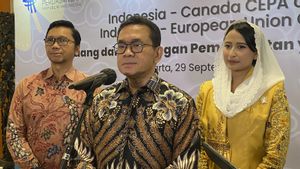
ICA-CEPA Diteken, Mendag Targetkan Perdagangan dengan Kanada Bisa Tembus 7 Miliar Dolar AS
29 September 2025, 14:25
Therefore, AEI re-emphasizes the urgency of serious handling of resource misallocation and the implementation of a country that is free from conflicts of interest, as voiced in the Seven Economic Emergency Pressures.
Here Are Seven Economic Emergency Pressures
Urge 1: thoroughly improve the budget misallocation that occurs and place the budget on policies and programs fairly and proportionally.
Urge 2: Restore independence, transparency, and ensure that there is no intervention based on the interests of certain parties in various state administrator institutions (Bank Indonesia, Central Statistics Agency, House of Representatives, Supreme Court, Constitutional Court, Corruption Eradication Commission, Supreme Audit Agency, Attorney General's Office), and return state administrators to their dignity and functions as they should be.
Urges 3: Stop the dominance of the state which risks weakening local economic activity, including the involvement of Danantara, BUMN, TNI, and Polri as the dominant organizers so as to make the market uncompetitive and can get rid of local jobs, the MSME ecosystem, the private sector, and social capital of the community.
Pressure 4: Deregulation of policies, licensing, licensing and simplification of the bureaucracy that hinders the creation of a conducive business climate and investment.
Urge 5: Prioritize policies that handle inequality in various dimensions.
Urge 6: Restore the proof-based policies and technocratic processes in policymaking and eradicating populist programs that disturb the stability and prevalence of fiscals (such as Free Nutritious Eating, Red and White Village Cooperatives, people's schools, downstreaming, subsidies and energy compensation, and Danantara).
Urges 7: Improve the quality of institutions, build public trust, and restore governance of state and democracy administrators, including eradicating conflicts of interest and rent-seeking.
The English, Chinese, Japanese, Arabic, and French versions are automatically generated by the AI. So there may still be inaccuracies in translating, please always see Indonesian as our main language. (system supported by DigitalSiber.id)


