

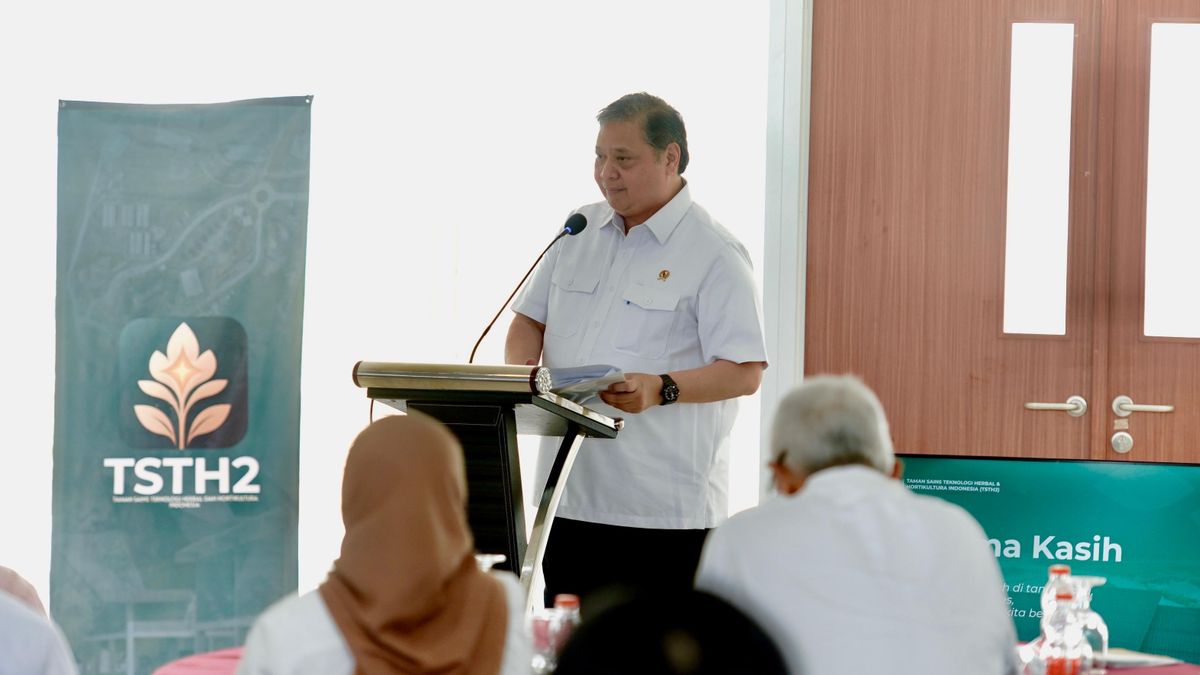


Coordinating Minister for Economic Affairs Airlangga Hartarto said the agricultural sector is an important source for national economic growth and plays a role in maintaining social stability and the community's economy.
He conveyed that with a growth of 1.65 percent (yoy) in the second quarter of 2025, the agricultural sector in February 2025 was also recorded to be able to absorb around 28.53 percent of the total national workforce or the equivalent of 41.60 million people.
"Integrated strategies are needed that not only maintain production, but also strengthen the horticultural value chain, ranging from farmer development, superior variety research, to access to the export market," he said in his statement, quoted on Sunday, September 21.
Furthermore, Airlangga also encouraged TSTH2 to be a research center for agricultural superior seeds and as a location for international-scale horticultural cultivation.
He hopes that the involvement of the food and beverage industry (mamin) can be the first step in exploring the potential for collaboration with farmers, especially for potato and black soybean commodities.
"We hope that with the downstreaming of agriculture, and it is appropriate that there cannot be agricultural products that are good without technology or research in nurseries. How dare sequencing is the new thing," he explained.
Airlangga said that there are two things that will be encouraged by the Coordinating Ministry for the Economy and are expected to be an advantage in the future, namely the genome sequencing, as well as AI and semiconductors.
Furthermore, he said that horticulture was also encouraged to be able to support the development of the food, health, and herbal industries.
According to him, with a large population and diverse market tastes, the total market value of the food and beverage industry in Indonesia reached US$109.9 billion in the 2024-2025 period.
In addition, the food and beverage sector is also able to contribute 7.2 percent to the national GDP and is the largest sub-sector with a contribution of 41.5 percent to the GDP of non-oil and gas industries.
"For that, we appreciate the construction of TSTH2 in Humbang Hasundutan so that it can encourage national food independence and superior SDA downstreaming. Hopefully, this area can support research and downstreaming of agricultural products, especially herbs and horticulture, as raw material for the pharmaceutical industry and also the food and beverage industry," he explained.
SEE ALSO:
-
 | OLAHRAGA
Fernandes dan Casemiro Selamatkan Amorim Saat Manchester United Kalahkan Chelsea
21 September 2025, 05:30

Airlangga conveyed that related to the Link and Match program between the Industrial and Agricultural Sector initiated by the Coordinating Ministry for the Economy, this is part of efforts to strengthen national food security, encourage local resource-based downstreaming, and improve farmers' welfare through integrated partnerships.
"Of course I hope that TSTH can really develop diagnostic sequencing and also for products that can be directly linked and matched with the industry. We will continue to encourage industries that need agro raw materials to continue to develop their seeds," he concluded.
The English, Chinese, Japanese, Arabic, and French versions are automatically generated by the AI. So there may still be inaccuracies in translating, please always see Indonesian as our main language. (system supported by DigitalSiber.id)
Popular


