

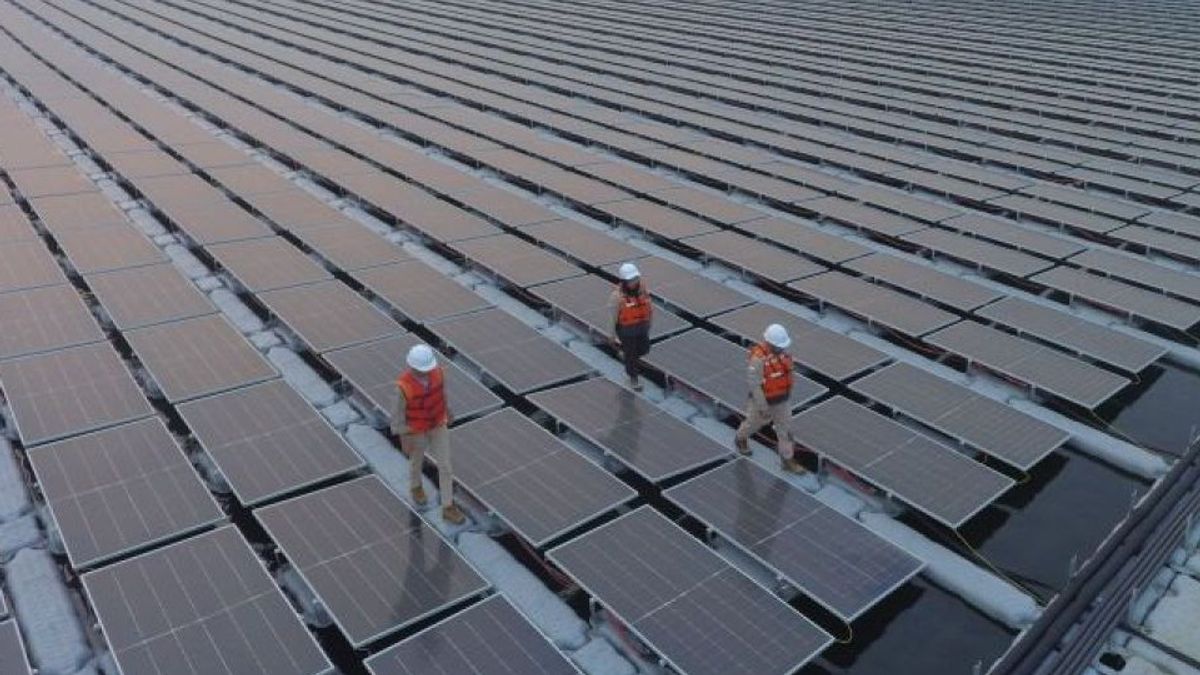


JAKARTA - Head of Research NH Korindo Sekuritas Ezaridho Ibnutama said that the prospects for the New Renewable Energy (EBT) sector in 2025 and in the future are predicted to stabilize.
He explained that in recent times, EBT had experienced an increase because the price of unrenewable energy commodities such as oil and coal had increased significantly. However, after the pandemic, the prices of these commodities began to fall again.
According to him, currently, both coal and world oil prices have decreased, while global oil supplies are increasing plus OPEC+ has also announced plans to increase its production targets since August or September this year.
Ezaridho emphasized that the EBT sector is a form of energy dividers that are dynamic and seasonal in nature so that it cannot immediately conclude that one type of EBT, such as geothermal, solar panels, or hydropower, will become an absolute source of energy for the future.
'We can't see, oh now geothermal is very hot, geothermal is very hot, so it looks like this will be the future. We can't say, oh solar panels seem to be very interested now, this will be the future. As for us, we can't see, oh hydropower will be the future, and it will beat non-renewable. This is just like it. Because if coal costs go up, it doesn't look feasible, after that it goes down again," he told VOI, Tuesday, September 9.
Ezaridho gave an example, such as the step of PT Toba Bara Sejahtra Tbk (TOBA) which is now starting to focus its business on the waste management sector (waste management).
"There are plans for waste management to become one of the highlights for how Indonesia will manage its tract," he said.
He explained that one of TOBA's strategic plans is to develop a waste power plant (PLTSa), where waste will be processed into fuel.
According to him, the cooperation scheme between TOBA and Danantara in this project is still open to various possibilities.
SEE ALSO:


He also said that TOBA will manage waste and sell it at premium prices. In fact, the price of the waste can be equivalent or higher than the price of coal, depending on the scheme.
"But indeed, at that point, in a world like what do people want to pay to buy trash? Usually people pay to throw garbage, not to get it. Danantara can be overwhelmed by the management of their waste-based PLTS," he said.
He explained that business schemes and ownership in EBT projects such as PLTSa are still very varied and TOBA could own and manage its own power plants and waste management systems, or only focus on waste management and then supply raw materials to other parties' PLTSa.
The English, Chinese, Japanese, Arabic, and French versions are automatically generated by the AI. So there may still be inaccuracies in translating, please always see Indonesian as our main language. (system supported by DigitalSiber.id)
Popular


