
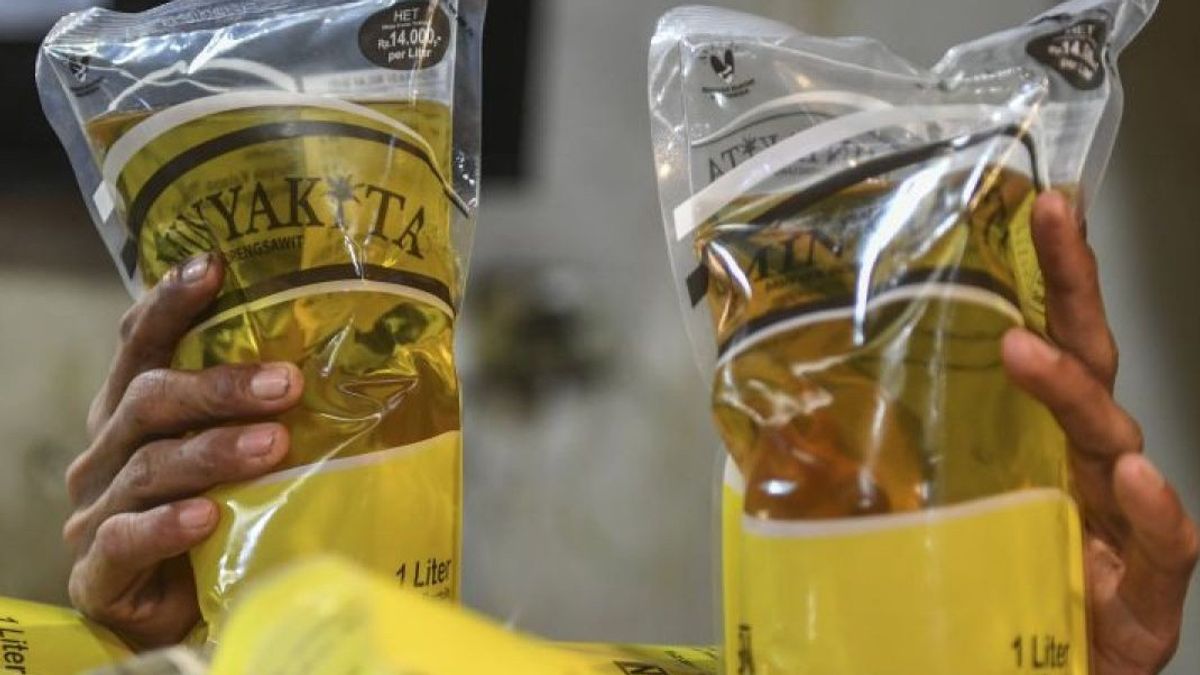


JAKARTA - The Association of Indonesian Vegetable Oil Industries (GIMNI) recommends that the distribution of people's cooking oil or Minya Kita be distributed directly by Bulog, ID FOOD and PT Pos Indonesia, to underprivileged communities.
According to GIMNI Executive Director Sahat Sinaga, the government can implement it according to the existing market mechanism, but in a limited number.
"So related to the price of MinyaKita, it is carried out according to the market mechanism alone, there is no need to regulate it, and for people who are less capable of being given assistance funds for the form of Direct Cash (BLT), notes and names of people are available in the sub-district, and the number is also limited," said Sahat, quoted by Antara, Sunday, July 6.
"The selling price of Minya Kita is determined by three factors, namely the price of raw palm oil (CPO) and transportation costs to processing plants; processing costs from CPO to cooking oil plus packaging: as well as distribution costs from producers to consumers, "said Sahat, explaining.
But on the other hand, Indonesia is an archipelagic country and 68 percent of cooking oil factories are centered in Java and Sumatra.
With these conditions, continued Sahat, rearranging the distribution scheme will not have a major effect on the price of MinyaKita.
Minya Kita is a strategy in maintaining the stability of cooking oil prices and controlling inflation, which is aimed at small communities with the highest retail price (HET) of IDR 15,700 per liter.
He gave an example, in other countries, the government only needs to convey the price of cooking oil distributed through traditional markets and the amount of price discounts per liter.
Selling shops or retailers record selling prices to buyers, accompanied by proof of sale. The difference in prices sold to small communities can be directly billed to the government. Thus, the polemic of cooking oil prices for the people is minimal.
SEE ALSO:


According to Sahat, the system that has been running through Simirah only records the physical flow of producers, retailers and consumers. Therefore, Indonesia needs a good system and is recorded through a trusted distribution system.
Furthermore, the source of funding for the payment can be taken from the Palm Oil Export Cut Fund carried out by the Palm Oil Plantation Fund Management Agency (BPDP).
"There is a simple road, buying Minya Kita from cooking oil producers at market prices, they distribute it to certain people (less capable), through PT.POS, and the difference in purchase prices from producers with certain selling prices to consumers is closed or paid off from BPDP," he said.
The English, Chinese, Japanese, Arabic, and French versions are automatically generated by the AI. So there may still be inaccuracies in translating, please always see Indonesian as our main language. (system supported by DigitalSiber.id)
Most Popular Tags
#Prabowo Subianto #donald trump #2026 World Cup #venezuela #konflik timur tengahPopular


