

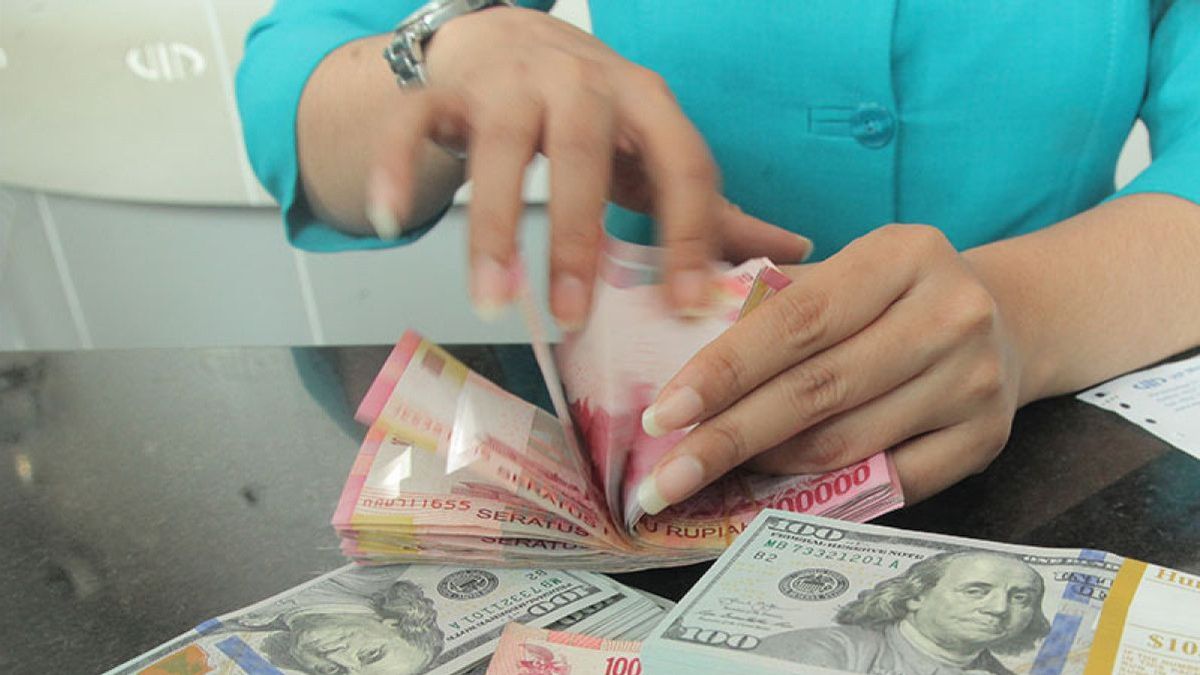


JAKARTA - Bright Institute economist Awalil Rizky conveyed that the fiscal policy strategy with the target of a wide budget deficit is maintained in Prabowo Subianto's government, which can be seen in the 2026 Macroeconomic Framework document and Fiscal Policy Principles (KEM-PPKF).
Meanwhile, the target deficit ratio for 2026 is set in the range of 2.48 percent to 2.53 percent of Gross Domestic Product (GDP) and the medium-term target for 2027-2029 is not much different.
On the other hand, in a speech by the Minister of Finance Sri Mulyani, which was delivered in a meeting with the House of Representatives (DPR) on May 20, 2025, prioritizing the narrative of the impact of global economic change.
According to Sri Mulyani, the world economy is considered to be full of uncertainty in poor connotation, so that Indonesia is also affected and fiscal policy is recognized as part of the response to these challenges.
Sri Mulyani also claims that Indonesia's condition is still better than most other countries and that fiscal policy has been considered appropriate to respond to these challenges, and can support Prabowo's priority programs.
However, Awalil saw that there was almost no acknowledgment of fiscal conditions that were severe, or were not doing well, even though the target deficit ratio for 2026-2029 which was stated in the range still seemed wide.
"The average lower limit is 2.35 percent, and the upper limit is 2.44 percent of GDP. Meanwhile, the average deficit ratio in 2005-2014 is only 1.19 percent. The lower limit for the target is almost the same as in the first Jokowi era (2015-2019) which was 2.32 percent," he explained in his statement, Wednesday, May 29.
According to him, this certainly cannot be compared to the deficit ratios in 2020 and 2021, because the big impact of the COVID-19 pandemic and the KEM-PPKF fiscal fiscal posture can be interpreted as a strategy for managing the deficit in the Jokowi era will continue.
Awalil said that government debt will continue to increase because the budget for deficits or income is less than state spending, so it requires financing to overcome it.
"The main financing source and it is predicted that the government will continue to be available as debt," he said.
In fact, according to him, the value of the debt needed is not only to cover the deficit, but for other purposes such as to pay the principal of the debt that is due, so the deficit means that it can only pay for it by withdrawing new debts.
However, he conveyed that the government still felt the need to increase other expenses that did not include spending, such as investing in State-Owned Enterprises (BUMN), investing in Other Business Entities, providing loans to local governments and SOEs, and others.
"As a result, debt financing is almost always greater than the budget deficit," he said.
He gave an example, such as the current 2025 State Budget, which plans a deficit of IDR 616.19 trillion, but debt financing reaches IDR 775.87 trillion.
Awalil explained that debt financing itself is a net value of the withdrawal of new debt minus the payment of the principal of old debt.
"Unfortunately, the table of KEM-PPKF macro fiscal posture only presents a budget financing ratio. Debt financing ratios are not presented in the table, only narrated without a clear mention of the amount," he added.
According to him, based on the realization over the past decade, debt financing is predicted to remain greater than the budget deficit.
"Thus, it is certain that the nominal position of government debt is planned to continue to increase until 2029. However, the ratio to GDP is promised to be controlled at certain amounts," he said.
For information, the lower limit targets for the government debt ratio are as follows 39.69 percent (2026), 39.43 percent (2027), 39.05 percent (2028) and 38.55 percent (2029). While the upper limit is as follows: 39.85 percent (2026), 39.62 percent (2027), 39.29 percent (2028) and 38.64 percent (2029).
Awalil said that the government seemed to be trying out scenarios so as not to exceed the psychological limit of the ratio of 40 percent.
"In the first Jokowi era, the limit was 30 percent and was narrated repeatedly in policy documents. However, in the end it was also passed in 2018 and 2029 which amounted to 30.31 percent and 30.23 percent," he said.
He added that psychological boundaries changed to around 40 percent, arguing that the impact of the Covid pandemic, which forced the government to owe more and the overall fiscal posture scenario of KEM-PPKF and there were many priority programs, there was a risk that it would exceed it.
"The realization of the debt ratio in 2024 has reached 39.75 percent. Meanwhile, the 2025 APBN target has lowered it to 39.43 percent. From realization to April, plus glorification of new programs at large costs, it has the potential to exceed 40 percent by the end of 2025," he explained.
As a reminder, the debt ratio in the SBY era decreased by 31.92 percentage points, from 56.60 percent (2004) to 24.68 percent (2014).
Meanwhile, the Jokowi era increased 15.07 percentage points, from 24.68 percent (2014) to 39.75 percent (2024).
The KEM-PPKF macro fiscal posture does not present a debt-to-state revenue ratio, but from related figures it can be calculated in 2026 in the range of 338.94 percent-340.31 percent of GDP.
Then in the following years, it is targeted to decline, namely 337.01 percent-338.63 percent (2027), 322.19 percent-324.17 percent (2028), 299.77 percent-300.47 percent (2029).
SEE ALSO:
-
 | EKONOMI
Gandeng Aparat Penegak Hukum, PTBA Amankan Aset dan Operasional Tambang
28 Mei 2025, 15:20

Please note, the ratio decreased in the SBY era, from 322.26 percent (2004) to 168.27 percent (2014).
Then the Jokowi era increased to 309.42 percent (2024) and the calculation of the 2025 APBN assumption, the ratio was 319.01 percent.
"If the mid-term KEM-PPKF 2026 scenario goes smoothly, then the government debt will continue to grow. The ratio to GDP which is claimed to be controlled will experience severe challenges. Likewise, if viewed from the debt ratio to state revenue," he concluded.
The English, Chinese, Japanese, Arabic, and French versions are automatically generated by the AI. So there may still be inaccuracies in translating, please always see Indonesian as our main language. (system supported by DigitalSiber.id)
Most Popular Tags
#Prabowo Subianto #donald trump #2026 World Cup #Febrie Adriansyah #8791Popular


