

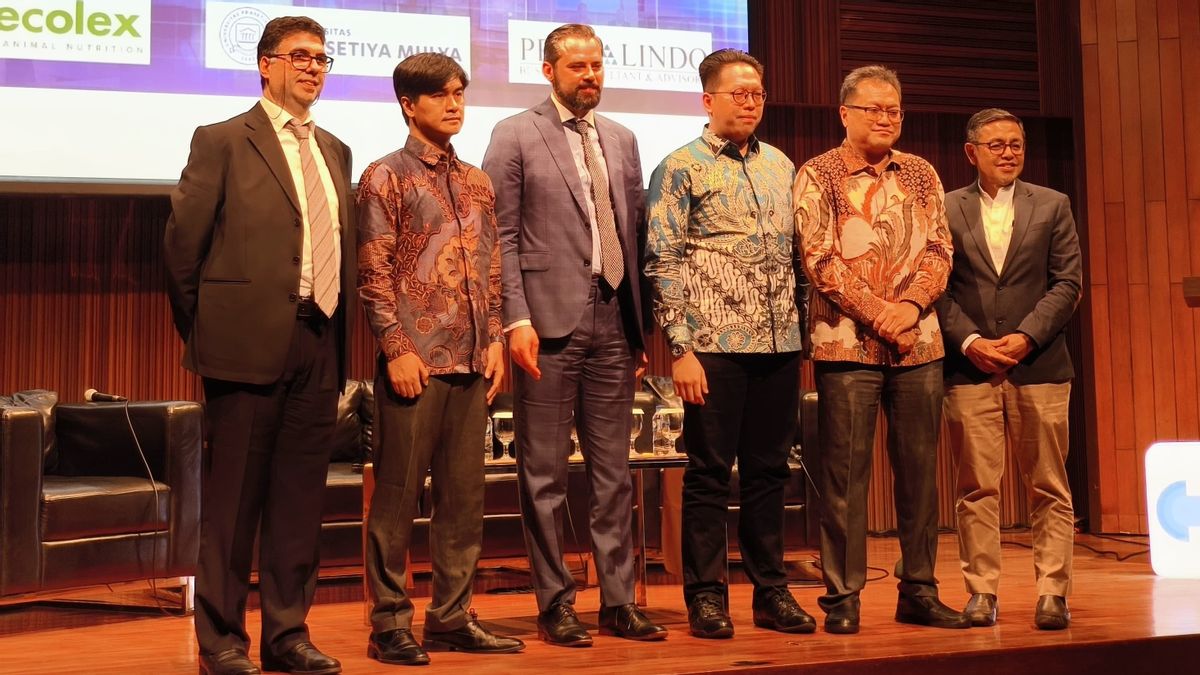


JAKARTA - The Center for Market Education (CME) and the Tholos Foundation again held the Innovation Summit Southeast Asia (ISSA) 2025 in Jakarta, Tuesday, May 6.
As for the implementation of ISSA 2025, it also launched the International Trade Barrier Index (TBI) 2025 which is a global index in comparing the level of openness and trade barriers between countries.
This launch also highlighted the study of the case of banning sales of the iPhone 16 in Indonesia amid rising global trade tensions due to tariff wars.
Policy Analyst Tholos Foundation Phillip Thompson said that protectionism policy actually hinders the progress and competitiveness of a country from openness and innovation, not from isolation.
Phillip said that Indonesia was in the last rank, but this actually showed great potential because there was a high interest in global companies because they were looking for alternative supply chains in the Asian region.
"Indeed, Indonesia is in last place, but this shows extraordinary potential. There is great hope for President Prabowo Subianto's new government. Especially now that many companies in the US and Europe are looking for alternative supply chains in the Asian region. Common sense reform can bring Indonesia to jump towards a new era," he said at Innovation Summit Southeast Asia (ISSA) 2025, Tuesday, May 6.
Instead of continuing to protect the industry through tariffs and restrictions on local content, ISSA 2025 encourages the Indonesian government to be able to rely on innovation and healthy competition as the main driver of economic growth because openness encourages productivity and resilience, while isolation actually hinders both of them.
CME Country Manager Alfian Banjaransari said that so far, the agricultural, commodity, and natural resources sectors are often seen as tilted, whereas these sectors have great opportunities for innovation ranging from sustainable agriculture, advanced logistics systems, to added value-based exports.
In 2024, the agricultural, forestry and fishery sectors contributed 12.61 percent to Indonesia's GDP, while plantations contributed 4.17 percent and the palm oil industry became the mainstay of exports and Indonesia dominated this sector.
Then, the tobacco industry remains the backbone of exports and state revenues which reach more than IDR 150 trillion per year.
On the other hand, Alfian said that the renewable energy, housing, and creative industry sectors also show growth and have the potential to support the future economy.
The government needs to let these sectors grow organically. With the right incentives and a healthy business climate, not the intervention or overregulation of the old sector and the new sector, the overlooked and the underrated, can grow side by side," he said.
CEO of CME Carmelo Ferlito said that in the midst of geopolitical dynamics and global trade tensions, President Prabowo Subianto showed his commitment to make Indonesia a competitive investment center.
"He emphasized the importance of ease of doing business and simplifying the bureaucracy and regulations that have been burdening business actors," he said.
SEE ALSO:


Carmelo added that trade openness, investment flow, and innovation are the keys to improving people's welfare and getting out of the trap of middle-income countries.
"This message is very much in line with our mission to encourage more open trade, investment flows, and innovation. The three of them, if combined, will be a recipe for improving people's welfare at large and removing Indonesia from the middle income trap," he concluded.
The English, Chinese, Japanese, Arabic, and French versions are automatically generated by the AI. So there may still be inaccuracies in translating, please always see Indonesian as our main language. (system supported by DigitalSiber.id)
Most Popular Tags
#Prabowo Subianto #donald trump #2026 World Cup #venezuela #konflik timur tengahPopular


