

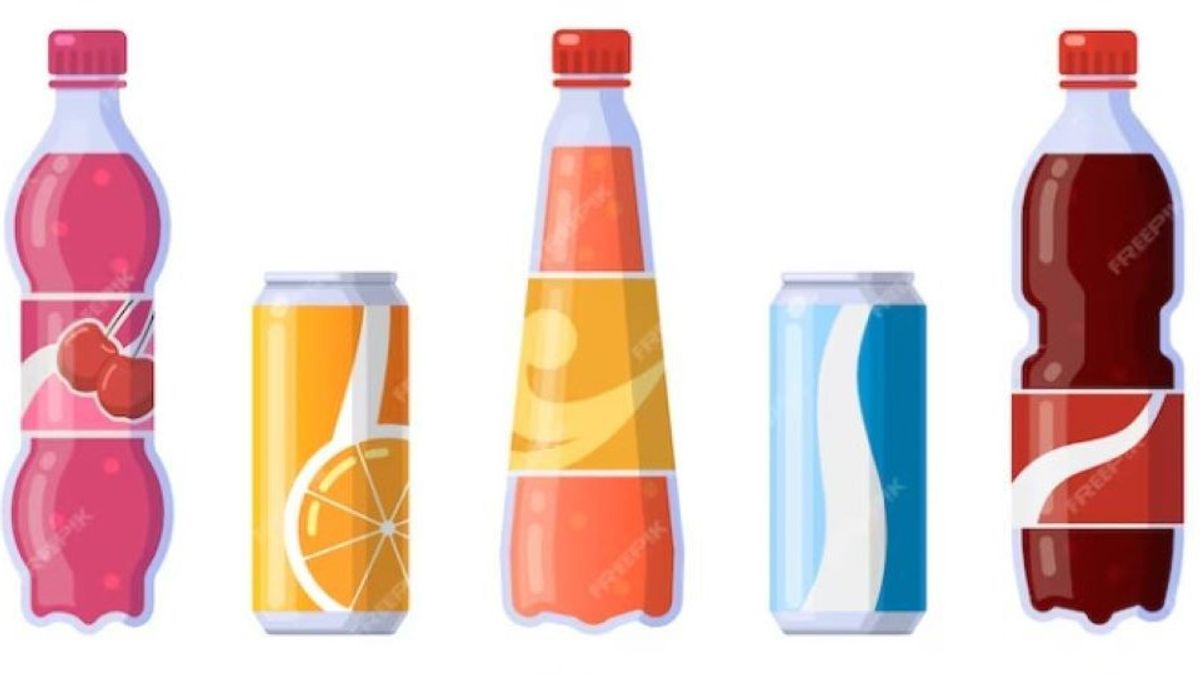


JAKARTA - The government is targeting revenue from the excise duty of packaged sweetened Drinks (MBDK) of IDR 3.8 trillion by 2025.
Although this figure is relatively small compared to the overall tax revenue target in 2025, this policy remains in the spotlight because of its broad impact on the industry and adds to the economic burden on the community.
According to tax observer from the Center for Indonesia Taxation Analysis (CITA) Fajry Akbar, the main objective of the imposition of MBDK excise is to control consumption, as written in the 2025 State Budget financial note.
However, it cannot be denied that the aspect of state revenue is also a consideration.
Fajry said that excise revenue from the tobacco products industry continues to decline, so the government is looking for new, more sustainable sources of income.
"If we refer to the 2025 State Budget financial note, the government imposes MBDK excise for control. However, we cannot deny that there are budgetair or receipt aspects," he said in his statement, Wednesday, February 19.
Fajry also emphasized the importance of the transition period in implementing this policy and there needs to be a grace period, where excise rates are still 0 percent so that producers have time to develop products with lower sugar levels.
In addition, Fajry said that the implementation of the initial tariff should not be too high so that the impact on the industry can be monitored properly.
He also highlighted the importance of considering economic conditions in 2025, including people's purchasing power.
"And at the beginning of the implementation, the government needed to be careful. The tariff should not be high. We will see the impact of the imposition of tariffs on the industry and its effectiveness in controlling," he said.
According to him, if this policy is implemented in a hurry, it is feared that it will have a negative impact on purchasing power and increase the economic burden on the community, especially in the midst of high political risks at the beginning of the Prabowo Subianto administration.
"We can see from the many policies that have been withdrawn. From the increase in VAT rates, gas 3 kg, to budget efficiency. The intentions are good but instead backfire to the government. So we need to be careful. The time needs to be right, the method also needs to be right," he said.
Meanwhile, Deputy Director of the Institute for Development of Economics and Finance (Indef) Eko Listiyanto highlighted the polemic related to MBDK excise in the context of purchasing power recovery.
According to him, this policy does aim to control sugar consumption for the sake of public health, but it must be implemented in stages so as not to interfere with the food and beverage industry.
"It is still a polemic, yes. Indeed, especially in the beverage industry, there are implications for food and beverage prices, so they should also consider their abilities, they can still be bought," he said.
Eko also emphasized that excise policy should not only increase state revenue, but rather focus on excessive consumption control. If sugar is proven to contribute to health problems such as diabetes and obesity, then there needs to be regulation.
"The name excise duty is the main goal for restrictions, not receipts. So, if the direction of state revenue is not appropriate," he said.
Eko said that if the excise rate was too high from the start, it was feared that it would also encourage the emergence of black markets and illegal products, as happened in the tobacco products industry.
"So far, our weakness in our excise policy has only targeted few products, even though the lack of health from these products is not only that," he said.
In practice, Eko said that the implementation of MBDK excise would have an impact on product prices in the market so that studies of people's purchasing power and price elasticity needed to be carried out so that this policy did not cause excessive resistance.
According to him, consumers who feel that the price of sweetened drinks has increased sharply may reduce their consumption, which in turn can have an impact on the industrial sector.
"So, the implementation must be gradual, not to kill the industry. Moreover, the food and beverage industry is also important for us. That there will be an increase in prices cannot be avoided," he said.
In addition, Eko conveyed that socialization to the community is also an important element in the success of this policy.
Many consumers may not yet fully understand the dangers of consuming excessive sugar, so health education is a step that is no less important than the implementation of excise itself.
SEE ALSO:
-
 | EKONOMI
BI Ungkap Aliran Modal Asing Masuk pada Instrumen SRBI Capai Rp892,90 Triliun
19 Februari 2025, 19:23 -
 | EKONOMI
Minta Tagar #KaburAjaDulu Diubah, Menteri Karding: Lebih Produktif
19 Februari 2025, 19:32
With a better understanding, Eko said it was hoped that the public would be more aware of controlling sugar consumption without having to rely fully on government regulations.
"What the industry must pay attention to should not fall. How to do this? Yes, it must be selective. And there must also be socialization related to sugar consumption so as not to overdo it. Because maybe people consume a lot of sugar because they don't know the dangers of sugar if it's excessive," said Eko.
The English, Chinese, Japanese, Arabic, and French versions are automatically generated by the AI. So there may still be inaccuracies in translating, please always see Indonesian as our main language. (system supported by DigitalSiber.id)
Popular


