

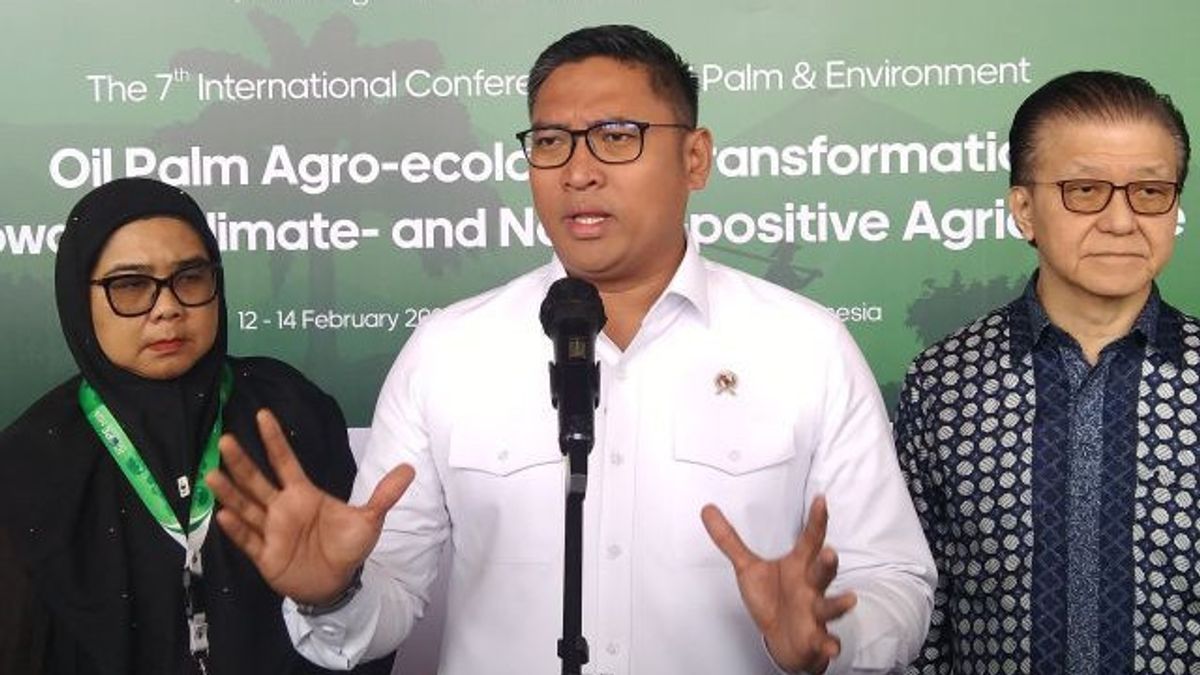


JAKARTA - Deputy Minister of Agriculture (Wamentan) Sudaryono emphasized the importance of increasing the productivity of palm oil in a sustainable manner to support government priority programs, especially food self-sufficiency, energy and downstreaming of natural resources.
"The government wants how our palm oil leads to sustainability," said Sudaryono as quoted by ANTARA, Wednesday, February 12.
He explained, to increase palm oil productivity, it is carried out with intensification and utilizing superior seeds to good governance and care for the same land and area or without adding land.
Then extensification is carried out without causing deforestation, through a comprehensive study of the environment and carried out through sustainable practice.
In addition, oil palm rejuvenation or replanting also utilizes an overlapping method with suitable gogo rice planting on dry land and corn planting.
He welcomed the implementation of ICOPE 2025 because it discussed oil palm research, ranging from seeds, fertilizers, climate change, technology to artificial intelligence (AI) needed to support increased palm productivity.
"Of course this is good for Indonesia because of the 100 percent of palm oil circulating in this world, 58 percent are sourced from Indonesia," he added.
The productivity of palm oil can support downstreaming of natural resources and food self-sufficiency, including for nutritious food priority programs.
In addition, self-sufficiency in energy through the B40 program is a mixture of 40 percent palm oil to reduce dependence on fossil energy.
Meanwhile, the Director of Conservation of the Indonesian World Wide Fund for Nature Foundation (WWF) Dewi Lestari Yani Rizki assessed that it is necessary to be serious about the palm oil industry to implement governance towards sustainability in order to answer global market challenges.
This effort is expected to support the Indonesian government in reducing carbon emissions and saving biodiversity.
"We believe that the palm oil industry can transform into a sustainable business in the future," said Dewi.
On the other hand, Chairman and CEO of Sinar Mas Agribusiness and Food Franky Oesman Widjaja revealed that sustainable innovation and synergy between the government, business actors, the community and other parties are the keys to the future of the palm oil industry.
He hopes that the meeting will bring concrete results to make the palm oil industry part of a global solution to climate and environmental challenges.
"We have committed to implementing the best practices in sustainable agriculture, as well as protecting biodiversity and ecosystems around," he said.
SEE ALSO:


The 7th ICOPE was held in Sanur, Denpasar, Bali, 12-14 February 2025 which was attended by a number of delegates, namely the government, academics, business actors to non-governmental organizations from Indonesia, India, the Netherlands, France, Malaysia, England, Finland, Colombia and Spain.
The conference became a medium to formulate a formula for the sustainability and transformation of the climate-friendly and environmental oil industry.
The English, Chinese, Japanese, Arabic, and French versions are automatically generated by the AI. So there may still be inaccuracies in translating, please always see Indonesian as our main language. (system supported by DigitalSiber.id)


