
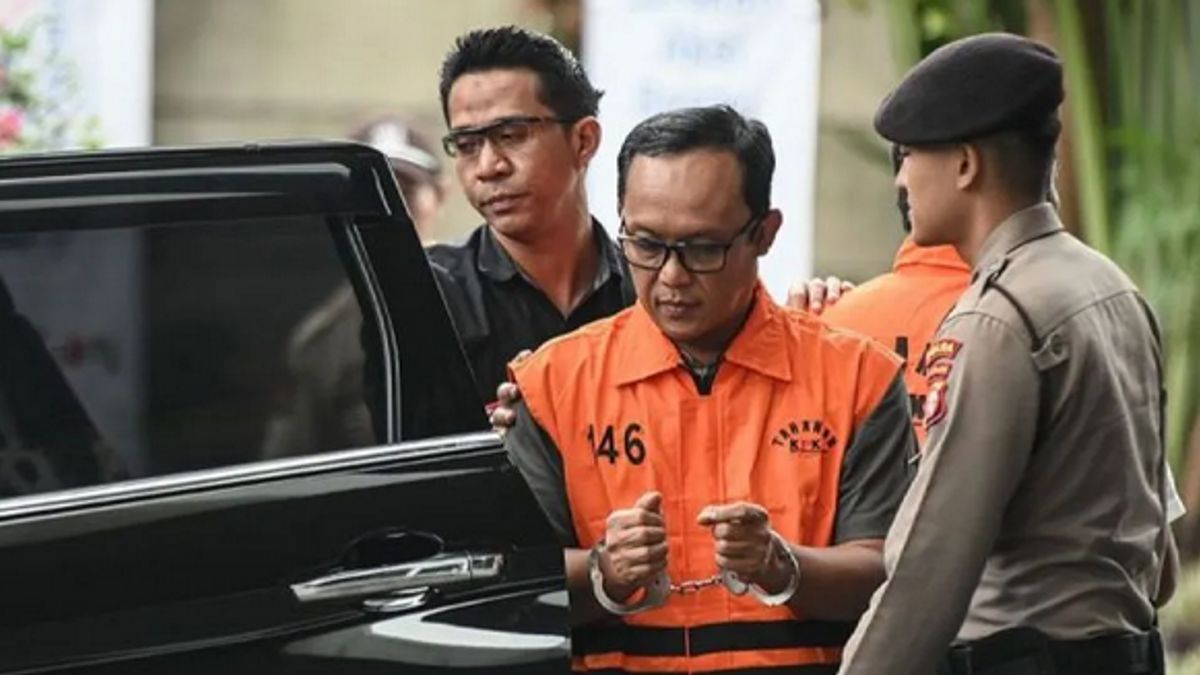


JAKARTA - High political costs have ensnared a number of regional heads in corruption cases. After the 2024 Elections, at least four regional heads have been caught by the Corruption Eradication Commission (KPK).
The operation of the Tangkap Tangan (OTT) officials in Central Lampung, including Regent Ardito Wijaya, by the KPK has become a public concern. The five suspects are the Regent of Central Lampung for the 2025-2030 period, Ardito Wijaya, members of the Central Lampung DPRD, Riki Hendra Saputra, the younger brother of the Regent of Central Lampung, Ranu Hari Prasetyo, Acting Head of the Regional Revenue Agency (Bapenda) Central Lampung Anton Wibowo, and Director of PT Elkaka Mandiri Mochamad Lukman Sjamsuri from the private sector.
The KPK said that the money from Ardito's corruption, which is suspected to have reached Rp. 5.75 billion, was partly used to pay off the 2024 election debt. Acting Director of Asset Tracking, Evidence Management, and Execution (Labuksi) of the KPK Mungki Hadipratikno said that the 2024 Central Lampung Regency Budget (APBD) reached around Rp. 3.19 trillion.
The budget was largely allocated for the construction of infrastructure, public services, to regional priority programs. Ardito Wijaya, as the Regent of Central Lampung, allegedly set a fee of 15-20 percent of a number of projects in Lampung.
Ardito arranged the winners of the procurement of goods and services in a number of Central Lampung Regional Apparatus Work Units (SKPD) through the direct appointment mechanism in the e-catalog.
After the conditioning, from February to November 2025, Ardito allegedly received a fee of Rp. 5.25 billion from a number of partners providing goods and services. Ardito also conditioned another project, namely the procurement of health equipment project at the Lampung Tengah Health Office.
"The total flow of money received by AW (the Regent of Central Lampung) reached approximately Rp. 5.75 billion, of which Rp. 500 million was used for the regent's operational funds and the repayment of bank loans used for campaign needs in 2024 of Rp. 5.25 billion," said Mungki.
The statement that Ardito's corrupt money was used to pay election debts attracted attention, although this is not new.
The Executive Director of the Voxpol Center Research and Consulting Pangi Syarwi Chaniago said that the expensive cost of elections is a long-standing disease in Indonesia. It is this high cost that makes the practice of buying and selling positions, conditioning projects, and others.
English:
"But many other regional heads do not incur high costs for elections. It depends on the person, some even owe, some win with trust capital," said Pangi when contacted by VOI.
Meanwhile, Transparency International Indonesia (TII) researcher Agus Sarwono considers the OTT of the Central Lampung Regent not just a personal case. The case strongly indicates the phenomenon of uncontrolled political costs and the weakness of integrity building in the region. Patterns such as kickback projects through close-knit companies confirm the still weak integrity of local political governance in the region.
"High political costs create structural pressure towards budget corruption and project trading. The total campaign fund for Ardito Wijaya is Rp9.9 billion, half of which is the result of bank debt," said Agus.
In the election, Pangi admitted that all aspects were expensive. However, the highest cost lies in vote buying. "Compared to props, witnesses, success teams, volunteers, face-to-face meetings, survey costs, and political consultants, the most expensive is vote buying," he explained.
"What makes it expensive is that they themselves, including through the dawn attack," added Pangi.
Pangi added that the practice of buying votes is difficult to let go of the habit before elections, including the 2024 Election. Buying and selling votes is very likely to occur, because on the one hand, the candidate for regional head needs an electorate, on the other hand, there are still many people in Indonesia who are far below the poverty line.
"The community indeed chooses the one who is generous, who comes to give assistance or basic necessities. One needs an election, and needs money," he explained.
Minister of Home Affairs Tito Karnavian said that the arrest was proof that direct elections could not immediately catch the best. The former National Police Chief also alluded to the elections through the DPRD which was said not to violate the 1945 Constitution.
The discourse on the return of the regional head system (pilkada) chosen by the DPRD has resurfaced recently. This discourse was first launched by Golkar General Chair Bahlil Lahadalia, who was then welcomed by President Prabowo Subianto.
This proposal is based on a number of reasons, such as cost efficiency, reducing potential horizontal conflicts, and increasing government effectiveness. However, on the other hand, many parties assess that this change can reduce public participation in the democratic process and open greater opportunities for transactional political practices.
Pangi said that the election of regional heads by the DPRD would only transfer transactional practices to the DPRD. Thus, the problem of the high cost that must be spent for the implementation of the election will remain unresolved.
"It can be even crazier if (the regional head) is chosen by the DPRD. The transactions that have been distributed to the people, later the money will be transferred to the DPRD and this can be bigger, more terrifying," concluded Pangi.
The English, Chinese, Japanese, Arabic, and French versions are automatically generated by the AI. So there may still be inaccuracies in translating, please always see Indonesian as our main language. (system supported by DigitalSiber.id)
Most Popular Tags
#Prabowo Subianto #donald trump #Febrie Adriansyah #8791 #giias 2026Popular


