
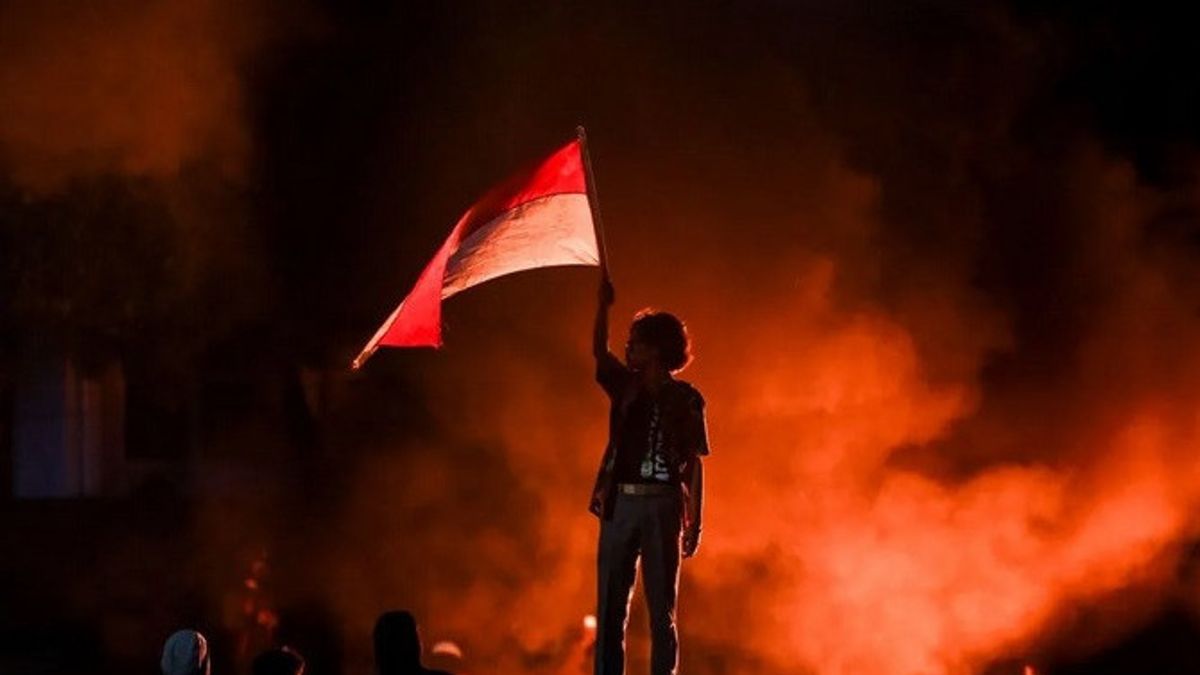


JAKARTA Social media now not only functions to socialize, expand the circle of friendship, but is also often used as a forum for collective movements.
The public certainly still remembers how social media is filled with content that shows the emotions of anger, sadness, and public fear.
This stems from demonstrations from various groups that led to riots. The climax was when an online motorcycle taxi driver (ojol) Affan Kurniawan was run over by a Brimob Police tactical vehicle and died on Thursday (28/8/2025).
Amateur video footage from netizens quickly spread on social media. This incident not only shows a portrait of the violence of the apparatus, but is a turning point for the concern of the Indonesian people who previously tended to be apathy and polarized in the world of politics.
After the incident, netizens also compactly provided support to ojol drivers by ordering food to be distributed.
SEE ALSO:
-
 | BERNAS
Butuh Political Will Kuat untuk Menggeser Penyerapan Anggaran MBG yang Lelet
09 Oktober 2025, 08:00 -
 | BERNAS
Menjaga Euforia Sirkuit Mandalika di Tengah Minimnya Promosi MotoGP Indonesia
07 Oktober 2025, 14:00 -
 | BERNAS
Syarat Capres dan Cawapres Minimal Lulus SMA Tidak Salah, tapi Mengkhawatirkan
06 Oktober 2025, 22:00 -
 | BERNAS
Iming-iming Insentif Rp100 Ribu dalam Program MBG dan Eksploitasi Guru Honorer
06 Oktober 2025, 19:00
Using social media to create a movement initiated by the millennial generation does not only occur in Indonesia, but also penetrates other countries, such as Nepal and France.
Previously, discussions on politics on social media were only carried out by activists, social media activists, or civil society. But lately, social media has become a more inclusive space.
The educated middle class, students, students, and even influencers also voiced their anxiety about the democratic and government situation in Indonesia.
Ika Idris, Co-Director of Monash Data and Democracy Research Hub, said that the movement that was born after the Affan incident followed logic that could be mapped through the framework of Framing Theory (Snow & Bendord, 1988).
The public was initially in the diagnostic framing phase, namely recognizing the main problems faced by the community. In this case, the problem is the issue of economic inequality and the domination of the elite. Through social media, residents appointed the DPR and the authorities as the cause of the problem.
After that, he went to prognostic framing, namely in the form of offers of radical solutions, such as demands for the dissolution of the DPR. Public anger peaked and turned into a strategic framing, namely using anger and grief to encourage wider public participation.
However, public conversations that initially contained anger began to shift towards solidarity, which was marked by a declaration of the demands of residents 17+8. The hashtag, which initially criticized, also turned into #wargajagawarga.
Netizens who initially had doubts about voicing political opinions on social media for various reasons, have now become more daring to speak, one of which is the color symbol of Brave Pink and Hero Green which was widely used at that time.
"Now it's enough to change the profile photo to pink and green, without having to use a hashtag or write down demands, it's a symbol of support," said Ika.
The dynamics with social media that is more fun, creative, and easy to follow, said Ika, poses a low risk so that everyone can get involved.
Yayuk Lestari, MA, Lecturer of Communication Science, Andalas University, said access to social media provided tools to the community, including the lower classes in Indonesia, to understand political issues and shape critical views on government policies. Mainly affecting everyday life.
This political awareness is increasing as lower class people engage in political discussions through platforms such as Twitter, Facebook, and Instagram.
They can discuss relevant issues and mobilize support for collective action when government policies do not reflect their interests. This gives them greater votes in the political process, "said Yayuk, citing the Andalas University page.
Thanks to social media, Yayuk said, the public can obtain information from various independent sources, including blobs, activists, and civil society organizations. This gives them the opportunity to gain diverse and unfiltered perspectives, which help build a more comprehensive understanding of issues that affect their lives.
This ease of access plays an important role in increasing political awareness among marginal groups. For example, when there is a reduction in subsidies or an increase in the price of basic necessities, people can easily access information from various sources and form a more critical view. They can also discuss solutions and listen to the experiences and perspectives of others who are experiencing similar situations.
"Platforms such as Facebook, Twitter, and WhatsApp not only function as communication channels, but also as discussion spaces. People can share views and support each other on political issues," he said.
"With the content sharing feature, they can disseminate important information, discuss government policies, and organize social movements. For example, when there is a detrimental policy, they can quickly collect signatures for online petitions or organize protests that get wider attention," Yayuk concluded.
The English, Chinese, Japanese, Arabic, and French versions are automatically generated by the AI. So there may still be inaccuracies in translating, please always see Indonesian as our main language. (system supported by DigitalSiber.id)


