


JAKARTA - The public has been treated to calls for the dissolution of the DPR for the past week. Can the dissolution of the DPR be a solution?
The call for the DPR to be disbanded echoed on social media. This emerged as a form of public disappointment with the provision of housing allowances of IDR 50 million per month for each member of the DPR.
The provision of allowances whose fantastic value is considered in contrast to the economic difficulties experienced by almost all people.
The public became even more annoyed after the statements made by members of the DPR regarding this housing allowance were minimally empathic. Politician from the Nafa Urbach National Democratic Party (Nasdem) said the allowances obtained were natural because the distance from his house in Bintaro to the DPR Building was far away and stuck.
Public anger peaked when Deputy Chairman of Commission III of the DPR from the Nasdem Party faction Ahmad Sahroni said those who called for the DPR to be dissolved were stupid people in the world.
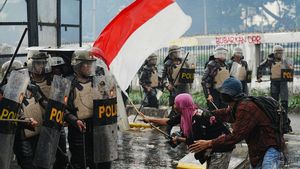
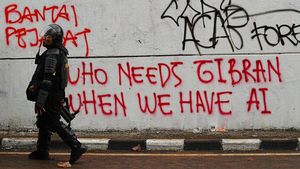
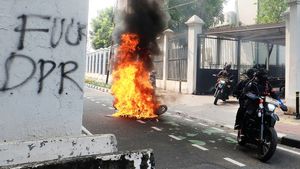
The gap between the DPR and the people who are far away, not to mention the controversial statements that ignite the emotions of the community. They not only called for the dissolution of the DPR on social media, but also took to the streets with a taste in front of the DPR Building, Jakarta, Monday (25/8/2025).
The Speaker of the House of Representatives, Puan Maharani, promised to absorb the aspirations of the people. He even asked for input from the entire community to help improve the performance of the DPR.
However, until the end of the demonstration earlier last week, none of the DPR members met the residents. The same thing happened after two consecutive actions on August 28 and 29.
This further sparked pressure for the DPR to be disbanded. However, is it appropriate for the DPR to be disbanded?
In an opinion entitled "Lumbung, Tikus, and DPR" written by the lecturer Imam Nawawi School Cibinong, Husni Magz, in the classical political theory, the existence of legislative institutions is a necessity in the democratic system.
This was also emphasized by Montesquieu in The Spirit of Laws (1978), which emphasized the importance of the division of power, namely the legislature, executive, and judiciary. The three must stand apart to prevent absolute power. Without legislation, the principle of check and balance collapse.
In Indonesia itself, the legislature is not just a symbol of democracy, but also a constitutional foundation. The 1954 Constitution emphasized that the DPR has three main functions, namely legislation, budget, and supervision.
Through this function, the DPR should be the distributor of people's aspirations and the equalizer of executive power.
Professor of Constitutional Law at the University of Indonesia Jimly Asshidiqie once said, "Without parliament, democracy is just a name. Power will fall on one hand and it will no longer be a state of law, but absolute power".
Basically, the problems that people often complain about are not institutional, but the behavior of some of its members, as exemplified previously. For this reason, what needs to be strengthened is the mechanism for public supervision of the DPR, not its disbandment.
Constitutional Law Expert Prof. Mahfud MD understands the public's anger towards the DPR. However, according to him, the narrative of disbanding the DPR should be avoided, because the DPR is an important instrument in the democratic system.
Historically, Indonesia once had a precedent. President Sukarno issued a Presidential Decree that dissolved the Constitute on July 5, 1959.
This decree ended the post-independence parliamentary democracy experiment and returned the 1945 Constitution as a constitution. The history of the Sukarno era, said Mahfud, teaches the dangers of power without observers, which actually leads to authoritarianism.
Chairman of the Center for Political Studies at the University of Indonesia Dr. Andi Rahman said the dissolution of the DPR was not a constitutional solution. The public, he said, has official channels such as the Honorary Court of the Council (MKD), the KPK, and other surveillance channels.
"So the solution is not to dissolve the DPR, but to improve the quality of its members through legal channels," he said.
SEE ALSO:
-
 | BERNAS
Oposisi Tak Berjalan Sesuai Harapan Sebabkan Eksekusi Politik Dilakukan di Jalanan
29 Agustus 2025, 14:00
Meanwhile, election monitoring activist Siti Handayani underlined the importance of public participation in elections, by exercising voting rights to replace untrusted representatives, and encouraging clean elections through election surveillance.
"The people's strength is in the ballot booth. If there are members who are not trustworthy, don't be elected again. In fact, the community can participate as election monitoring volunteers to ensure the process is honest and fair," said Siti.
The English, Chinese, Japanese, Arabic, and French versions are automatically generated by the AI. So there may still be inaccuracies in translating, please always see Indonesian as our main language. (system supported by DigitalSiber.id)


