



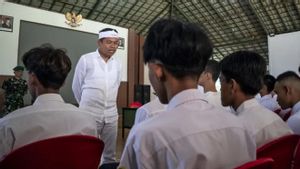
JAKARTA - West Java Governor Dedi Mulyadi's policy regarding school entry hours at 06.00 WIB is said to have no basis.
The idea that regulates school entry hours in West Java starting at 06:00 WIB has attracted public attention in the past month. This plan also coincides with the implementation of a curfew for students who started in early June.
However, the school's efficacy at 06:00 p.m., which Dedi Mulyadi recently held at 06:30 p.m., received a number of rejections. Many parents objected to the plan to attend school at that time, because it was considered too early in the morning.
But warnings to Dedi Mulyadi were also given by a number of academics. The former Regent of Purwakarta is said to have not conducted a study before making a policy.
West Java Governor Dedi Mulyadi said this policy was part of major reforms in the education system in the region. In addition to arranging school entry hours early, the West Java Provincial Government also plans to abolish homework or homework for students.
Prior to this, the Gerindra Party politician had already imposed a curfew for teenagers in West Java. One of the hopes is that, apart from preventing juvenile delinquency, school children will also have quality time at home.
However, the Head of the Advocacy Division of the Education and Teacher Association (P2G) Iman Zanatul Haeri assessed that the policy of entering school at 06.00 in West Java was counterproductive to the goal of building quality of life and developing children.
According to Iman, there have been many research or scientific studies that have shown negative impacts of sleep shortages, including children who have difficulty concentrating, decreased memory, impaired body metabolism, breakfast can be missed, fatigue, anxiety, and even a decrease in academic achievements.
The policy of entering school at 06.00, said Iman, was outside of international literature. He gave an example of Malaysia, China, the United States, which generally entered school around 7.30 am. Meanwhile, India, England, Russia, Canada, South Korea entered school at 8.00 am. Then Singapore and Japan entered at 8.30 am.
Everything is with a learning scheme of 5 days or Monday to Friday. This means that the average developed countries enter schools by noon," said Iman, in a statement received by VOI.
Even in a study by Kelley et al. (2017) from The Open University, Brigham and Women's Hospital, Harvard University, and University of Nevada, it shows that school entry hours at 10:00 are better for the health and academic performance of students aged 13-16 years than 8:30 am. This means that teaching and learning activities (KBM) which are held at six am do not have a study basis.
"Therefore, we hope that there will be a study first for the implementation of entry at six in the morning", said Iman.
SEE ALSO:
-
 | BERNAS
Seberapa Efektif Aturan Jam Malam Ala Dedi Mulyadi Cegah Kenakalan Remaja?
05 Juni 2025, 10:00



The discourse on entering school at 06.00 is not the first time this has happened. East Nusa Tenggara Province tried to implement a school policy at 05.00 in 2023. However, after going through trials and evaluations at schools, the hours of entry were revised to 05:30 am, and finally returned at 07.00 am.
This was done after the Provincial Government conducted a comprehensive evaluation, including listening to input from various parties.
"We have to learn from NTT, don't let education policies try and eventually return to normal. We'd better be careful and study first," Iman explained.
Dedi Mulyadi's goal is to prevent children from being lazy, excited to go to school, and likes to study by accelerating school entry hours is actually not directly correlated with each other.
The development of quality learning actually lies in the learning ecosystem in schools, parenting at home, how teachers are able to build quality, safe, comfortable, healthy, dialogistic, constructive, and centered study rooms. According to Iman, it will be useless to enter too early in the morning, but the quality of learning is still low.
On the other hand, the challenges of education in West Java are also quite difficult. The number of children who do not go to school is quite high, reaching 623,288 and 164,631 of them who drop out. According to data from the Ministry of Basic and Secondary Education, West Java has even placed it in first place in the national number of dropouts at the elementary school level.
There are still many educational problems that must be handled by Dedi Mulyadi in West Java. For example, there are around 22,000 classrooms that were heavily damaged and 59 thousand classes were moderately damaged in West Java," he explained.
Teachers in West Java who have been certified have below 40 percent. This means that half of teachers in West Java are considered unprofessional on paper, "he added.
Looking at these notes, Iman from P2G assessed that the policy of the education sector by Dedi Mulyadi so far has not been based on evidence based policy and research based policy. Thus, these policies are conceptually fragile and vulnerable to change drastically because they do not have a strong basis.
What was built was not the strength of the bureaucracy below, but the personal Dedi Mulyadi as governor. Of course, this is an internal regional bureaucracy problem.
P2G merasa kebijakan pendidikannya lebih banyak berdasarkan pada ide spontanetas, bukan yang direncana dan systematic sebagaimana konsep dasar pendidikan itu sendiri, kata Iman lagi.
With the 5-day school study scheme plus entering too early in the morning and returning home early in the afternoon, children could vent their fatigue at the school on Saturdays and Sundays with negative and destructive activities such as brawls, and other forms of outlets.
"All of this must be anticipated by all parties," he concluded.
The English, Chinese, Japanese, Arabic, and French versions are automatically generated by the AI. So there may still be inaccuracies in translating, please always see Indonesian as our main language. (system supported by DigitalSiber.id)


