

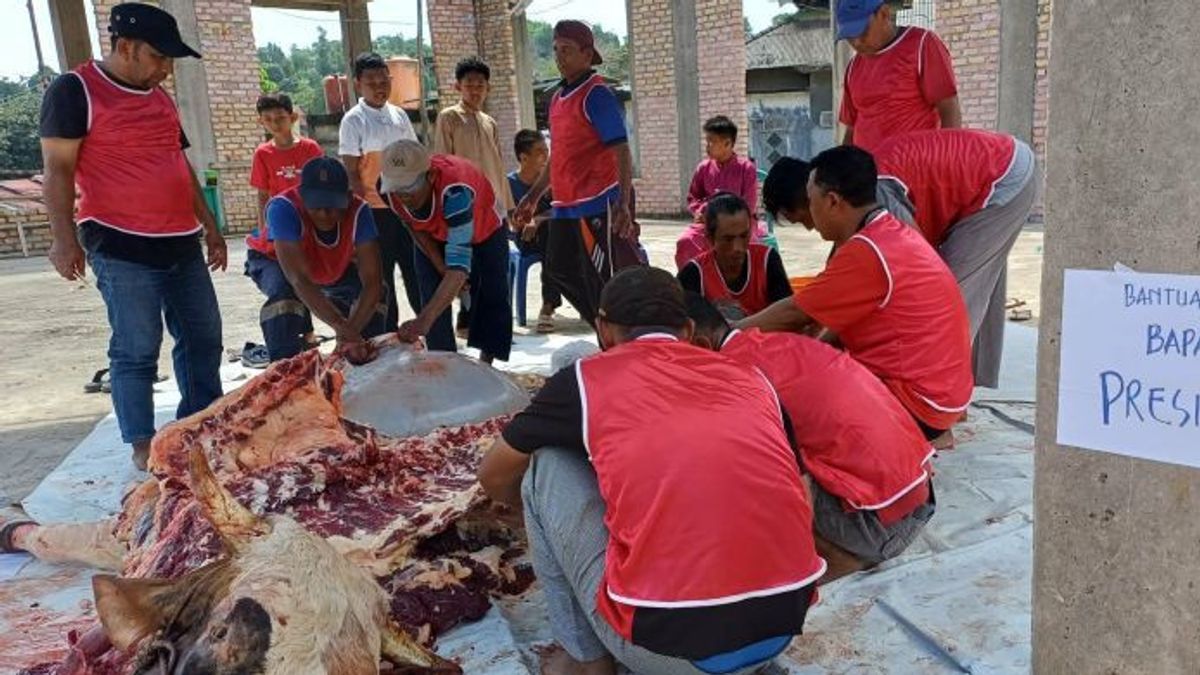


JAKARTA - The Ministry of Agriculture recorded the number of sacrificial animals nationwide in 2026 reached 3.5 million heads. Of these, more than 32,000 goats come from the payment of dam or fines for Indonesian haj pilgrims carried out in the country.
Deputy Minister of Agriculture Sudaryono said the number of goats from dam payments increased significantly compared to the previous year which was only around 10,000.
"Dam for our people who perform the hajj. In 2025, 10,000 goats were slaughtered and this year, thank God, it became more than 32,000," said Sudaryono in his explanation, Wednesday, May 27.
According to Sudaryono, the government continues to encourage the increase in the implementation of dams in the country because it can stimulate the economy, especially the livestock sector.
He explained that the number of Indonesian pilgrims reaches around 200,000 people every year. If all pilgrims pay dam in Indonesia, the potential for economic turnover is considered to be very large.
"The economic potential is also good, which means that if it reaches 200,000, everyone will pay dam, we can imagine the economic cycle," he said.
Director General of Animal Husbandry and Animal Health of the Ministry of Agriculture, Agung Suganda, said that Eid al-Adha 2026 was the second year of the implementation of the Hajj dam in Indonesia. According to him, this policy contributes to increasing the growth of the national livestock sector.
"If 200,000 heads for the Hajj dam alone are added to the sacrifice, then at least 2 million heads must be prepared every year," said Agung.
Based on the report of the Agung report, the number of sacrificial animals slaughtered in Indonesia this year reached around 3.2 million, consisting of 860,000 cows, 34,000 buffaloes, 1.4 million goats, and 935,000 sheep.
The Ministry of Agriculture projects the national demand for sacrificial animals to be around 2.4 million heads, so there is still a surplus of around 800,000 heads. "There is still a surplus of around 800,000 heads," said Agung.
Previously, the Ministry of Hajj and Umrah (Kemenhaj) invited Indonesian pilgrims to slaughter dams in the country, not in Saudi Arabia. This policy is said to be in line with the results of tarjih or the establishment of Muhammadiyah law.
"We welcome and can be cut in the country, such as the tarjih view of Muhammadiyah and other views," said Kemenag spokesman, Ichsan Marsha.
The English, Chinese, Japanese, Arabic, and French versions are automatically generated by the AI. So there may still be inaccuracies in translating, please always see Indonesian as our main language. (system supported by DigitalSiber.id)
Most Popular Tags
#Prabowo Subianto #donald trump #Febrie Adriansyah #8791 #giias 2026Popular


