

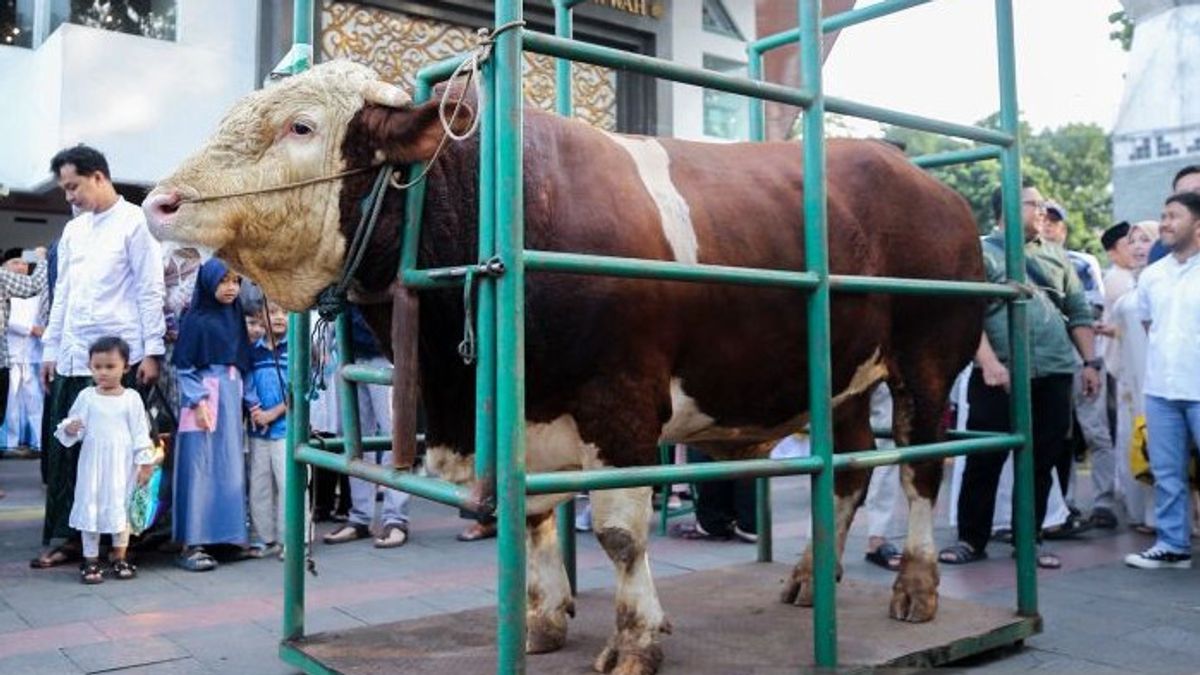


JAKARTA - The Indonesian Ulema Council (MUI) has confirmed that the use of the State Budget (APBN) for the purchase of President Prabowo Subianto's sacrificial animals is not contrary to Islamic law. MUI considers the mechanism to be legally valid because it is intended for the benefit of the wider community.
The statement was made by the Chairman of the MUI Fatwa Department Asrorun Niam Sholeh in response to the controversy over the use of state budget funds in the procurement of sacrificial cows through the presidential assistance scheme (Banpres).
"Regarding the purchase of cows from the state budget by the president through the Presidential Decree, I think this is not a matter of syar'i," Niam said in his statement, Wednesday, May 27.
The Professor of Islamic Law at UIN Syarif Hidayatullah Jakarta explained that the use of state funds for the procurement of sacrificial animals has a strong basis in Islamic jurisprudence and government practices since the early days of Islam.
According to him, this refers to the hadith in the biography of Imam Bukhari which states that an imam or leader is encouraged to buy sacrificial animals through the baitul mal or state treasury.
Niam said that in the modern context, the state budget can be understood as a form of baitul mal that the state uses for public interest. Therefore, the sacrifice made through the state budget is essentially a state sacrifice whose benefits are returned to the community.
"So the sacrifice of the state for the benefit of the community. And it's not about it in terms of syar'i," he said.
Apart from the Islamic legal aspect, MUI also considers the mechanism to be reasonable in terms of administration and bureaucracy. According to Niam, the pattern of distributing sacrificial animals through Banpres is similar to government social assistance that has been running for a long time.
"Technically, we can also understand, as the state budget through the Banpres is given for basic necessities and then distributed to the community, and this certainly has no issues," he said.
He emphasized that the sacrificial cows purchased using the state budget were not used for the personal interests of the president or the palace environment, but were distributed to the public in various regions.
According to Niam, the policy is also relevant to the momentum of Eid al-Adha because it can strengthen religious worship as well as social solidarity in the community.
It is known that President Prabowo Subianto distributed 1,098 sacrificial cows on Eid al-Adha 1447 Hijriah. The sacrificial animals were distributed to 552 areas, educational institutions, pesantren boarding schools, to social institutions throughout Indonesia.
Deputy Minister of State Secretary Juri Ardiantoro previously explained that as many as 598 cows were distributed to 38 provinces and 514 regencies and cities. Meanwhile, another 500 were given to various institutions and community leaders.
The English, Chinese, Japanese, Arabic, and French versions are automatically generated by the AI. So there may still be inaccuracies in translating, please always see Indonesian as our main language. (system supported by DigitalSiber.id)
Most Popular Tags
#Prabowo Subianto #donald trump #Febrie Adriansyah #8791 #giias 2026Popular


