

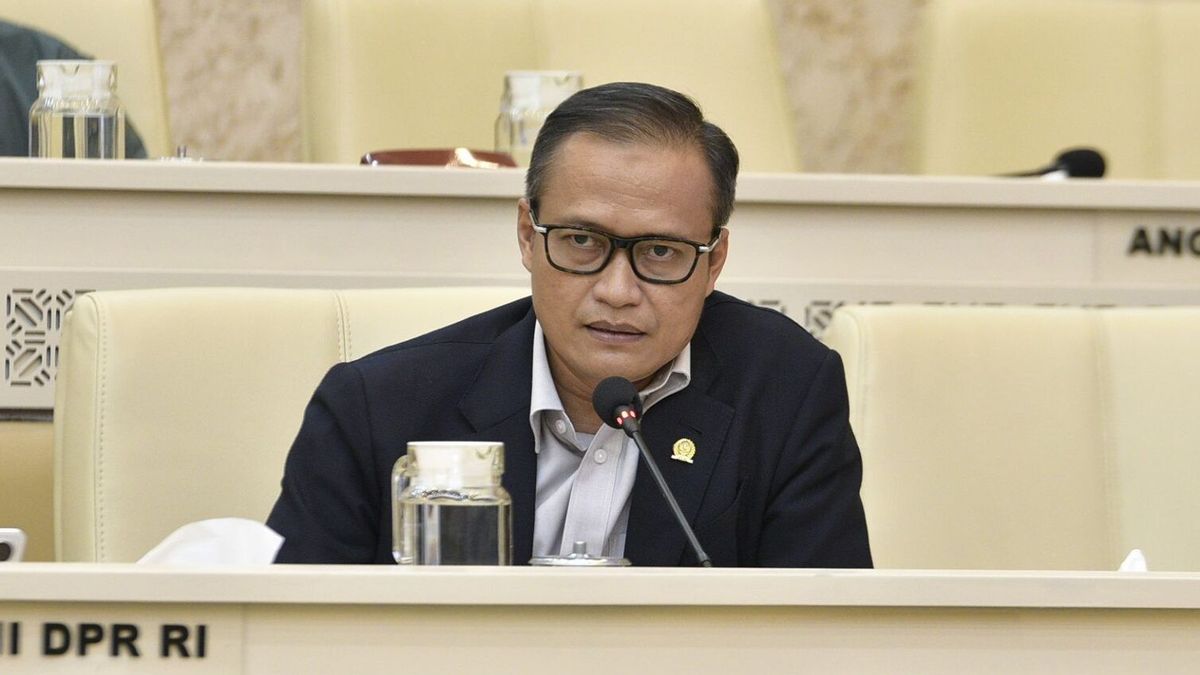


Member of the House of Representatives from the Gerindra Faction, Azis Subekti, assessed that there was something that slowly hindered Indonesia's economic journey over the past two decades, namely it took too long to learn to accept paradoxes as reasonableness.
"We see mountains being cut down and turned into giant lakes, ships transporting minerals abroad, millions of hectares of land generating wealth, growth figures are announced every year, buildings towering in big cities, but at the same time we also see farmers selling rice anxiously, fishermen returning with expensive solar, young people in villages leaving their villages because there is no work available, and the middle class living in silent fear of the cost of education, health, and an increasingly expensive future," said Azis Subekti in his statement, Monday, May 25.
For the past 22 years, according to Azis, the Indonesian economy has indeed moved. But in many ways, it moves like a big machine that has been directed for too long to maintain stability, not the courage to change the structure.
"We build roads, but it is too slow to build industrial sovereignty. We export natural wealth, but it takes too long to import added value. We praise investment, but often forget to ask: after the mine is exhausted, what is left for the people around?," said the Gerindra legislator from the Central Java District.
In many areas, said Azis, the irony is very real. Rich land actually produces poor people, coal-producing areas still have damaged schools, strategic mining areas still leave villages with murky water and potholes, palm trees grow widely, but their workers live barely, the world's largest maritime country still makes its people fight with brutal markets and unfair prices.
"And the most painful thing: all of this has been too long considered normal. We are like a nation that slowly gets used to seeing wealth flowing out, while the people only receive the remnants of the benefits. It seems that the people's right is only to be patient while hearing promises that growth will one day trickle down. But history proves, not all growth automatically produces justice," he said.
"That is the legacy that Prabowo Subianto received. Not just the state budget. Not just the national debt. Not just the fiscal deficit. What is inherited is an economic culture: the way the state thinks, the way the bureaucracy works, the way the elite reads development, and the way national wealth is distributed," continued the member of Commission II of the DPR.
Azis said that for more than two decades, Indonesia's economy has grown in a pattern that tends to be the same: resources are extracted, investments are expanded, consumption is maintained, imports of food are allowed to support domestic needs, and then the country is busy ensuring stability so that the machine can continue to run. According to him, this model is not entirely wrong, he managed to keep Indonesia standing when many countries collapsed due to the global crisis.
But over time, he said, this nation began to realize something, namely that stability was not enough to break down inequalities in economic use. Because people do not live from growth figures alone, they live from a sense of justice.
"What does a nickel-rich country mean if young people around the mine still find it difficult to work decently? What does the surplus of commodities mean if farmers are afraid that the price of the harvest will fall? What does economic growth mean if small houses in villages still feel that their children's future must be sought away from their own homeland? At this point, the new direction begins to gain its historical context," he said.
"Prabowo's courage is not merely to change the development program. What is being tried to touch is the psychological foundation and the old structure of the Indonesian economy: the belief that this nation should not continue to live as a supplier of raw materials to the world while its people bear the long social costs," he continued.
Therefore, Azis assessed, when the government began to talk and focus on working to realize the downstream, food self-sufficiency, free nutritious meals, national industrialization, village cooperatives, strengthening economic defense, and siding with domestic production, in fact, what was at stake was not just a technocratic policy. But what is at stake is a change in the state's view of its own people.
"That the small people should no longer be positioned as mere statistical objects of growth. That farmers are not just food production figures. That villages are not just social assistance locations. That poor children are not just recipients of the state's mercy, but human beings who must be ensured to grow healthy, smart, and strong so that this nation does not continue to pass on intergenerational inequality," he said.
"Of course this direction is not easy. Every major change is always overshadowed and disturbed by doubts, cynicism, even resistance. Because for decades too many interests have grown comfortable on the old pattern. There are always groups who prefer Indonesia to remain a large market and supplier of raw materials rather than a strong industrial country that stands on its own feet. But the history of great nations always changes when they stop making peace with paradoxes," he added.
Azis also gave an example, South Korea changed when they realized that they could not be a poor nation forever after the war. China changed when it realized that its people could not continue to live in mass starvation. And Indonesia today is beginning to reach a similar awareness: that it does not make sense for this wealthy country to continue to let its people live in economic anxiety from generation to generation.
"So the essence of the change in the direction of the economy today is actually simple, but fundamental: national wealth must again feel as belonging to the Indonesian people themselves. If the mine is opened, the people must rise in class. If the industry grows, the local workforce must be strong. If the country is building, the village must live. If the economy grows, small families must breathe more easily. Because the ultimate goal, the measure of the country's success is not only foreign exchange reserves, stock indices, or applause from the global market," he said.
"The most calming measure is this simple question: Do people feel their lives are more dignified in their own homeland? If the answer is not yet, then it is time to straighten the direction of history," concluded Azis Subekti.
The English, Chinese, Japanese, Arabic, and French versions are automatically generated by the AI. So there may still be inaccuracies in translating, please always see Indonesian as our main language. (system supported by DigitalSiber.id)
Most Popular Tags
#Prabowo Subianto #donald trump #firearm #8791 #giias 2026Popular


