

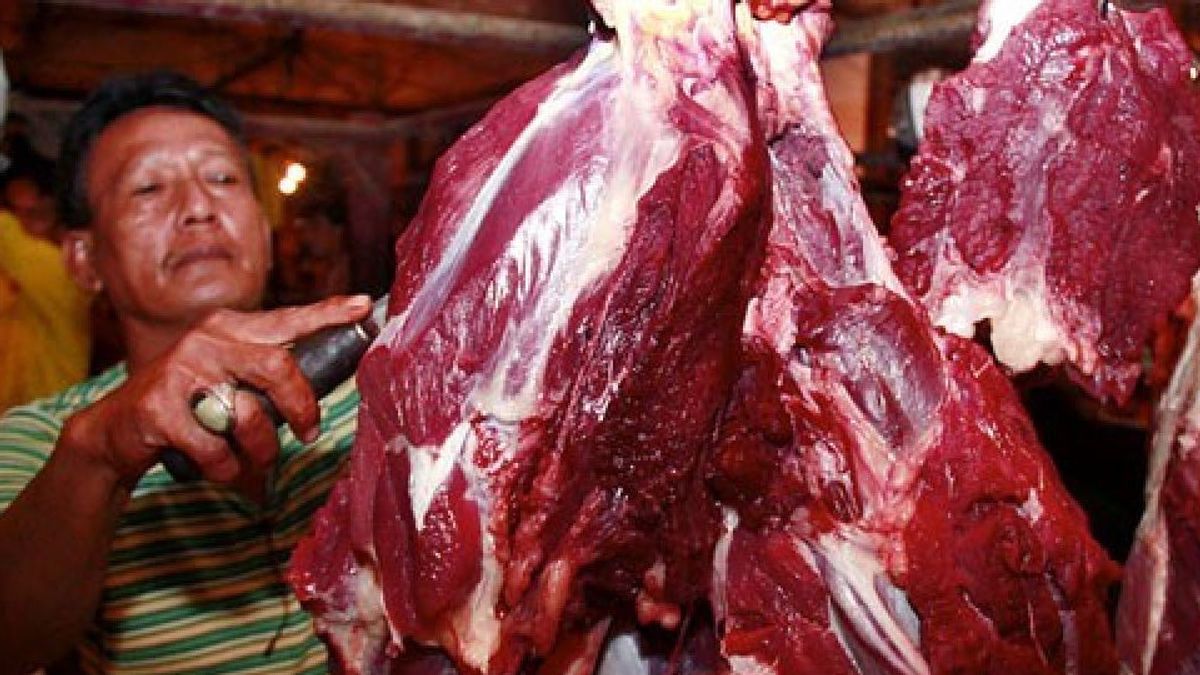


BANDUNG - Deputy Chairman of the West Java DPRD, Iwan Suryawan, highlighted a strange problem ahead of Eid al-Adha 2026. He saw strange things in the field, the stock of sacrificial animals was abundant, but the price of beef in traditional markets actually jumped up.
Based on data from the West Java Food and Livestock Directorate (DKPP) through the iSIKHNAS system, the stock of sacrificial animals this year is indeed very large. The availability of sheep in West Java has increased sharply to 223,812 from last year which was only 187,395.
A similar condition occurred in the sacrificial cattle stock which rose to 120,916 heads from last year's 99,565 heads. The West Java DKPP noted that the abundance of this year's stock is partly due to the fact that there are still sacrificial animals from last year that have not been sold.
However, Iwan Suryawan reminded the local government not to be complacent with the data on paper. According to him, the real challenge today is to maintain the purchasing power of residents who are starting to be depressed by the high cost of basic necessities.
"We are grateful that our livestock supply is abundant based on iSIKHNAS data. However, the local government should not turn a blind eye, the intention of the people to sacrifice is currently hit by the price of basic necessities that continue to creep up," said Iwan, Monday, May 25.
Data from the Indonesian Market Traders Association (Ikappi) and PIHPS Bank Indonesia at the end of May indeed showed a price trend that was detrimental to consumers.
The price of red chili climbed to Rp82,000 per kilogram, and red onions remained high at Rp56,000 per kilogram.
This condition is getting heavier because the price of beef for daily consumption has also jumped to Rp. 150,000 per kilogram. This increase in beef prices is reported to have occurred in several markets in West Java, such as Cicalengka Market, Soreang Market, as well as Kordon Market and Sederhana Market in Bandung City.
Meanwhile, for the Cirebon area, the e-TUKU application owned by the Cirebon City Government also recorded a stable high price for pure beef at Rp. 150,000 per kilogram.
According to Iwan, the high price of meat in this wet market must be immediately overcome because it can drain the savings of residents who are actually prepared to buy sacrificial animals.
"The surge in the price of beef to one hundred and fifty thousand rupiah in traditional markets in Bandung and Cirebon makes mothers dizzy before the holidays. This is what the government must immediately fix," he said.
Iwan assessed that one of the root causes was the improper management of the distribution channel from farmers to the market. Seasonal price spikes like this should have been prevented earlier if the relevant departments had mapped the logistics channel from a long time ago.
He emphasized that the task of the service ahead of Eid al-Adha was not only busy checking the health of sacrificial animals at the trader's stall. The issuance of certificates or healthy stickers on animals is mandatory, but overseeing the stability of prices is also a determinant of government success.
The West Java DPRD also, said Iwan, asked the government to protect the fate of local farmers in the region. Because, the abundance of sacrificial stock risks making the selling price of local farmers drop if the entry of livestock from outside the province is not fairly restricted.
"The relevant services must protect our local farmers in West Java. Don't let the flood of supplies from outside the region actually damage the selling price of our own farmers who have spent a lot of capital on feed and care," added Iwan.
Therefore, this West Java PKS politician urges the West Java Regional Inflation Control Team (TPID) to immediately hold a large-scale market operation. Programs such as the Cheap Food Movement (GPM) must immediately be directed to the region where the basic price has risen the most.
In terms of health, Iwan reminded that the Animal Health Certificate (SKKH) must still be strictly checked at the border post. This is important to ensure that the sacrificial animals that enter are completely free from infectious diseases such as FMD and LSD.
In addition to examining animals at the trader's stall before being slaughtered (antemortem), Iwan asked the local government to alert a team of veterinarians until H. These officers are important to check the feasibility of sacrificial meat after being slaughtered (postmortem) in mosques.
Iwan highlighted the problem of the distribution of sacrificial meat which every year always piles up in densely populated urban areas or around large housing.
"We need equalization. The distribution of sacrificial meat should not just pile up in the city. The Provincial Government must create a zoning system so that this sacrificial meat reaches the hands of people in remote villages who need it more," he explained.
Iwan Suryawan emphasized that Eid al-Adha was successful when the worship went smoothly and the community's economy remained stable. He hopes that the local government will immediately evaluate the distribution channels so that West Java residents can celebrate the holiday peacefully without the burden of expensive prices.
The English, Chinese, Japanese, Arabic, and French versions are automatically generated by the AI. So there may still be inaccuracies in translating, please always see Indonesian as our main language. (system supported by DigitalSiber.id)
Popular


