

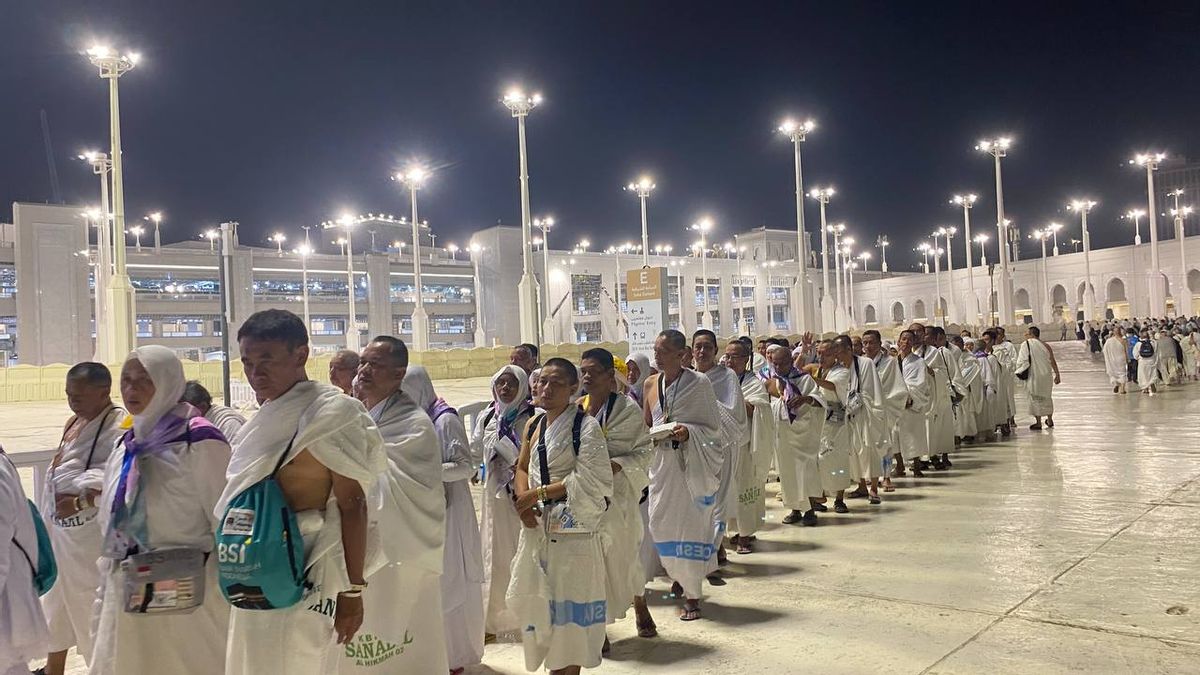


JAKARTA - The Ministry of Hajj and Umrah has confirmed that all Indonesian pilgrims have arrived in Saudi Arabia. The government is now focusing on the readiness of peak haji services in Arafah, Muzdalifah, and Mina or Armuzna.
Kemenag spokesperson Maria Assegaff said the departure phase from the country had been completed. A total of 527 batches with 202,551 pilgrims and 2,098 officers were already in Mecca. In addition, 16,596 special pilgrims have also arrived in Saudi Arabia.
"Currently, all of our services are directed to ensure the readiness of Armuzna, ranging from tents, placement of pilgrims, consumption, transportation, health, protection of pilgrims, to the placement of officers," said Maria in Jakarta, Saturday (23/5).
Ahead of the most crowded phase of the hajj, the Ministry of Religion also began tightening the arrangement of the pilgrims' tents in Arafah and Mina. All Hajj and Umrah Guidance Groups (KBIHU) are asked not to put any attributes, banners, stickers, or identification marks in the tent.
According to Maria, the installation of attributes has the potential to interfere with the placement of worshipers and cause confusion during Armuzna.
"If officers find KBIHU attributes or identities attached to the Arafah and Mina tents, the attributes will be immediately revoked," he said.
The Ministry of Religion has also prepared sanctions for those who continue to violate the rules.
In addition to focusing on the Armuzna service, the Ministry of Religion noted that approximately 145,341 pilgrims had paid the dam according to official regulations. A total of 102,364 pilgrims paid through Adahi in Saudi Arabia, while another 38,992 paid through a mechanism in Indonesia.
"This achievement shows the increasing awareness of the congregation to carry out the obligation of dam in an orderly, safe, and according to the provisions," said Maria.
The Ministry of Religion appeals to the congregation to start saving energy and maintaining physical condition before Armuzna. The congregation is asked to get enough rest, maintain food and drink intake, and only carry important items such as identity, personal medicine, worship equipment, masks, and drinking water.
Maria also asked pilgrims and officers to help each other during the peak of the hajj.
"If you see a congregation walking alone, confused, exhausted, or separated from the group, immediately take them to the nearest officer," he said.
The English, Chinese, Japanese, Arabic, and French versions are automatically generated by the AI. So there may still be inaccuracies in translating, please always see Indonesian as our main language. (system supported by DigitalSiber.id)


