

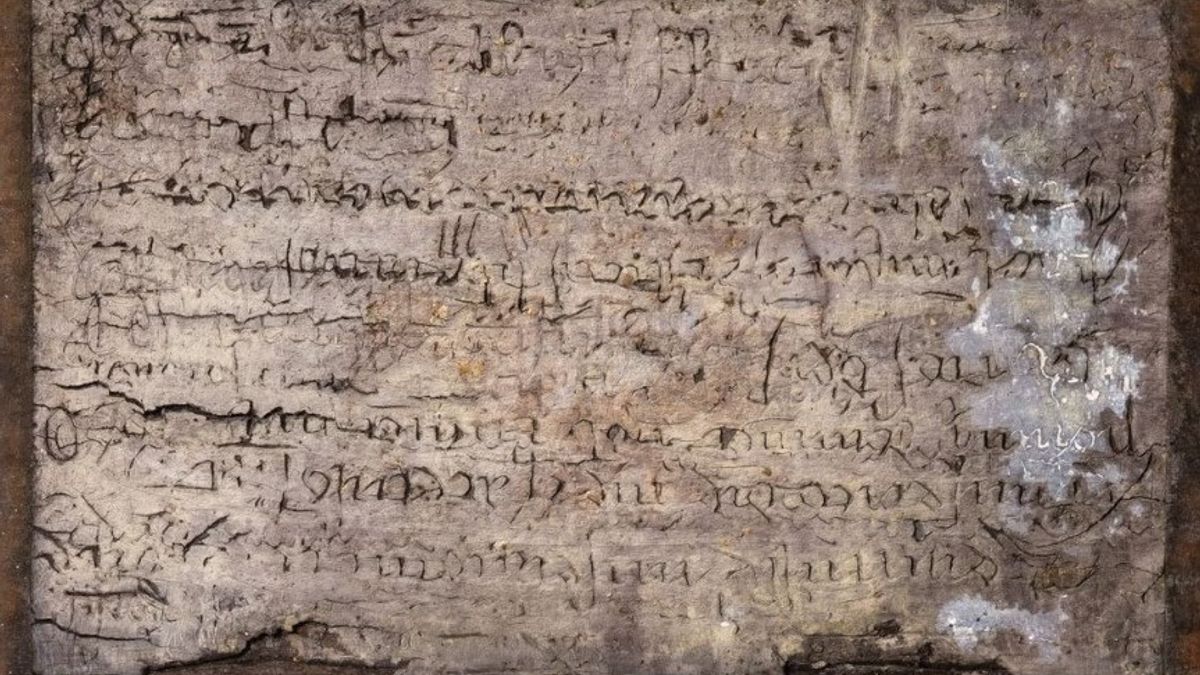


Arkeolog di Jerman menemukan buku catatan pedagang abad pertengahan dalam kondisi nyaris utuh. Tempatnya tidak biasa. Sebuah toilet abad ke-14.
According to a report by The Independent, quoted on Friday, May 12, the findings were found in North Rhine-Westphalia or NRW, Germany. The little book is made of leather, wood, and wax. Now, the object is being restored by the Landschaftsverband Westfalen-Lippe or LWL in Münster.
"This is the only find like this in the whole of NRW," said LWL archaeologist Barbara Rüschoff-Parzinger.
For archaeologists, old toilets are not just dirty places. There, old objects can be stored well because of the soil and humidity.
"It sounds strange, but for us archaeologists, toilets are almost always a treasure trove," said Rüschoff-Parzinger.
What surprised them, this time what was found was not a common fragment, but a complete book.
Archaeologists hope that the text in the book can be read again with high technology. If successful, the contents can open the story about daily life in Germany more than 800 years ago.
Initial analysis suggests the book likely belonged to a medieval merchant from the city of Paderborn. At the time, merchants were among the educated.
"The traders could read and write, unlike most people," said city archaeologist Sveva Gai.
However, how the book got into the toilet is still unclear.
"The object may have fallen there due to an accident," said Gai.
The book consists of 10 pages. Eight pages contain writing on both sides. The first and last pages are only given wax on one side.
The book was found bound and wrapped in a small leather cover. When it was first found, its shape was inconspicuous because it was covered with a wet clump of soil.
"The object was only clearly visible when it was cleaned in our restoration workshop in Münster," said LWL restorer Susanne Bretzel.
Even though it has been buried in the toilet for centuries, the smell has not completely disappeared.
"The findings in the ground still have a pretty unpleasant smell," said Bretzel.
The cover of the skin is actually preserved very well. According to researchers, the soil conditions and humidity at the location help keep the book intact. The text written on the wax is also still lasting for 700 to 800 years.
Bretzel said he only needed to clean the outside of the book. The inside was so tightly sealed that not much dirt got in. The wood is also not curved. The wax is intact and the writing is still legible.
The cover of the book is decorated with a relief pattern in the form of a small row of lilies. This motif indicates that the book is not a cheap object. In the Middle Ages, lilies were often associated with purity, royal power, and divine grace.
Gai said the use of Latin and italic forms also pointed to an upper-class owner. The book is estimated to have been used between the 13th century to the late 14th century.
According to The Independent's report, the process of re-reading the text is estimated to take time. Therefore, researchers first examined the book's materials, especially wood and wax, with scientific methods.
Archaeologist Sandra Peternek said the materials must be studied in detail.
Researchers will also compare the book with other objects from the same toilet. One of them is a remnant of silk cloth that is torn into a rectangular piece. Some of the cloth is very fine and decorated.
"Maybe it's toilet paper, after the cloth that used to be luxurious was about to be thrown away," said Gai.
If the location of the toilet can later be linked to a certain piece of land, archaeologists hope to trace who the residents or owners are through historical archives.
The English, Chinese, Japanese, Arabic, and French versions are automatically generated by the AI. So there may still be inaccuracies in translating, please always see Indonesian as our main language. (system supported by DigitalSiber.id)


