

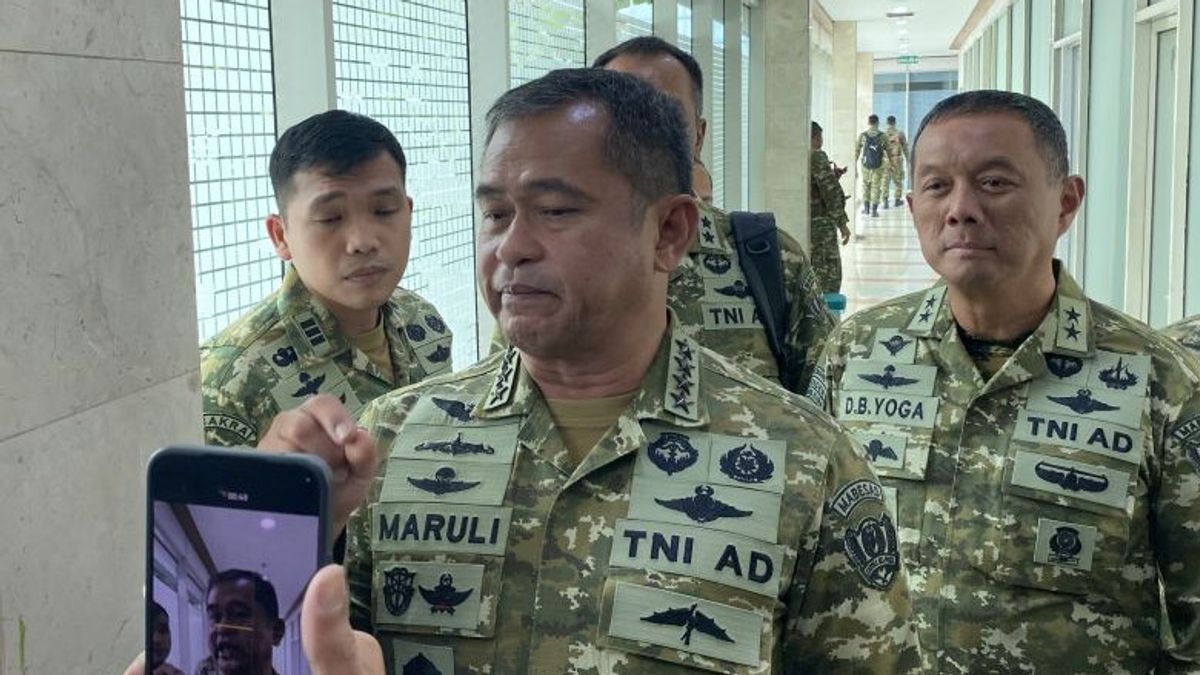


JAKARTA - The Chief of Staff of the Indonesian Army (KSAD) General TNI Maruli Simanjuntak said there was no direct instruction to the ranks regarding the dissolution of the Pesta Babi: Colonialism in Our Time film.
Maruli said the dissolution of the nobar was a request from the local regional government (Pemda).
"The dissolution is from the local government for the security of the region. That is the responsibility of the regional coordinator between the government officials there who consider there is a risk of unrest. There is no direct instruction, kok," he said as quoted by ANTARA, Tuesday, May 19.
According to Maruli, the dissolution of nobars in several regions is the result of coordination and local government decisions for the sake of regional security.
"The local government has coordination. They have the authority to secure the area, to secure their students because the level of truth of this film is also not necessarily true," he said.
Regarding the substance of the film, Maruli also questioned the funding of the documentary.
"Now the problem is, people even make videos about how this story is like this, all kinds of things, where does the money come from? That's just try it, yeah, right. Until you get there, make a video. Fly here, fly there. People are rich," said KSAD.
Previously, Coordinating Minister for Legal, Human Rights, Immigration, and Corrections Yusril Ihza Mahendra said the dissolution of the Pesta Babibukan film nobar was a directive from the government or law enforcement officials.
He said not all campuses banned the screening of documentaries. According to him, this pattern shows that the dissolution was not carried out on a centralized basis.
"Seeing this pattern, the dissolution of the Pesta Babi film nobar is not a direction from the government or law enforcement officers, which is usually centralized," said Yusril.
He explained that the documentary contained criticism of national strategic projects (PSN) in South Papua which were considered to interfere with the sustainability of nature, the rights of the Ulayat of the Papuan people, and the environment.
For Yusril, such criticism is normal, even though there is a narrative that is considered provocative.
The English, Chinese, Japanese, Arabic, and French versions are automatically generated by the AI. So there may still be inaccuracies in translating, please always see Indonesian as our main language. (system supported by DigitalSiber.id)
Most Popular Tags
#Prabowo Subianto #donald trump #firearm #8791 #giias 2026Popular


