
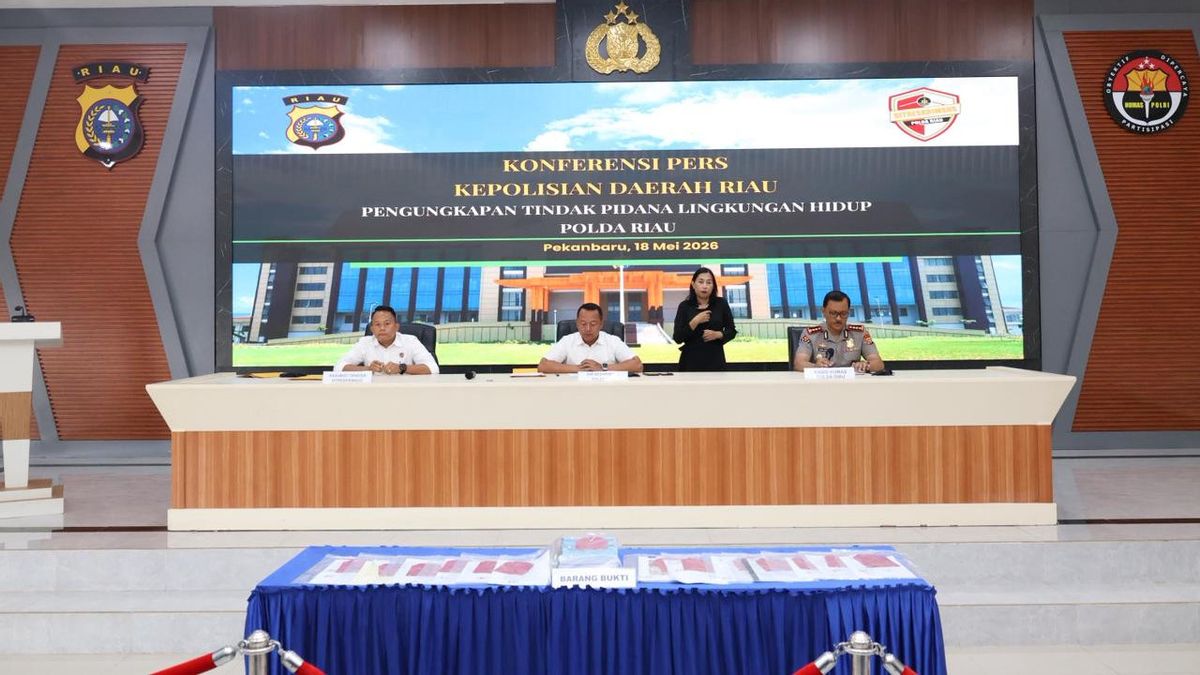


PEKANBARU - The Riau Police have named PT Musim Mas as a suspect in a case of alleged environmental crimes related to the cultivation of oil palm plantations in the border area of the Air Hitam River, a tributary of the Nilo River, in Ukui District, Pelalawan Regency.
Director of Special Criminal Investigation of the Riau Police, Kombes Ade Kuncoro, emphasized that handling the case was a form of the Riau Police's seriousness in thoroughly addressing environmental crimes, including against large corporations that have proven to gain profit from activities that damage the environment.
According to Kombes Ade, the current environmental law enforcement approach is no longer only oriented towards field actors or individuals, but also targets corporations as legal entities that have criminal responsibility if proven to have allowed, planned, or obtained economic benefits from activities that violate environmental regulations.
"Environmental law enforcement must not stop at individual perpetrators. Corporations can also be held criminally responsible if their business activities are proven to have caused environmental damage and provided economic benefits to the company," said Kombes Ade at a press conference at the Riau Police Headquarters, Monday, May 18.
He emphasized that the case was a strong message from the Riau Police that they would not hesitate to apply corporate criminal liability in environmental cases, especially those that have an impact on conservation areas, river basins, and the ecosystem that supports people's lives.
During the investigation process, the Riau Police's Criminal Investigation Unit found an oil palm plantation activity located in the border area of the Air Hitam River and the forest area in Estate IV Division F of PT Musim Mas, Air Hitam Village, Ukui District, Pelalawan Regency.
"Investigators revealed that the area had been opened and planted with oil palm from 1997 to 1998," said Kombes Ade.
Director of Special Criminal Investigation of the Riau Police, Kombes Ade Kuncoro
The palm oil plantation at the location began entering the production phase in 2002 and is said to continue to generate economic profits for the company for approximately 22 years.
"The company is suspected of having gained profits from palm oil cultivation activities carried out in the river border area. This is not a momentary activity, but has been going on for a long time," said Kombes Ade.
In this case, investigators assessed the company's activities as being contrary to the company's own AMDAL documents, Presidential Decree Number 32 of 1990 concerning the Management of Protected Areas, Government Regulation Number 35 of 1991 concerning Rivers, and other provisions for river border protection.
In addition, based on the provisions of the Minister of PUPR Decree Number 28/PRT/M/2015, the river border area can only be used in a limited manner and must have a permit.
"In the results of the investigation, PT Musim Mas was said to not have a permit for the use of the river border from the Sumatera III River Regional Office," he said.
Kombes Ade explained that the river border area has an important ecological function as a water body protection area, erosion control, and buffer for environmental balance.
Therefore, the cultivation of oil palm in the area is considered to have the potential to cause environmental damage and interfere with the ecological function of the river.
"This law enforcement is not merely about licensing administration, but concerns the protection of ecosystems and environmental safety in the long term," he said.
In handling the case, the Riau Police's Ditreskrimsus also involved various cross-disciplinary experts, ranging from forest area strengthening experts, water resources experts, environmental experts, land and environmental damage experts, environmental criminal law experts, to corporate law experts.
In addition, investigators also seized various important evidence in the form of company legal documents, company deeds, AMDAL documents, HGU maps, conservation area maps, environmental management documents, river border management reports, to environmental laboratory test results.
Based on the results of expert calculations, the losses due to environmental damage in the case amounted to IDR 187,863,860,800.
Ade emphasized that the Riau Police is currently prioritizing the scientific crime investigation approach in handling environmental crimes, so that all proof processes are carried out based on scientific data, expert testimony, technical documents, and laboratory test results.
"Every environmental case that we handle must be scientifically proven and legally accountable. Therefore, we involve experts and conduct a comprehensive in-depth study," he said.
Kombes Ade emphasized that handling the case was in line with the commitment of Green Policing, which is currently one of the main approaches of the Riau Police in protecting the environment and enforcing the law against ecological crimes.
"The living environment is not only about today, but about the future. Therefore, the state must be present and ensure that no party makes environmental damage a way to gain profit," he explained.
For this matter, PT Musim Mas was charged with Article 98 paragraph (1) junto Article 99 paragraph (1) junto Article 116 of Law Number 32 of 2009 concerning Environmental Protection and Management related to corporate criminal liability, with a maximum penalty of 10 years in prison and a maximum fine of Rp. 10 billion.
The English, Chinese, Japanese, Arabic, and French versions are automatically generated by the AI. So there may still be inaccuracies in translating, please always see Indonesian as our main language. (system supported by DigitalSiber.id)


