

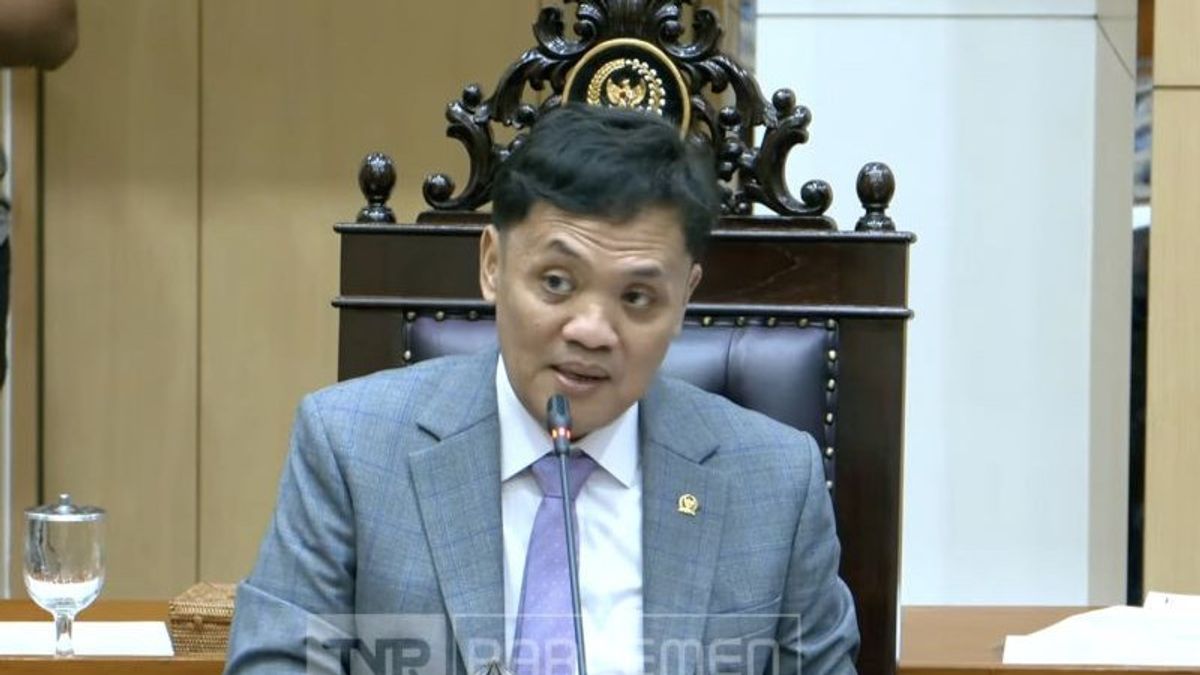


Commission III of the Indonesian House of Representatives reminded the implementation of the new Criminal Code (KUHP) during a meeting discussing the criminalization of agrarian activists with the East Nusa Tenggara Regional Police and Agrarian Reform Consortium.
As the chairman of the meeting, Chairman of Commission III of the House of Representatives, Habiburokhman, said that Article 36 of the Criminal Code had just stipulated that everyone could only be punished for a crime committed intentionally.
"Article 36, no one can be convicted without intent. If this is a crime of entering people's yards. In fact, there is a background of disputes between the parties," he said at the Parliament Complex, Senayan, Jakarta, Antara, Monday, May 18.
This statement was made by Habiburokhman in response to the explanation of the NTT Regional Police regarding the handling of the alleged criminal case of entering the grounds without permission against lawyers, activists, and two tribal chiefs.
They were reported by PT Krisrama, which was previously named PT Perkebunan Kelapa Diag. The four suspects are suspected of violating Article 167 paragraph (1) in conjunction with Article 55 paragraph (1) of the old Criminal Code.
According to him, law enforcement officers should be able to respond to the case between the corporation and the agrarian fighters by complying with the Criminal Code and the new Code of Criminal Procedure (KUHAP).
"Because the system was not good yesterday, now I think we have arranged it well, wisely, our law in the new Criminal Code, the new KUHAP," he said.
Habiburokhman also emphasized that Commission III of the DPR would be a guarantor for agrarian fighters who are facing the law so that they are not detained.
In addition, he encouraged members of Commission III of the DPR RI who are members of the Special Committee for the Resolution of Agrarian Conflicts to maximize performance, especially to protect the community from criminalization.
In the meeting, the Secretary General of the Agrarian Reform Consortium, Dewi Kartika, explained that based on members' complaints during 2025-2026, there were 123 cases of criminalization against 113 victims.
The cases occurred in 12 provinces. A total of 91 cases were related to plantation conflicts, eight cases related to forestry conflicts, and 21 other cases related to mining conflicts.
Dewi hopes that Commission III of the DPR can actively support the resolution of structural agrarian conflicts through a constructive and humanistic approach to dialogue, as well as encourage the cessation of the involvement of security personnel and repressive approaches.
He also encouraged the issuance of a directive from the National Police Chief to the police to stop summoning, investigating, or investigating farmers and indigenous people in various areas.
The English, Chinese, Japanese, Arabic, and French versions are automatically generated by the AI. So there may still be inaccuracies in translating, please always see Indonesian as our main language. (system supported by DigitalSiber.id)


