

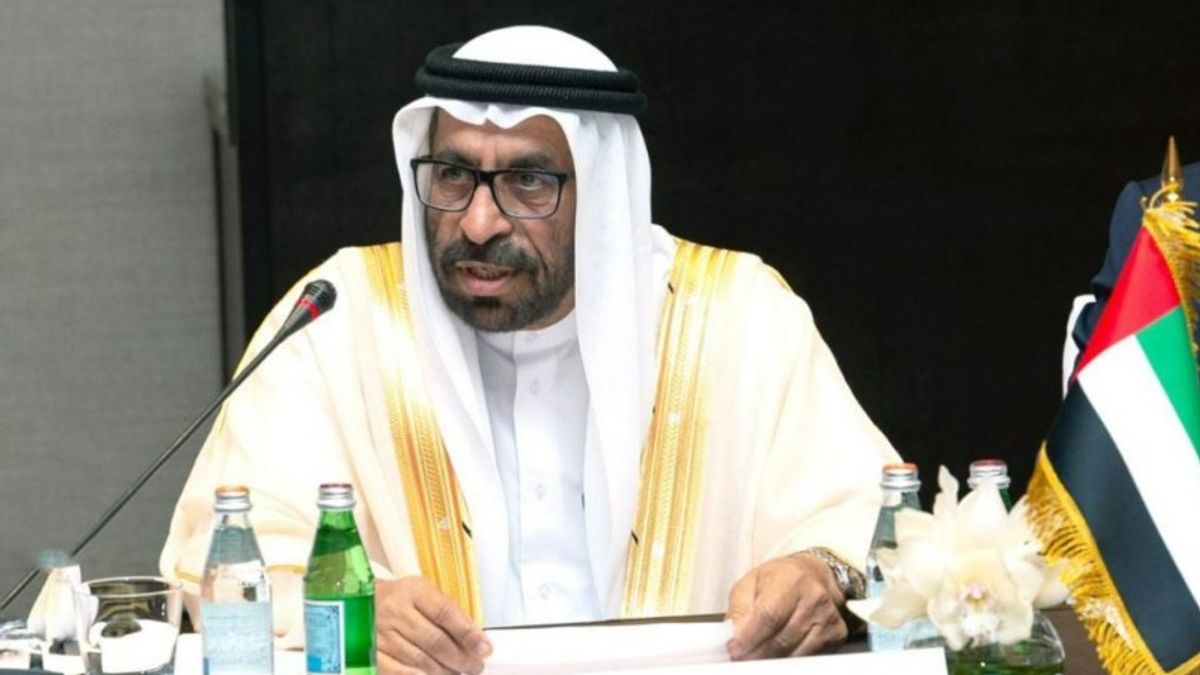


JAKARTA - The United Arab Emirates (UAE) said they were not seeking protection from any party and were capable of preventing aggression, while reaffirming their right to defend their sovereignty and territorial integrity.
The statement was made by the Minister of State at the UAE Ministry of Foreign Affairs Khalifa Shaheen Al Marar during a meeting at the level of foreign ministers of the BRICS bloc in New Delhi, India, Friday (15/5).
According to the WAM News Agency, Al Marar rejected Iran's accusations and criticism aimed at the UAE and dismissed attempts to justify attacks targeting his country and other countries in the region.
He said the action violated the United Nations Charter (UN), international law, and the principles of good neighborly relations. The UAE and Iran are members of BRICS and both attended the meeting in India.
Al Marar also rejected threats to the UAE's sovereignty, national security, and independent decision-making, stressing that his country maintains its sovereignty, legal, diplomatic, and military responses to hostile acts.
Pressure and what he called malicious accusations, he continued, would not change the UAE's position or hinder it in protecting its national interests.
Al Marar also said the UAE had intercepted nearly 3,000 ballistic missiles, cruise missiles, and drones since February 28, which was the start of the US-Israeli war against Iran by targeting civilian facilities and critical infrastructure, including airports, ports, and energy facilities.
He also accused Iran of interfering with maritime routes, including what he described as an effective closure of the vital Strait of Hormuz, and described the use of the sea lanes as a tool of pressure as "piracy".
Al Mararitu's statement came a day after Iranian Foreign Minister Abbas Araghchi accused the UAE of maintaining its alliance with Israel and claimed that Abu Dhabi was directly involved in the attack on Iran.
Regional tensions have escalated since the US and Israel launched an attack on Iran, triggering Iranian retaliation against Israel and US allies in the Gulf region and the closure of the Strait of Hormuz.
The ceasefire came into effect on April 8 through Pakistani mediation, but negotiations in Islamabad failed to produce a permanent agreement. US President Donald Trump then extended the ceasefire indefinitely.
The English, Chinese, Japanese, Arabic, and French versions are automatically generated by the AI. So there may still be inaccuracies in translating, please always see Indonesian as our main language. (system supported by DigitalSiber.id)


